Modafinil, Armodafinil & the -Finil Class — Deep Dive
Category: Eugeroics / Wakefulness Agents / Atypical Stimulants
Modafinil CAS: 68693-11-8 | Armodafinil CAS: 112111-43-0
Classification: Schedule IV controlled substance (US) | Prescription-only medicine (UK)
| Modafinil | Armodafinil | |
|---|---|---|
| Composition | Racemic (R + S enantiomers, 1:1) | Pure R-enantiomer only |
| Brand (pharma) | Provigil | Nuvigil |
| Brand (generic) | Modalert (Sun Pharma) | Waklert (Sun Pharma) |
| Typical dose | 100–200mg | 75–150mg |
| Terminal t½ | ~13h | ~13h |
| PK profile | Biphasic | Monophasic |
The Mechanism — What's Actually Known
Modafinil's mechanism has been debated for 30 years. The narrative has evolved from "unknown mechanism" to "DAT inhibitor" to "multi-system eugeroic." Here is the current picture.
Layer 1: Dopamine Transporter (DAT) Inhibition
The primary molecular target is the dopamine transporter — modafinil binds competitively to DAT and blocks dopamine reuptake. This is confirmed by PET imaging studies showing displacement of radioligands from DAT in living human brains (PMC12004278).
However: modafinil's DAT affinity is Ki ~2.3 μM — approximately 100× weaker than cocaine. It raises synaptic dopamine levels modestly and gradually — not the sudden surge produced by amphetamine's active reversal of DAT (efflux). This is mechanistically decisive for understanding the subjective profile.
Layer 2: The Cascade — Dopamine → Orexin → Histamine
DAT inhibition is the input; the wakefulness output emerges through a cascade:
flowchart TD
    MOD[Modafinil] -->|weak DAT inhibition| DA[↑ synaptic dopamine]
    DA --> LH[Activates lateral hypothalamus]
    LH --> OR["Orexin (hypocretin) neurons fire"]
    OR --> TMN[Tuberomammillary nucleus]
    TMN --> HIST["Histamine release → cortical arousal<br/>= sustained wakefulness"]
Modafinil does not bind directly to orexin receptors. It activates orexin neurons indirectly via dopaminergic and glutamatergic signalling — which then engage the histamine system to sustain wakefulness.
Important caveat: orexin-knockout mice still respond to modafinil, confirming orexin is not the sole mechanism — the dopaminergic and histaminergic routes operate in parallel. This cascade architecture explains why modafinil is less effective in narcolepsy type 1 (destroyed orexin neurons) and why pure orexin receptor agonists (danavorexton) are outperforming modafinil in some recent wakefulness trials.
Layer 3: Multi-System Neurotransmitter Effects
Beyond the DAT→orexin→histamine chain, modafinil:
- ↑ Noradrenaline — not via direct NET binding (modafinil has negligible NET affinity); elevated DA competes with NE for NET clearance in regions co-expressing both transporters, raising extracellular NE indirectly
- ↑ Serotonin (minor)
- ↑ Glutamate (cortical excitation, independent of dopamine)
- ↓ GABA (reducing inhibitory tone)
- ↑ Cortical acetylcholine (turnover increases — hence the citicoline pairing)
No single pathway fully explains the effect. The consensus from the 2025 Frontiers neuroanatomy review (PMC12722882): modafinil is best understood as a multi-target wakefulness facilitator whose net effect is mediated by dopaminergic priming of the orexin-histamine arousal system.
Why It's Not Amphetamine
BasedBiohacker (@BasedBiohacker):
"If you want focus + a drug-like high and don't care about the consequences, take Adderall. If you want focus + stimulation without the euphoria and comedown, take modafinil."
The mechanistic reason: amphetamine reverses DAT, pumping dopamine out of neurons into the synapse (efflux) — causing the rapid, large dopamine surge that produces euphoria and subsequent depletion. Modafinil only blocks reuptake, slowing the clearance of dopamine already released through normal firing. The rise is gradual, modest, and dissipates without a deficit. No tank-draining, no crash.
BasedBiohacker on TAK-653 + modafinil:
"Modafinil provides wakefulness, focus, executive function through dopamine and noradrenaline, histamine pathways."
Modafinil vs Armodafinil — The PK Case
Despite identical terminal half-lives (~13h), armodafinil and modafinil have fundamentally different concentration-time profiles (PMID 19663523):
Modafinil is a 50:50 racemic mixture. The S-enantiomer has a t½ of only ~3 hours — it is cleared rapidly. The R-enantiomer has a t½ of ~15 hours. The combined plasma profile is biphasic: concentration peaks then drops sharply as S clears (often felt as a mid-day dip), before stabilising as R persists.
Armodafinil is pure R-enantiomer. The decline is monophasic: smooth, sustained, consistent. Higher plasma levels are maintained later in the day with less fluctuation.
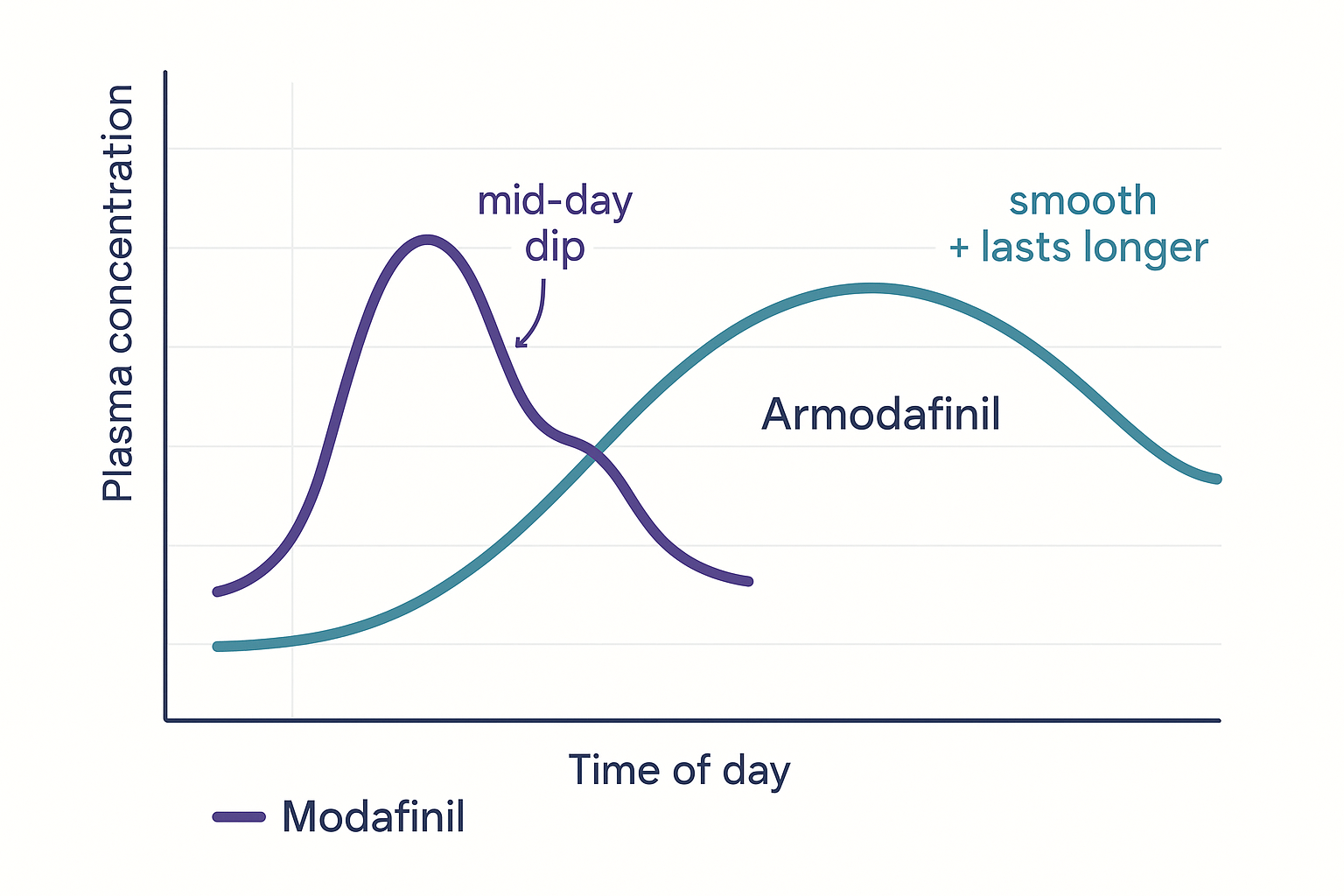 The PK difference made visible: modafinil's biphasic curve dips mid-day (the S-enantiomer clears fast); armodafinil's single smooth curve lasts longer — which is also why it wrecks sleep more reliably.
| Metric | Modafinil 200mg | Armodafinil 150mg |
|---|---|---|
| AUC (exposure) | Baseline | +33–40% on mg basis |
| Plasma fluctuation | Higher | 28% less |
| Plasma swing | Higher | 42% less |
| Concentration later in day | Lower | Higher |
| Profile shape | Biphasic | Monophasic |
BasedBiohacker (@BasedBiohacker):
"150mg armodafinil — cleaner pharmacokinetics than modafinil, longer-lasting wakefulness + deep focus."
The practical implication: at equivalent doses, armodafinil delivers more consistent wakefulness through the afternoon and evening. This is also why it wrecks sleep more reliably — its monophasic persistence means higher plasma levels at bedtime. Timing discipline is more important with armodafinil.
Waklert vs Modalert
These are the Indian generic brands (Sun Pharma) that the community uses as the accessible alternatives to branded Provigil/Nuvigil:
- Modalert 200 — generic modafinil 200mg. Community-trusted for consistency.
- Waklert 150 — generic armodafinil 150mg. BasedBiohacker's preferred form.
Both are manufactured by Sun Pharma, a large Indian pharmaceutical company with WHO-GMP certification. Quality is generally considered equivalent to branded versions. Referenced by name in BasedBiohacker's shopping list: "more modvigil, more waklert."
The -Finil Family
Modafinil is the parent compound of a structural family. Here is each member, what it is, and how it differs:
Adrafinil — The Liver-Converted Prodrug
Adrafinil is metabolised in the liver to modafinil. It was actually developed before modafinil (1970s, Lafon Laboratories). Effects are essentially identical — but onset is slower (requires hepatic conversion) and liver burden is higher with chronic use. Chronically elevated liver enzymes have been reported with daily adrafinil.
Status: Unscheduled in US, UK, EU — legal to purchase without prescription. This makes it the accessible alternative for those who cannot obtain modafinil legally. Functionally inferior to modafinil due to hepatic load; only relevant as a legal workaround.
Flmodafinil (CRL-40,941) — The Difluoro Variant
Flmodafinil (also called bisfluoromodafinil) adds two fluorine atoms to modafinil's structure. Fluorination typically increases lipophilicity, blood-brain barrier penetration, and resistance to metabolic degradation.
Flmodafinil is reported to be 4–8× more potent than modafinil by weight in animal studies — meaning 25–50mg may produce comparable effects to modafinil 200mg. The shorter effective dose requirement means potentially shorter duration too. No published human PK data. The community uses it; the safety profile at human doses is unknown beyond anecdotal reports. Available as a research chemical.
Fladrafinil (CRL-40,028) — The Fluorinated Prodrug
The prodrug version of flmodafinil — converts to flmodafinil via hepatic metabolism. Less common in the community than flmodafinil. Similar hepatic concern to adrafinil, compounded by the higher potency of its active form. Less attractive than either modafinil or flmodafinil.
Hydrafinil (Fluorenol) — Structurally Different
Hydrafinil is not a true -finil (no sulfinyl group). It is a fluorene-9-ol compound with some structural overlap with modafinil. Shorter half-life (~6 hours) than modafinil. Reported as less jittery with faster clearance — potentially useful for users who need wakefulness for a defined window without the all-day commitment of modafinil. Mechanism less characterised. Research chemical only, minimal human safety data.
CE-123 — The Precision DAT Inhibitor (and Its Limits)
CE-123 is not strictly a -finil but sits adjacent — a modafinil structural analogue developed as a selective DAT inhibitor (PMID 29410048). Unlike modafinil's multi-system effects, CE-123 targets DAT with IC50 = 4.606 μM and negligible SERT/NET activity. BBB penetration confirmed within ~30 minutes in rodents.
Key research findings: - Improved memory acquisition and retrieval in rodents (PMID 29410048) - Specifically enhanced performance in aged animals — not young ones (declining dopaminergic tone in aging is the specific vulnerability) - Enhanced cognitive flexibility without increasing impulsivity - (S)-CE-123 partially reversed motivation deficits from tetrabenazine (PMC6611521)
The critical framing caveat: the community describes CE-123 as a "cleaner modafinil," but this is misleading. CE-123's DAT selectivity means it lacks the orexin/histamine arousal cascade that modafinil generates. It is primarily a research tool for isolating DAT-specific dopamine contributions — not a practical eugeroic. You will not get modafinil-like wakefulness from CE-123; you will get a focused dopaminergic effect without the arousal scaffolding. Different compound, different purpose.
Morph (@doctormorphh) lists it alongside modafinil — treating it as a complement, not a substitute. Available from Kimera Chems.
The -Finil Comparison Table
| Compound | Relative potency | t½ | Legal status | Liver concern | Human data |
|---|---|---|---|---|---|
| Modafinil | 1× (reference) | ~13h | Rx-only (UK/US) | Minimal | Extensive |
| Armodafinil | ~1.3× (mg basis) | ~13h | Rx-only (UK/US) | Minimal | Extensive |
| Adrafinil | ~0.5× (prodrug loss) | ~13h (as modafinil) | Unscheduled | Yes | Moderate |
| Flmodafinil | ~4–8× | ~8–10h (est.) | Research chemical | Unknown | Minimal |
| Fladrafinil | Similar to flmodafinil | Variable | Research chemical | Yes | Minimal |
| Hydrafinil | ~0.8× (est.) | ~6h | Research chemical | Unknown | Minimal |
| CE-123 | Targeted (DAT only) | Unknown | Research chemical | Unknown | Rodent only |
Cognitive Enhancement — The Evidence, Honestly
Modafinil is better studied in healthy adults than almost any nootropic on this site — and the evidence is more modest than the community claims.
Meta-analyses of healthy, rested adults (PMID 22779312, PMID 26383743): - Overall effect size: SMD = 0.12 (p = 0.01) — statistically significant, practically small - Memory updating specifically: SMD = 0.28 — the strongest domain - The 2015 Battleday & Brem systematic review (PMID 26383743): complex tasks most improved in healthy subjects; attention, learning, memory — "the first study to show that modafinil can enhance complex higher-order cognitive function in healthy non-sleep-deprived humans"
Where modafinil does show clearer benefits: - Sleep-deprived individuals — robust, consistent benefit; helicopter pilot study (PMID 10332946) maintained alertness and accuracy at pre-deprivation levels after 40h sleep deprivation - Complex, long-duration tasks — greater benefit on tasks requiring sustained attention over hours than simple tasks - Shift workers and military — well-replicated; Turner et al. (PMID 14561278): ↑ digit span, visual recognition memory, spatial planning, stop-signal reaction time - Working memory and impulse control — Baranski et al. (PMID 15252824): also noted an overconfidence effect — users rated their performance better than it actually was
BasedBiohacker on the student use case: "100mg modafinil — will lock you in on actual quality work for hours on end that you will remember a week down the road." Noting he pairs it with TAK-653 (AMPA potentiator) for the memory consolidation layer that modafinil alone doesn't address.
Calibration: modafinil is excellent at keeping you at your functional baseline despite sleep pressure, and modestly effective at improving specific cognitive domains in rested adults. It is not a cognitive multiplier. The ceiling of the effect is restoration and organisation of existing capacity — not creation of new capability.
Tolerance and Cycling
Does tolerance develop? Yes, but modestly and more slowly than classical stimulants.
Mechanisms: - D2 autoreceptor upregulation (same feedback brake as other dopaminergic agents) - Orexin system habituation with chronic daily activation - Histamine receptor downregulation
The rate is slow enough that many users report minimal change over weeks. Daily use over months produces noticeable attenuation of effect in most users.
Community standard: 2–5 days on, 2 days off. BasedBiohacker in his advanced stack lists modafinil/armodafinil under "at need" (up to 100mg max) — not as a daily compound. The 5-on/2-off protocol is designed to prevent tolerance while maintaining weekly productivity goals.
BasedBiohacker on the 80/20 stack: "You could run this 5 days on, 2 days off pretty much indefinitely without building tolerance" — referring to the armodafinil + citicoline + supporting compound protocol as a unit.
The bromantane pairing is explicitly motivated by tolerance prevention:
"Bromantane upregulates tyrosine hydroxylase so your dopamine production capacity actually builds instead of depleting." — BasedBiohacker
The logic: modafinil raises synaptic dopamine by slowing clearance; bromantane expands production capacity. Running both means the production floor stays high as the reuptake inhibition does its work — theoretically preventing the production deficit that underlies tolerance.
The Hidden Cost: Sleep Debt Accumulation
This is the section that most modafinil users need but don't get.
Modafinil does not reduce sleep need. It suppresses adenosine signalling — the chemical that accumulates during waking hours and creates sleep pressure. By blocking adenosine's signal, modafinil allows you to feel and function as if rested while the underlying adenosine debt continues to accumulate.
The consequences: - Impaired memory consolidation (which happens during sleep, and the missed sleep can't be fully recovered) - Cumulative cognitive debt that outlasts any acute modafinil benefit - Rebound adenosine surge when modafinil clears — the crash is not dopamine depletion (unlike amphetamine) but adenosine flooding in
Sleep after modafinil is the practical challenge. The armodafinil monophasic profile and long duration make it more likely to impair night sleep unless taken early (before 8am for most users).
BasedBiohacker (@BasedBiohacker) on sleep recovery from modafinil/armodafinil:
"If your sleep gets WRECKED from modafinil/armodafinil, you can't get your hands on daridorexant or lemborexant, and nothing else works — perhaps cyproheptadine has been the answer all along?"
Countermeasures for modafinil-wrecked sleep: - Cyproheptadine (antihistamine, H1 blocker, 5-HT2 antagonist) — sedating, counters histamine-mediated wakefulness - Daridorexant / Lemborexant — dual orexin receptor antagonists (DORAs); mechanistically elegant — block the orexin signalling that modafinil amplified - Epithalon (from the Pinealon & Epithalon deep dive) — restores endogenous melatonin production; BasedBiohacker's 80/20 stack includes 6mg epithalon evening specifically to "reset circadian rhythm despite long-lasting armodafinil" - Magnesium L-Threonate — in the same stack for sleep quality
Community Stacks
BasedBiohacker — The 80/20 Cognitive Stack
- 150mg Armodafinil (morning)
- 250mg Citicoline — replenishes acetylcholine depleted by armodafinil
- 200mg Caffeine
- 800mg L-Theanine
- 144mg Magnesium L-Threonate
- 2mg Pinealon
- 6mg Epithalon (evening — circadian reset after armodafinil)
The citicoline is load-bearing: modafinil increases cortical acetylcholine turnover — citicoline supplies the choline needed to maintain ACh synthesis rather than running down stores.
BasedBiohacker — Performance Foundation
- Tadalafil 5mg (cerebral blood flow)
- Meldonium 500–1000mg (glucose metabolic efficiency)
- Modafinil 100–200mg (acute focus and wakefulness)
- Bromantane 50mg sublingual (dopamine production capacity — the anti-tolerance layer)
"Modafinil drives acute focus and wakefulness on top of the already optimised foundation."
BasedBiohacker — Student Focus Stack
- TAK-653 2.5mg (AMPA potentiator — synaptic plasticity, BDNF, memory encoding)
- Modafinil 100mg (wakefulness + executive function)
"Will lock you in on actual quality work for hours on end that you will remember a week down the road."
The TAK-653 + modafinil pairing addresses the specific gap in modafinil alone: modafinil sustains attention and executive function; TAK-653 drives BDNF release and synaptic plasticity to actually consolidate what you're learning.
Morph's Cognitive Enhancement List
Modafinil alongside cerebrolysin, piracetam, pinealon, bromantane, and CE-123 — treating it as one wakefulness component in a broader cognitive enhancement stack, not as a standalone.
Side Effects and Critical Interactions
Common Side Effects
- Headache — most common (dehydration + vasoconstriction contribution; hydration is mandatory)
- Appetite suppression — significant; eating on schedule required, not when hungry
- Anxiety — dose-dependent; some users sensitive at 200mg, fine at 100mg
- Sleep disruption — the primary long-term concern (see above)
- Mild cardiovascular — modest heart rate and blood pressure elevation; relevant at higher doses
Critical Drug Interaction: Hormonal Contraceptives
This is the most clinically important interaction. Modafinil is a moderate CYP3A4/5 inducer — direct study (PMID 11823757) showed an 18% reduction in ethinyl estradiol AUC with co-administration. Effect persists ~1 month post-discontinuation. This can render combined oral contraceptives, patches, and rings substantially less effective.
This interaction is in the official prescribing information and consistently underreported in community discussions. Any user taking combined hormonal contraception must use additional barrier contraception while on modafinil and for at least one month after stopping. Non-hormonal alternatives (copper IUD) and progesterone-only methods relying on mechanisms other than ovulation suppression are unaffected.
Other CYP450 Interactions
- CYP3A4/5 induction (moderate): lowers levels of cyclosporine, some statins, warfarin, most oral contraceptives — CYP3A4 induction appears to be predominantly intestinal rather than hepatic (PMID 34623637)
- CYP2C19 inhibition (mild): raises levels of omeprazole, diazepam, phenytoin, some SSRIs — relevant for anyone on any of these
- Caffeine — synergistic; combined use can push heart rate and BP higher than expected from either alone
Legal Status and Sourcing
| Jurisdiction | Status |
|---|---|
| UK | Prescription Only Medicine (POM) under MHRA; not scheduled under Misuse of Drugs Act 1971. Possession without Rx is not a criminal offence. Importing for personal use is widely tolerated. Illegal to supply. |
| US | Schedule IV controlled substance (DEA, since 1999). Rx required. Personal import of ≤90-day supply widely tolerated in practice; technically illegal without Rx. Adrafinil unscheduled. |
| EU | EMA approved only for narcolepsy (2014 restriction). Rx required in France, Germany, Netherlands, others. Adrafinil generally unscheduled across EU. |
| India | Manufactured freely; Modalert/Waklert (Sun Pharma) exported globally via online pharmacies. |
Community sourcing: Indian generics (Modalert, Waklert from Sun Pharma) are widely used by the community in the UK and EU. Purchased from online pharmacies operating in India. The grey market status means no quality guarantee from the buyer's regulatory framework, though Sun Pharma is a WHO-GMP certified manufacturer. Community consensus on quality is consistently positive for these specific brands.
Adrafinil is the legally unambiguous route in the UK — unscheduled, no prescription required, available from research chemical suppliers. Hepatic burden is the trade-off.
Research Sources
Mechanism: - Modafinil as atypical CNS stimulant (2025): PMC12004278 - Dopaminergic arousal neuroanatomy (2025): PMC12722882 - Modafinil overview — ScienceDirect: sciencedirect.com
Pharmacokinetics: - Armodafinil vs modafinil substantially different PK profiles: PMID 19663523 - Shift work clinical comparison (PMC): PMC3135062
Cognitive enhancement: - Meta-analysis (healthy adults): PMID 22779312 - Battleday & Brem systematic review (complex tasks): PMID 26383743 - Turner et al. (digit span, spatial planning): PMID 14561278 - Baranski et al. (working memory, overconfidence): PMID 15252824 - Caldwell helicopter pilots, 40h sleep dep.: PMID 10332946 - Multi-drug meta-analysis: ScienceDirect
Drug interactions: - OCP/ethinyl estradiol AUC reduction (18%): PMID 11823757 - CYP3A4 induction (intestinal mechanism): PMID 34623637
CE-123: - Memory improvement study: PMID 29410048 - Effort-related effects and motivation: PMC6611521 - PK and CNS distribution: MDPI IJMS - Aged rat cognitive profiling: Scientific Reports
All community quotes compiled from biohacking Twitter discussions. Educational purposes only. Not medical advice. Modafinil and armodafinil are prescription-only medicines in the UK and US.