The Testosterone Kabbalah, Explained
A slow, pedagogical walk through one of the most-shared pieces of the bioenergetic/Ray Peat corner of biohacking — the idea that you don't "boost" testosterone, you remove what suppresses it. We take the original article apart system by system, explain every mechanism it invokes from the ground up, link each one to the relevant foundations page, and flag honestly where the claims run ahead of the evidence.
Recommended prerequisite
This deep dive assumes you already understand how the hormone system works — receptors, the steroidogenesis tree (cholesterol → pregnenolone → testosterone → DHT/estrogen), free vs bound hormone, aromatase, 5-alpha-reductase, and the HPG feedback axis. If those terms aren't second nature, read the Hormones & the Endocrine System foundations page first — this page builds directly on it (and on the other Foundations pages it links throughout).
About this deep dive
This page is a teaching companion to an X (Twitter) long-form article, "The TESTOSTERONE Kabbalah" by Jamal Dinkoui (@BerbarianWizard). The article argues a single, genuinely useful idea — that testosterone is the last step of a long chain, an output of whole-body health rather than a dial you turn directly — and then walks down that chain.
The original is dense, fast, and written from inside the bioenergetic / Ray Peat worldview, which means it states some things with more confidence than mainstream physiology would. This deep dive does three things the original doesn't:
- Explains every mechanism slowly and from first principles, defining terms as we go.
- Links each section to the Foundations pages that cover its biology in depth, so you can drill down.
- Adds honest calibration — marked ⚖️ Calibration — wherever a claim is heterodox, oversimplified, or stronger than the evidence supports. The goal is for you to understand the article's logic and know where to hold it loosely.
Credit: the framework, the structure, and the flowcharts below are the original author's work. The explanations and the cross-links are this site's.
The core idea: testosterone is an output, not a lever
Here is the whole thesis in one move. Most testosterone advice targets the final step — herbs, "boosters," even injections aimed at the hormone itself. The article's claim is that this is targeting the wrong level of the system, because the body chooses how much testosterone to make based on everything upstream:
Cellular energy production, mitochondrial respiration, blood glucose stability, gut inflammation and endotoxin, liver function and estrogen clearance, thyroid hormone output, cortisol, serotonin, prolactin, aromatase activity, and androgen metabolism — these are the variables that control your natural testosterone production.
The logic is evolutionary: testosterone drives reproduction, and reproduction is expensive and risky. So the body suppresses it by design whenever conditions signal that now is a bad time to reproduce — when energy is low, inflammation is high, stress hormones dominate, or estrogen and prolactin are rising. That suppression is a protective adaptation, not a malfunction.
This reframes the whole problem. If testosterone is low, the body is (in this model) reading the environment as unsafe or under-resourced. The fix is therefore not to force the output but to remove the suppressors — fix the energy, the gut, the liver, the thyroid, the stress — until production becomes, in the article's words, "inevitable."
You don't boost testosterone. You remove what suppresses it.
This connects directly to the Hormones foundations page, which covered why perception and whole-body state drive the hormone axes: the hypothalamus sits atop the reproductive (HPG) axis and reads the body's condition, throttling testosterone accordingly. The article is essentially a practical map of everything the hypothalamus is "listening to."
Here is that map — the article's master flowchart, which we will now walk through left to right:
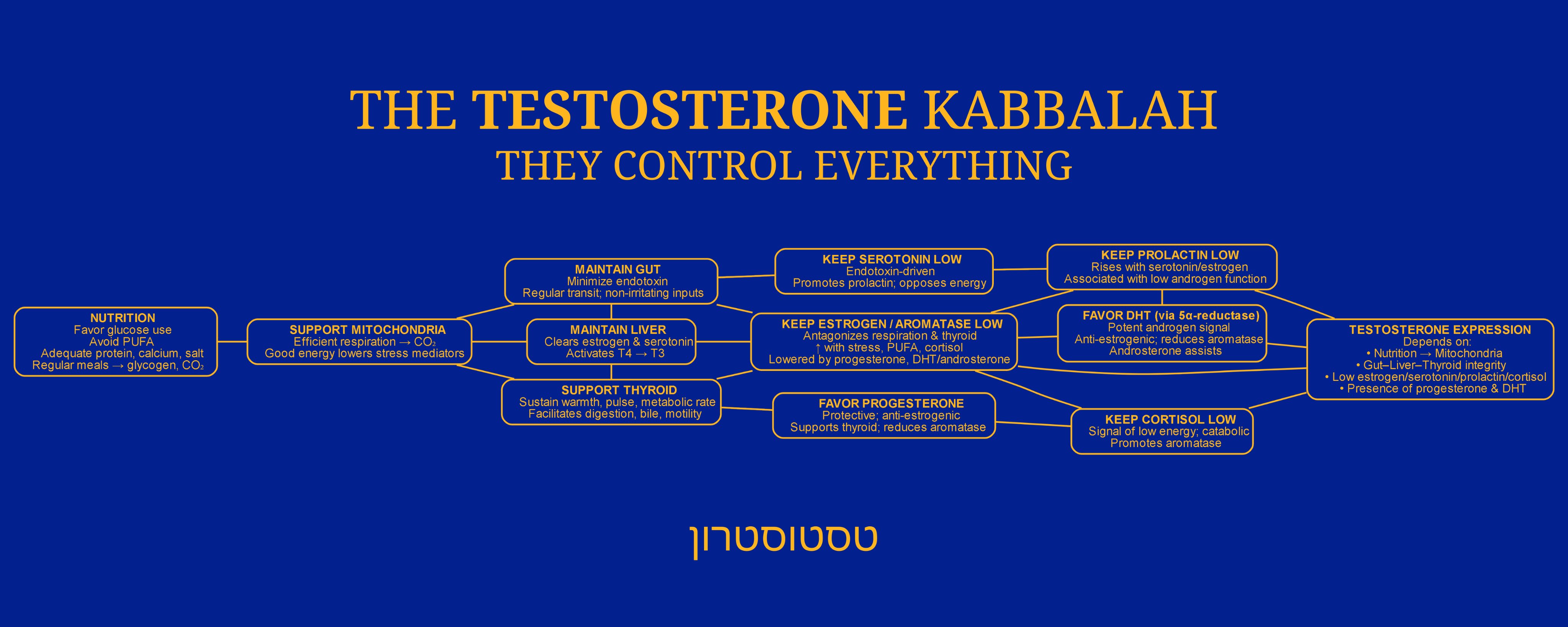 The dependency cascade: each block permits the next, and testosterone expression (far right) is the output of everything to its left. Read it as "fix the left before chasing the right."
The same cascade, simplified:
flowchart LR
    NUT[Nutrition<br/>fuel] --> MITO[Mitochondria<br/>energy]
    MITO --> GUT[Gut]
    MITO --> LIV[Liver]
    MITO --> THY[Thyroid]
    GUT --> SUP[Low endotoxin,<br/>serotonin, estrogen]
    LIV --> SUP
    THY --> SUP
    SUP --> LOW[Low cortisol,<br/>prolactin · good DHT]
    LOW --> T[Testosterone<br/>EXPRESSION]
Layer 1 — Nutrition: fuel
The claim: testosterone production is energetically expensive, so the body only "permits" it when fuel is abundant and metabolism is clean. Nutrition doesn't boost testosterone; it removes the energy-scarcity signal that suppresses it.
The article's central nutritional lever is fuel selection — glucose vs fat oxidation — and this is pure cellular energy territory. Recall from that page that a cell can burn either glucose or fat to make ATP, and the two are wired as a see-saw (the Randle cycle). The bioenergetic view strongly favours glucose oxidation, and the article lists why:
- Glucose burning yields more ATP per unit of oxidative stress, and produces CO₂, which the Peat framework treats as protective (stabilising and anti-inflammatory).
- It suppresses cortisol and lipolysis (the release of stored fat). When you're well-fed on carbohydrate, the body doesn't need stress hormones to mobilise fuel.
- Fat oxidation, by contrast, is framed as generating more reactive oxygen species (ROS) — the unstable molecules from the gut microbiome page's lipid-peroxidation section — and as relying more on stress hormones, and as liberating stored PUFA (polyunsaturated fats), which the framework treats as pro-inflammatory and estrogenic.
The practical diet that follows (the article's food pyramid):
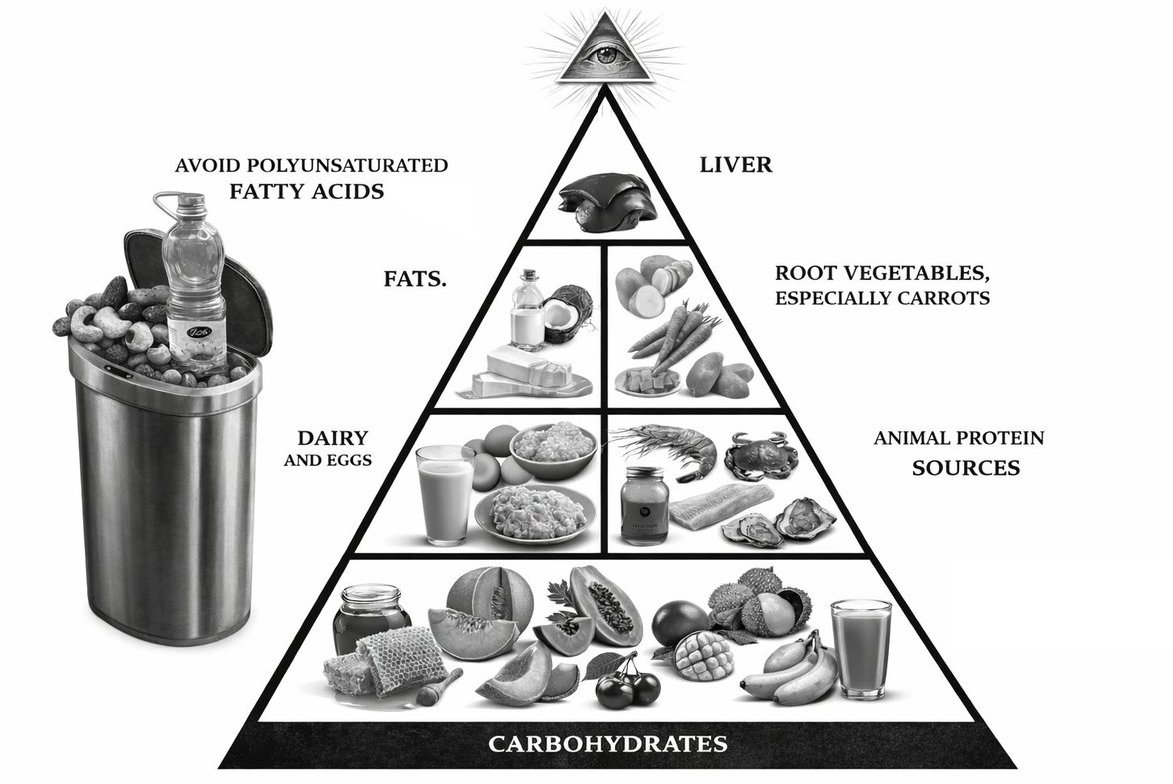 The bioenergetic plate: carbohydrate (fruit, honey, juice) as the base, animal protein and dairy, saturated fats, carrots and liver — and seed oils/nuts/PUFA explicitly binned.
- Carbohydrates (fruit, orange juice, honey) to stabilise blood sugar and suppress cortisol — the metabolism page's point that stable glucose keeps the stress axis quiet.
- Protein (eggs, dairy, shellfish, ruminant meat), deliberately balanced with gelatin/collagen to lower the load of the amino acids tryptophan, cysteine and methionine (tryptophan because it's the serotonin precursor — see Layer 7).
- Saturated fats (coconut oil, butter, tallow) as "structurally stable" fuels that resist oxidation.
- Calcium and salt to lower stress signalling (parathyroid hormone, aldosterone).
- Strict PUFA avoidance — seed oils, nuts, nut butters — which the article calls "non-negotiable."
One genuinely good nuance the article gets right and most "eat fat for testosterone" advice gets wrong: you do not need to eat cholesterol or saturated fat to make testosterone. Cholesterol (the raw material for all steroids, per the Hormones page) is made in the liver from acetyl-CoA, which can come from any macronutrient. Saturated fat is "supportive but optional" — its value is in not interfering with metabolism, not in being a required input.
⚖️ Calibration. The pro-glucose / anti-PUFA stance is the single most heterodox position in the article, and it's stated far more absolutely than the evidence warrants. Some points are reasonable (whole-food carbs do blunt cortisol; very high seed-oil intake is plausibly pro-inflammatory). But "PUFA removal is non-negotiable" overstates it: essential omega-3 and omega-6 fats are dietary requirements, and mainstream evidence links replacing saturated fat with polyunsaturated fat to lower cardiovascular risk, not higher. Treat "minimise industrial seed oils and don't fear fruit" as the defensible core, and "all PUFA is poison" as ideology. The CO₂-as-protective and ROS framing is also a specific Peat interpretation, not settled consensus.
Layer 2 — Mitochondria: energy
The claim: "Hormones follow energy, not the other way around." The mitochondria (the cellular energy power plants) decide whether the organism signals growth/reproduction or stress/survival, and that decision gates testosterone.
The mechanisms the article lists map exactly onto the cellular energy page:
- ATP availability and a high NAD⁺/NADH ratio favour oxidative metabolism and steroidogenesis (steroid-hormone production). NAD⁺ is the electron-carrier built from vitamin B3.
- Efficient electron flow through the electron transport chain minimises electron leak and ROS — the cleaner the chain runs, the less oxidative damage.
- CO₂ production is again treated as protective.
Its "foundational supports" are a checklist of cofactors we've already met:
- Vitamin B1 (thiamine) — activates pyruvate dehydrogenase (PDH), forcing pyruvate into clean mitochondrial oxidation instead of lactate. This is exactly the mechanism of the Thiamine deep dive — PDH is the gate from sugar into the mitochondria, and it needs B1.
- Vitamin B3 (niacinamide) — restores NAD⁺ pools.
- Magnesium — required for ATP synthesis and enzyme stability, the core of the Magnesium deep dive (every functional ATP is Mg-ATP).
- Vitamin K2 (MK-4) — supports mitochondrial respiration.
- Methylene blue (low dose) — described as an "electron cycler" that lets electrons bypass damaged ETC complexes, reducing leak and restoring ATP.
⚖️ Calibration. The cofactor logic (B1, B3, magnesium → mitochondrial function) is solid and matches mainstream biochemistry. Methylene blue genuinely does act as an alternative electron carrier at low doses, but it's a potent drug with a serious interaction the article rightly flags: it is a monoamine oxidase inhibitor, so combined with serotonergic drugs (SSRIs and others) it can cause life-threatening serotonin syndrome. "Cautiously" is doing a lot of work in that sentence — this is not a casual supplement.
Layer 3 — Gut: signal
The claim: the gut is a hormonal signalling organ that controls testosterone through inflammation, serotonin, estrogen recycling, and even direct microbial steroid metabolism — and a dysfunctional gut suppresses testosterone even when the testes are perfectly capable of producing it. (The article author honestly flags this as the section they understand least; we'll explain the mechanisms cleanly.)
This is the Gut Microbiome and Gut-Brain Axis pages applied to testosterone. The throughline is endotoxin (LPS) — the inflammatory fragment of gram-negative bacteria from the gut microbiome page. The article's chain:
- Gut irritation → increased intestinal permeability ("leaky gut") → more LPS crossing into the blood → TLR4 activation → inflammation → ↑ cortisol, prolactin, estrogen → testosterone suppressed. Every link here is straight from the foundations pages; the new endpoint is "and this suppresses Leydig cell steroidogenesis" (the Leydig cells in the testes are the testosterone factories).
- A neat feedback loop: estrogen increases TLR4 expression (amplifying endotoxin damage) while testosterone decreases it (protecting the barrier) — so low testosterone begets more endotoxin damage begets lower testosterone.
- Thyroid governs gut integrity: low thyroid → low stomach acid, low bile, slow motility → bacterial overgrowth and endotoxin. So "fix the gut" partly means "fix the thyroid" (Layer 5). This is why the article insists thyroid optimisation must precede probiotics.
It then goes deeper than the foundations pages in two interesting directions:
- Testosterone-degrading bacteria. Some gut bacteria express an enzyme (3β-HSD) that literally converts testosterone into the weaker androstenedione — deactivating testosterone in the gut. The article cites Mycobacterium neoaurum and others, and a striking statistic: in one study, 83% of depressed patients had stool capable of degrading testosterone. This is the mechanistic basis for "normal production but low functional androgen signalling."
- Testosterone-supportive bacteria. Butyrate-producers (Faecalibacterium prausnitzii, Roseburia, Bifidobacterium longum) strengthen the barrier and lower endotoxin (the butyrate story from the gut pages), and specific probiotic strains — notably Lactobacillus reuteri — have raised testosterone in animal models by shifting the inflammatory balance (↓ IL-17, ↑ IL-10).
Its practical gut tools are familiar from the gut pages and the Gut Reset protocol: raw carrot, white button mushrooms, bamboo shoots (the "antiseptic fibre" idea); binders (activated charcoal, citrus pectin); and zinc-carnosine, lactoferrin (see the Lactoferrin & Colostrum deep dive), and Saccharomyces boulardii.
⚖️ Calibration. The LPS → inflammation → low testosterone axis is real and increasingly well-supported. The specific bacterial claims (the 3β-HSD degraders, the named probiotic strains) are mostly from animal or small/early human studies — directionally interesting, not established clinical fact. "83% of depressed patients" is the kind of single-study statistic that should be held loosely until replicated. The overall message — heal the gut barrier, lower endotoxin — is sound; the strain-level specifics are frontier science.
Layer 4 — Liver: filter
The claim: the liver decides whether testosterone can exist by clearing estrogen, converting thyroid hormone (T4 → T3), maintaining bile flow and glycogen, and controlling inflammatory load. Impair it, and estrogen/serotonin/prolactin/cortisol rise and testosterone falls.
This is the Liver foundations page pointed at testosterone. Two liver jobs from that page do the heavy lifting:
- Estrogen clearance. The liver inactivates spent estrogen (Phase I/II detox) and dumps it into bile. Poor liver function → estrogen accumulates → the estrogen-suppression effects of Layer 9. (And recall the gut microbiome's estrobolome can un-clear it by reactivating estrogen for reabsorption — gut and liver are one system here.)
- T4 → T3 conversion. The liver is the main site that activates thyroid hormone (the metabolism page), needing selenium. So liver health gates the thyroid (Layer 5), which gates everything.
The article's liver-strainers (alcohol, oral 17-α-alkylated steroids, chronic endotoxin, PUFA overload, insulin resistance, sleep apnoea, iron overload) and supports (choline, taurine/TUDCA, glycine, creatine, niacinamide, vitamin E, coffee) all map onto that page's "what strains / what supports the liver" sections. Note the elegant placement: the liver sits between the gut and the thyroid in the hierarchy, because it processes what the gut sends and activates what the thyroid makes.
⚖️ Calibration. This section is the most mainstream-compatible in the whole article — liver health genuinely is central to hormone clearance and thyroid activation, and the strainers/supports listed are reasonable. The one caution is dose and context (e.g. niacinamide and TUDCA are real tools but not casual megadose candidates).
Layer 5 — Thyroid: rate
The claim: the thyroid sets the metabolic rate that determines whether the body runs in growth/reproductive mode or stress/survival mode. Low thyroid → the body compensates with cortisol, adrenaline, serotonin, prolactin, and estrogen — all testosterone suppressors.
This is the Systemic Metabolism page's thyroid system, and the article leans hard on a Peat-typical point: low thyroid function often exists despite "normal" blood tests. Rather than trusting TSH/T4/T3 labs, it uses functional markers — waking temperature (~36.6–36.8 °C), daytime temperature (~37 °C), and resting pulse (~75–85 bpm) — as readouts of thyroid effect at the tissue level. Cold hands, low temperature, slow pulse, constipation = insufficient thyroid effect regardless of labs.
The mechanism by which low thyroid lowers testosterone is a tidy summary of everything upstream: it reduces mitochondrial ATP (Layer 2), slows gut motility → more endotoxin (Layer 3), reduces bile → worse estrogen clearance (Layer 4), and raises cortisol, prolactin and aromatase (Layers 6–9). Supports: adequate carbohydrate, protein and salt; selenium (T4→T3), iodine, B-vitamins; and, "when necessary," T3 or natural desiccated thyroid.
⚖️ Calibration. The biology — thyroid sets metabolic tempo, and low thyroid drives a compensatory stress/estrogen state — is sound and matches the metabolism page. The contentious part is clinical: the claim that temperature/pulse should override lab values, and especially self-treating with T3/NDT, is firmly outside mainstream endocrinology. Functional markers are a reasonable additional signal, but thyroid hormone is a powerful drug — over-treatment causes atrial fibrillation, bone loss, and can suppress your own thyroid axis (the exact feedback shutdown from the Hormones page). This is a "work with a doctor," not a "dose yourself from temperature readings," situation.
Layer 6 — Cortisol: the brake
The claim: cortisol is the body's signal that conditions are unsafe for reproduction, so when cortisol is up, testosterone is deliberately suppressed.
Pure metabolism and autonomic nervous system material. The mechanism the article gives is precise and correct: cortisol suppresses GnRH and LH signalling — i.e. it acts at the top of the HPG axis from the Hormones page, turning down the brain's command to the testes. It also raises aromatase (more estrogen), drives lipolysis (releasing PUFA), and promotes visceral fat. The cortisol-lowering toolkit (adequate carbs and regular meals, salt, sleep, sunlight, magnesium, theanine, cyproheptadine) is the ANS page's "shift toward parasympathetic recovery" applied to hormones.
⚖️ Calibration. Well-grounded. Chronic cortisol genuinely suppresses the reproductive axis — this is textbook. Cyproheptadine is a real prescription antihistamine/anti-serotonergic, not a casual supplement.
Layers 7–8 — Serotonin and Prolactin: the suppressors
The article treats serotonin and prolactin together as downstream suppressors, and here it makes its most provocative reframing.
Serotonin. Against the popular "happiness chemical" image, the article (following Peat) calls serotonin "the anti-metabolic, anti-androgen signal" and insists high serotonin signals inflammation, not happiness. The mechanistic hook is real and comes straight from the Gut-Brain Axis page: ~90% of serotonin is made in the gut, it rises with endotoxin and inflammation, and it raises prolactin and suppresses thyroid and dopamine. Tools to lower it: gelatin/collagen (less tryptophan), and anti-serotonergics like cyproheptadine.
Prolactin. A pituitary hormone (the Hormones page) that, when chronically high, directly suppresses male reproduction — it suppresses GnRH, lowers testosterone and DHT, and blunts libido. Dopamine suppresses prolactin (the cognition page link), which is why the article's prolactin-lowering list runs through sleep, zinc, vitamin E, P5P, and dopamine agonists. Its top item — delivered via an Uncle Sam poster — is behavioural:
 The article's blunt prolactin advice. "Gooning" (prolonged compulsive arousal) is associated with prolactin elevation; the orgasm-linked prolactin surge is the physiological hook behind the joke.
⚖️ Calibration. The serotonin reframing is the second-most heterodox claim in the article. The gut-serotonin-inflammation link is real (gut-brain page), but "serotonin = inflammation, not happiness" overshoots — serotonin has many roles, and the gut pool and brain pool are separate (a nuance the article blurs). Deliberately lowering serotonin with drugs like cyproheptadine or metergoline is a fringe intervention with real risks, not a wellness tweak. The prolactin biology, by contrast, is solid: chronically high prolactin genuinely does suppress testosterone, and dopamine genuinely does suppress prolactin.
Layer 9 — Estrogen and Aromatase: interference
The claim: estrogen is anti-respiratory and anti-thyroid in excess — it inhibits mitochondrial respiration, raises serotonin and prolactin, increases aromatase, and suppresses androgen signalling. "Testosterone cannot dominate in an estrogen-driven environment."
This is the Hormones page's aromatase story applied with a Peat slant. The key enzyme, aromatase, converts testosterone into estrogen — and it's highly active in fat tissue, so more body fat means more conversion (lower T, higher estrogen), exactly as the Hormones page described. The article's estrogen-lowering levers act at the points that page identified: improve liver clearance, lose fat (less aromatase tissue), and use anti-aromatase agents — aspirin, vitamin E, progesterone, orange-juice flavonoids (naringenin), and carrots/mushrooms (gut estrogen handling via the estrobolome).
⚖️ Calibration. The aromatase/fat-tissue mechanism is mainstream and correct. The "estrogen is anti-metabolic and broadly harmful in men" framing is the Peat view — directionally reasonable for excess estrogen, but men still need some estrogen (for bone, libido, and brain), and aggressively crushing it (e.g. with aromatase-inhibitor drugs like Aromasin, which the article rightly calls "not first-line") causes its own problems. "Lower excess estrogen via fat loss and liver/gut health" is the defensible reading.
Layers 10–11 — Progesterone and DHT: protection and amplification
The last two upstream levers are the ones the article wants you to favour.
Progesterone — "not a female hormone, a protective steroid." Straight from the Hormones page: progesterone opposes estrogen, supports thyroid, lowers aromatase, and is calming (its metabolite allopregnanolone modulates GABA). In men, adequate progesterone "creates a hormonal environment where androgens can function." This is the bioenergetic case for progesterone (e.g. Progest-E) that the Hormones page introduced.
DHT — the amplifier. Dihydrotestosterone (DHT) is, as the Hormones page established, the most potent natural androgen — ~5× the receptor affinity of testosterone, binding tighter, dissociating slower, driving stronger gene transcription, and non-aromatizable (it can't become estrogen). It's made locally from testosterone by 5-alpha-reductase ("the alpha enzyme"). The article's key insight: 5-AR activity depends on the upstream conditions — thyroid hormone, cellular energy (NADPH), zinc, low inflammation — so low energy or high stress down-regulates DHT production even when testosterone is adequate. This is why "normal testosterone" can still "feel weak." Supports: thyroid, zinc, creatine (consistently raises DHT), glycine, low PUFA. It also warns against 5-AR inhibitors (finasteride, saw palmetto), which lower DHT and can cause sexual and mood side effects (the DHT compound page).
⚖️ Calibration. The DHT biochemistry is accurate and matches the Hormones page. Progesterone-in-men is a genuine Peat-world practice with a plausible mechanism but limited large-scale human evidence — reasonable to understand, cautious to self-administer (it is a hormone, with feedback effects). The finasteride caution is fair: post-finasteride syndrome is real for a minority, though for many it's well-tolerated.
Layer 12 — Testosterone: the expression
The payoff restates the thesis. Testosterone rises on its own when everything upstream is in order — energy sufficient, mitochondria efficient, endotoxin low, liver clearing estrogen, thyroid adequate, and cortisol/serotonin/prolactin low. It is the output, not the target.
You don't boost testosterone. You remove what suppresses it.
This is the article's enduring value, and it's correct in spirit regardless of the specific Peat positions: testosterone is downstream of whole-body health. The single best summary is the cascade itself — fix left to right, not right to left.
flowchart TD
    subgraph CAUSE["The suppression cascade (what to actually fix)"]
      E[Low energy / poor mitochondria] --> S
      G[Gut endotoxin / inflammation] --> S
      L[Poor liver estrogen clearance] --> S
      TH[Low thyroid] --> S
      S[↑ Cortisol · serotonin · prolactin · estrogen]
    end
    S --> SUPP[Testosterone suppressed BY DESIGN<br/>protective adaptation]
    FIX[Remove the suppressors] --> OUT[Testosterone rises as an OUTPUT]
How to read this article well
Taken as a whole, "The Testosterone Kabbalah" is a genuinely good systems-level reframing wrapped in a specific ideology. Hold the two apart:
- Keep the framework. Testosterone is an output of energy, gut, liver, thyroid, and stress. Chasing the hormone while ignoring those systems really is targeting the wrong level. This much is sound and maps cleanly onto the Foundations pages.
- Hold the dogma loosely. The absolute anti-PUFA stance, "serotonin = inflammation," temperature-over-labs thyroid self-treatment, and self-administered hormones (T3, progesterone) are Ray Peat positions, not consensus medicine — some defensible in moderation, some risky if taken literally. Several of the tools mentioned (methylene blue, cyproheptadine, T3, aromatase inhibitors, dopamine agonists) are real drugs with real dangers, not supplements.
- The safest, highest-yield actions are the ones that are also mainstream: don't over-rely on industrial seed oils, eat enough whole-food carbohydrate to keep cortisol down, sleep well, heal the gut barrier, lose excess visceral fat (less aromatase), support the liver, and manage stress. Those alone remove most of the suppressors — no exotic intervention required.
The deepest point is the one this whole Foundations series has been building toward: the body is one connected system. Testosterone, like mood, like metabolism, like cognition, is not an isolated dial — it's a readout of how well the whole machine is running. That's worth far more than any "booster."
Related foundations & deep dives
This article is essentially a tour of the Foundations series viewed through one hormone:
- Cellular Energy — the glucose-vs-fat fuel selection and mitochondrial ATP that "permit" testosterone (Layers 1–2).
- Digestion — how the nutrition in Layer 1 is actually absorbed.
- Gut Microbiome & Gut-Brain Axis — endotoxin, LPS, butyrate, and gut serotonin (Layers 3, 7).
- Liver — estrogen clearance and T4→T3 conversion (Layer 4).
- Systemic Metabolism — the thyroid and cortisol axes (Layers 5–6).
- Hormones & the Endocrine System — the steroidogenesis tree, aromatase, 5-alpha-reductase/DHT, progesterone, prolactin, and the HPG feedback that makes testosterone an output (Layers 9–12).
- Neuroscience of Cognition — dopamine's suppression of prolactin (Layer 8).
Compound deep dives touching this topic:
- Thiamine (B1) — the PDH activation central to Layer 2.
- Magnesium — the ATP cofactor of Layer 2.
- Lactoferrin & Colostrum — gut-barrier support from Layer 3.
Source article: "The TESTOSTERONE Kabbalah" by Jamal Dinkoui (@BerbarianWizard), 29 Jan 2026. Flowcharts and food-pyramid image are the original author's. This page is an educational explainer with added cross-references and calibration; the full verbatim source is archived in for-agent/testosterone-kabbalah-article.md.