Semax & Selank — Deep Dive
Category: Neuropeptides / Cognitive Enhancement / Anxiolytic
Origin: Institute of Molecular Genetics, Russian Academy of Sciences
Status: Registered pharmaceuticals in Russia and Ukraine — not research chemicals
| Semax | Selank | |
|---|---|---|
| Sequence | Met-Glu-His-Phe-Pro-Gly-Pro (MEHFPGP) | Thr-Lys-Pro-Arg-Pro-Gly-Pro (TKPRPGP) |
| Length | Heptapeptide (7 AA) | Heptapeptide (7 AA) |
| Derived from | ACTH(4–7) + Pro-Gly-Pro extension | Tuftsin + Pro-Gly-Pro extension |
| Primary effect | Cognitive enhancement / neuroprotection | Anxiolytic / immune modulation |
| Route | Intranasal | Intranasal / subcutaneous |
| Russian approval | 1994 (stroke, ADHD, optic nerve) | 2009 (generalised anxiety, neurasthenia) |
The Unusual Starting Point: Actual Approved Drugs
Most compounds in this database sit in a grey zone — research chemicals, off-label peptides, unscheduled compounds. Semax and Selank are different. They are registered pharmaceutical drugs, prescribed and dispensed in Russia and Ukraine, with decades of clinical use and human safety data.
This does not guarantee they are as effective as claimed — Russian pharmaceutical research carries the same single-lab replication concerns as BPC-157 and Epithalon. But the bar of evidence is meaningfully higher than a rodent study published by one group.
What makes them remarkable from a Western perspective is not that they are exotic — it is that they are entirely mainstream in one country and almost completely unknown in another.
Both share a structural quirk: the Pro-Gly-Pro (PGP) tripeptide at the C-terminus. This was originally added to increase metabolic stability. Research subsequently showed PGP is not a passive linker — it is pharmacologically active in its own right, independently activating neurotrophin transcription in ischemic tissue. The modification that was meant to stabilise the peptide turned out to double as a second mechanism.
Semax — The BDNF Peptide
What It Is
Semax is a synthetic heptapeptide derived from the ACTH(4–7) fragment — a region of adrenocorticotropic hormone known to influence memory, attention, and adaptive behaviour. The critical modification from native ACTH: the Pro-Gly-Pro extension was added, and the full steroidogenic activity of ACTH was deliberately eliminated. Semax does not stimulate cortisol production. It carries the cognitive signal of ACTH without the adrenal consequences.
Primary Mechanism: BDNF Upregulation
The main mechanism is rapid upregulation of Brain-Derived Neurotrophic Factor (BDNF) and its receptor TrkB in the hippocampus.
A single intranasal application of Semax (50 µg/kg) produces (PMID 16996037, Dolotov et al.):
- 1.4× increase in BDNF protein levels
- 3× increase in BDNF mRNA (exon III)
- 1.6× increase in TrkB phosphorylation (receptor activation)
Why BDNF matters: it is the primary growth factor for neurons in the hippocampus and prefrontal cortex. BDNF drives: - Long-term potentiation (LTP) — the cellular basis of learning and memory - Neurogenesis (new neuron formation in the hippocampus) - Synaptic plasticity — the brain's ability to reorganise in response to experience - Protection of existing neurons against oxidative stress, ischemia, and excitotoxicity
BDNF declines with age, chronic stress, poor sleep, and sedentary lifestyle. Its reduction is implicated in depression, cognitive decline, and reduced neuroplasticity. This is why Semax attracts interest well beyond its approved indications.
The Pro-Gly-Pro Layer
The C-terminal extension is not passive. Studies on PGP administered alone show it independently activates neurotrophin transcription in ischemic brain tissue — acting as a secondary mechanism distinct from the ACTH-derived core. The full Semax molecule thus operates on two pharmacological tracks simultaneously: the ACTH(4–7) fragment driving dopaminergic/serotonergic modulation, and PGP driving neurotrophin expression.
Clinical Indications (Russia/Ukraine)
- Ischaemic stroke — neuroprotection and recovery; reduces infarct progression when given within the critical window
- Attention deficit disorder — clinical use in Russia as an alternative/adjunct to stimulants
- Optic nerve atrophy — restoration of visual function in optic nerve disease
- Cognitive impairment — prescribed for vascular dementia and age-related cognitive decline
- Anxiety and depression — off-label but widely used; mechanism overlaps with the BDNF hypothesis of depression
Morph (@doctormorphh) on Semax in his plasticity stack:
"Semax. You will literally have child-like learning again." — listed alongside Magtein, Bacopa, and intranasal insulin as tools for recovering adult neuroplasticity.
Forms — Semax, NA-Semax, NA-Semax Amidate
Three forms exist, differing in stability and potency:
| Form | Modification | Relative potency | Notes |
|---|---|---|---|
| Semax (base) | None | 1× | Original pharmaceutical form; shorter half-life |
| NA-Semax | N-terminal acetylation | ~2–3× | Resists aminopeptidase degradation; standard community choice |
| NA-Semax Amidate | N-acetylation + C-terminal amidation | ~4–6× | Most stable; resists both ends of proteolytic cleavage; strongest effect per mcg |
The acetylation blocks the N-terminus from enzymatic attack; the amidation protects the C-terminus. The amidate form survives the nasal mucosa and reaches the CNS in higher intact concentrations. Community users frequently prefer NA-Semax Amidate for this reason, at proportionally lower doses.
Dosing (Semax)
Nasal spray is the standard form. Typical concentrations: 0.1% (1mg/ml, ~100µg/spray) or 1% (10mg/ml, ~1mg/spray).
| Use case | Dose | Timing |
|---|---|---|
| Cognitive enhancement | 200–600µg/day intranasal | Morning, split across nostrils |
| Neuroprotection / neuroplasticity | 300–500µg/day | Morning |
| Acute cognitive demand | 600µg–1mg | As needed |
| NA-Semax Amidate (higher potency) | 100–300µg/day | Scale down 50–70% from base Semax dose |
Selank — The Clean Anxiolytic
What It Is
Selank is a synthetic heptapeptide derived from tuftsin (Thr-Lys-Pro-Arg) — a natural immune-regulatory tetrapeptide found in IgG. The same Pro-Gly-Pro extension was added. Like Semax, the modification stabilises the molecule while adding independent pharmacological activity.
Where Semax is primarily a cognitive/neuroprotective compound, Selank is primarily anxiolytic — but through mechanisms so different from conventional anxiolytics that the comparison requires care.
Three Mechanisms — Why It's Not a Benzo
Conventional anxiolytics (benzodiazepines, phenibut) work by directly agonising GABA receptors, producing broad inhibitory CNS depression — which is effective but causes sedation, tolerance, dependence, and withdrawal. Selank does not work this way.
Mechanism 1: Indirect GABA-A Modulation
Selank increases expression of GABA-A receptor α1 and γ2 subunits in the hippocampus and prefrontal cortex. This enhances the efficacy of inhibitory GABAergic transmission without directly binding the benzodiazepine site. The effect is modulatory, not agonistic — it makes the existing GABA system work more efficiently rather than flooding it. This is why Selank does not produce sedation or the tolerance profile of direct GABA agonists.
Mechanism 2: Enkephalinase Inhibition
Selank inhibits enzymes (enkephalinases) that degrade endogenous enkephalins — the brain's natural opioid-adjacent anxiolytic peptides. By slowing enkephalin breakdown, Selank raises the concentration of these endogenous molecules without adding exogenous opioids. This is the mechanism that produces calm alertness rather than sedation — enkephalins modulate anxiety without the depressive profile of exogenous opioid agonism.
Mechanism 3: IL-6 Normalisation
Uchakina et al. (PMID 18683560) demonstrated that Selank significantly suppresses IL-6 production in stimulated immune cell cultures. IL-6 is a pro-inflammatory cytokine elevated in chronic anxiety states, depression, and stress — it drives neuroinflammation that feeds the anxiety-depression cycle. By normalising IL-6, Selank addresses an inflammatory root of anxiety that benzodiazepines entirely ignore.
flowchart TD
    SEL((Selank)) --> M1["1. ↑ GABA-A α1/γ2 subunits<br/>(makes existing GABA work better —<br/>not a direct agonist)"]
    SEL --> M2["2. Inhibits enkephalinase<br/>(preserves the brain's own<br/>anxiolytic enkephalins)"]
    SEL --> M3["3. Normalises IL-6<br/>(cuts the neuroinflammation<br/>that feeds anxiety)"]
    M1 --> OUT["Calm WITHOUT sedation,<br/>tolerance, or dependence<br/>(unlike a benzo)"]
    M2 --> OUT
    M3 --> OUT
This tri-mechanism profile — GABAergic modulation + enkephalin preservation + neuroinflammation reduction — produces anxiolysis that is:
- Non-sedating (no motor impairment in animal models at effective anxiolytic doses)
- Non-addictive (no withdrawal syndrome reported in clinical use)
- Tolerance-free (no dose escalation required over time)
- Anxiolytic comparable to diazepam in elevated plus-maze models (PMID 19916388) without the dependence profile
Selank vs Phenibut
Phenibut (GABA-B agonist) is the Russian anxiolytic the biohacking community encountered first. It is effective and powerful — and notoriously dangerous for chronic use. GABA-B agonism produces strong tolerance within days, dependence within weeks, and withdrawal that can be severe and prolonged.
| Selank | Phenibut | |
|---|---|---|
| Mechanism | Indirect GABA-A + enkephalin + IL-6 | Direct GABA-B agonist |
| Onset | 15–30 min (intranasal) | 1–2h (oral) |
| Sedation | No | Dose-dependent |
| Tolerance | None documented | Develops within days |
| Dependence | None documented | High risk with regular use |
| Withdrawal | Not reported | Significant; can be severe |
| Frequency | Daily use possible | Maximum 1–2×/week strictly |
Selank is the compound you can use the morning before a stressful event, a public presentation, or a demanding work day without the cognitive tax of sedation or the risk of next-day rebound anxiety. Phenibut hits harder acutely but cannot be used this way.
Forms — Selank vs NA-Selank
| Form | Modification | Notes |
|---|---|---|
| Selank (base) | None | Standard pharmaceutical; official Russian nasal spray |
| NA-Selank | N-terminal acetylation | Improved stability, longer duration |
The potency difference between forms is less dramatic than with Semax — Selank's base form is already reasonably stable intranasally. NA-Selank is preferred for subcutaneous injection where aminopeptidase exposure is lower and the stability advantage matters less.
Clinical Indications (Russia/Ukraine)
- Generalised anxiety disorder — approved indication since 2009
- Neurasthenia — chronic mental exhaustion; Selank restores functional capacity
- Adjunct to benzodiazepine tapering — used clinically to ease benzo withdrawal (supports GABA signalling while the benzodiazepine dose is reduced)
Dosing (Selank)
| Use case | Dose | Route | Timing |
|---|---|---|---|
| Anxiolytic (acute) | 250–750µg | Intranasal | As needed; onset 15–30 min |
| Daily anxiolytic maintenance | 250–500µg | Intranasal | Morning or as needed |
| Subcutaneous | 250–500µg | Injection | Slightly longer duration than intranasal |
| BasedBiohacker's stack dose | 500µg | SubQ | Morning (labelled "selank" in the stack) |
The Nose-to-Brain Route
Both Semax and Selank are designed for intranasal administration — and the reason is more interesting than simply avoiding injections.
The olfactory epithelium at the top of the nasal cavity provides a direct anatomical pathway to the brain. Olfactory neurons project directly through the cribriform plate into the olfactory bulb — bypassing the blood-brain barrier entirely. Molecules absorbed via the olfactory route can travel along axonal and perineural pathways to reach the brain within minutes of nasal application.
This is why intranasal delivery achieves clinically meaningful CNS concentrations at doses far lower than would be required orally or even subcutaneously. It also explains why administration technique matters significantly.
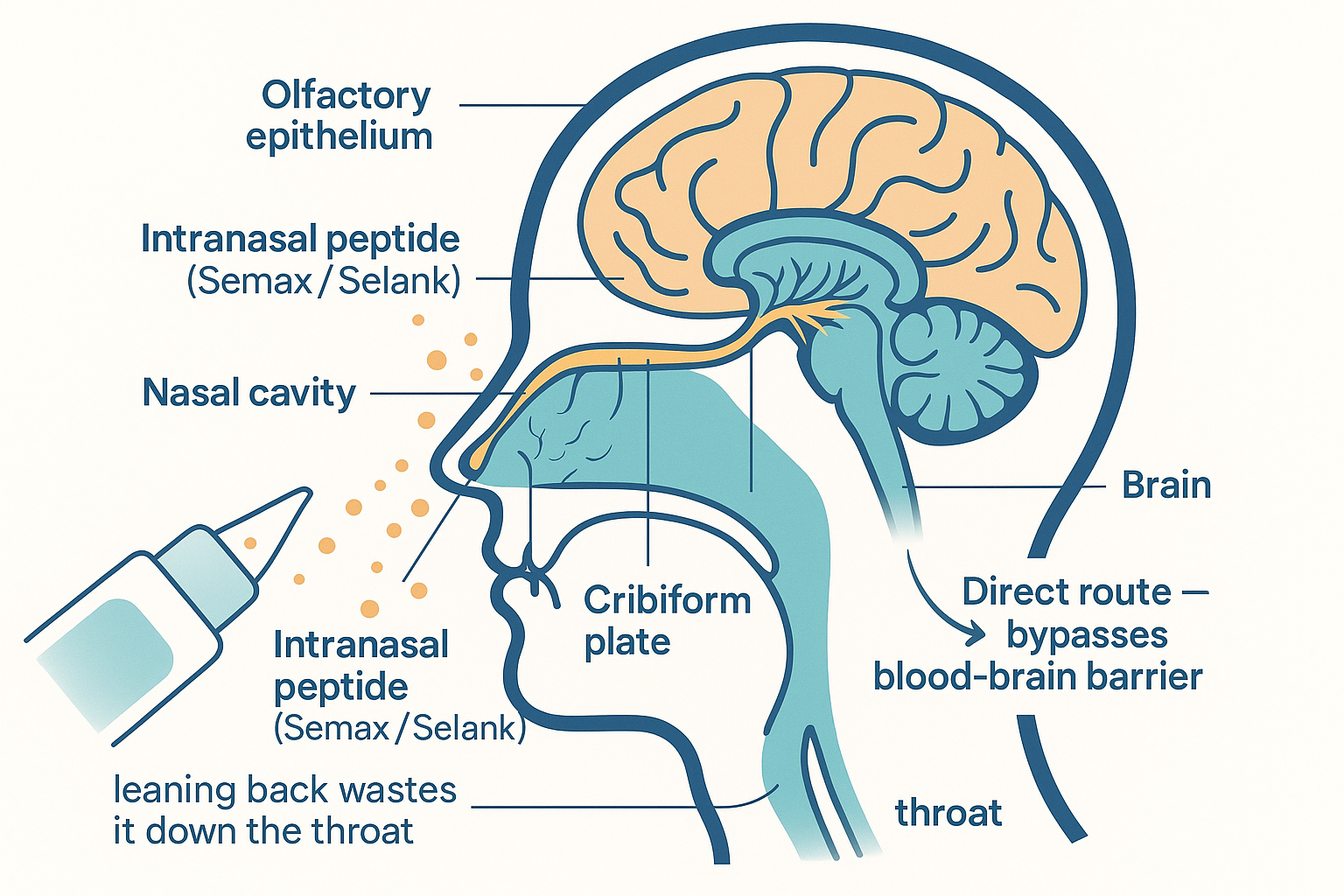 The nose-to-brain shortcut: peptide reaching the olfactory epithelium travels along olfactory nerves through the cribriform plate straight into the brain — bypassing the blood-brain barrier (and why leaning back wastes it down the throat).
BasedBiohacker (@BasedBiohacker) on nasal spray technique (the same protocol applies to Semax as to Bromantane):
"You're probably wasting your nasal sprays due to poor administration."
Correct technique for doubled efficacy: 1. Lean forward (not back) 2. Aim towards your ear, not straight up 3. Shake before each spray 4. Cover the other nostril 5. Normal breath in as you spray 6. Big snort immediately after — drives the solution toward the olfactory epithelium rather than letting it run down the throat
Leaning back and inhaling deeply sends the spray to the throat and stomach. Leaning forward with a snort directs it to the olfactory cleft where olfactory neurons are accessible.
Semax vs Selank — When to Use Which
These are complementary, not competing. The community uses them together precisely because they operate on different axes:
| Semax | Selank | |
|---|---|---|
| Primary effect | Cognitive enhancement, drive, neuroprotection | Calm, anxiolysis, social ease |
| BDNF | Strong upregulation | Modest; some evidence |
| Anxiety | Can increase in sensitive users | Reduces |
| Energy/motivation | ↑ | Neutral |
| When to use | Deep work, learning, neuroplasticity protocol | Stressful situations, high-anxiety periods, social contexts |
| Pairing logic | Semax provides drive; Selank removes the anxious edge | Together: focused calm |
BasedBiohacker (@BasedBiohacker):
"selank + fasopracetam = amazingly calm"
Fasopracetam (GABA-B upregulator) complements Selank's indirect GABAergic modulation — both improve GABAergic tone through different points of leverage. The combination addresses anxiety from the top (fasopracetam potentiating the receptor response) and the bottom (Selank modulating subunit expression and enkephalin availability).
Community Stacks
BasedBiohacker — Neuroprotection & Longevity Stack
Morning: Amantadine, Royal Jelly, Tadalafil, Selank 500µg SubQ, Epitalon, Vilon, Mexidol, ALCAR
Selank sits in the morning neuroprotective cluster alongside Epitalon and Mexidol — used subcutaneously here rather than intranasally. The stack is focused on "neuroprotection, dopaminergic and executive function optimisation, glutamate mitigation" — Selank contributes the glutamate-moderating and neuroinflammation-reducing angle via IL-6 normalisation.
Morph — Neuroplasticity Stack
Semax for plasticity: "Pinealon. Magtein. Semax. Intranasal Insulin. Learn new things constantly." Treated as one of the core tools for recovering adult neuroplasticity alongside BPN14770 and Bacopa Monnieri.
BasedBiohacker — Calm Focus
"selank + fasopracetam = amazingly calm" — the anxiolysis pair vs "modafinil + bromantane = amazing focus" as the stimulating pair. Two distinct modes, not combined simultaneously.
Morph's Comprehensive Nootropic List
Semax listed as "recovery + sleep" — different from how others frame it (primarily cognitive), suggesting it also has a restorative/consolidating function overnight rather than purely a daytime wakefulness compound.
Research Quality and Calibration
The same single-institution caveat applies here as with BPC-157 and Epithalon — the majority of published research originates from Russian and Ukrainian institutions, with limited Western replication. The bar is higher than BPC-157's Sikiric group situation: Semax and Selank are registered pharmaceuticals with post-marketing surveillance data from decades of clinical prescription. That is meaningful.
What remains uncertain: - Magnitude of effect in healthy non-neurologically-impaired adults (most research targets pathological populations) - Optimal dosing for cognitive enhancement in healthy users (clinical doses target disease states) - Long-term neurological effects of chronic BDNF upregulation via Semax
A 2020 connectomics study (PMID 32342318) examined both Semax and Selank effects on brain functional connectivity — one of the few independent neuroimaging approaches to their mechanisms.
Safety
Semax: - No serious adverse events in clinical trials or post-marketing surveillance - Can transiently increase anxiety in sensitive users (BDNF upregulation activates the same pathways as stress responses briefly before the adaptive benefit emerges) - Mild nasal irritation with chronic high-frequency use - No hormonal effects (steroidogenic activity eliminated)
Selank: - Extremely clean safety profile; no addiction, tolerance, or withdrawal in any published data or clinical use - Mild sedation possible at very high doses (above typical therapeutic range) - The Doyno 2021 review (Journal of Clinical Pharmacology) placed Selank in a GABA-modulating agent review alongside phenibut and GHB — but explicitly noted the absence of dependency risk as a distinguishing feature
Legal Status and Sourcing
| Jurisdiction | Status |
|---|---|
| Russia / Ukraine | Registered pharmaceuticals; OTC availability in pharmacies |
| UK | Not scheduled; uncontrolled; legal to possess and import for personal use |
| US | Not FDA-approved; no DEA scheduling; legal grey area; widely imported |
| EU | Generally unscheduled; not approved as medicines |
Community suppliers: - CosmicNootropic — primary community source for both, ships internationally; stocks all form variants (base, NA, amidate) - CerebralGarden — UK/EU-focused, reliable for Semax and Selank - Peptides Lab UK — UK domestic
Quality markers: both should arrive as lyophilised powder or pre-made nasal spray. Nasal sprays from Russian manufacturers (the actual pharmaceutical product) are considered highest quality. Store at 4°C; reconstituted solutions use within 2–4 weeks refrigerated.
Research Sources
Semax: - BDNF / TrkB upregulation (Dolotov et al.): PMID 16996037 - Semax in ischaemic stroke: ScienceDirect - Functional connectomics (Semax + Selank): PMID 32342318
Selank: - Anxiolytic effects vs diazepam (Seregin et al.): PMID 19916388 - IL-6 suppression (Uchakina et al.): PMID 18683560 - GABAergic gene expression: ResearchGate - Selank + diazepam synergy in chronic stress: PMC5322660 - GABA-modulating agents review (includes Selank vs phenibut): Doyno 2021, J Clin Pharmacol - Generalised anxiety / neurasthenia clinical trial: ResearchGate
All community quotes compiled from biohacking Twitter discussions. Educational purposes only. Not medical advice.