Vilon — Deep Dive
Category: Peptide Bioregulators / Immune / Longevity
Sequence: Lys-Glu (L-lysyl-L-glutamic acid) — a dipeptide
Also written: KE, "the KE peptide"
MW: ~275 Da
Origin: St. Petersburg Institute of Bioregulation and Gerontology — Prof. Vladimir Khavinson
Target organ: Thymus (the T-cell training organ)
The Shortest Thing That Could Plausibly Be a Drug
Vilon is two amino acids. Lysine joined to glutamate by a single peptide bond. That is the entire molecule.
This is worth pausing on, because it sits at an extreme. A dipeptide is roughly the smallest object you can call a "peptide" at all — one bond more than a free amino acid. At ~275 daltons it is smaller than caffeine (194 Da) is to a protein, smaller than most small-molecule drugs, and orders of magnitude below the antibodies and 30-kDa proteins we usually mean when we say "biologic". Insulin is ~5,800 Da. BPC-157 is fifteen residues and ~1,400 Da. Vilon is two residues.
The claim attached to this tiny object is enormous: that it re-tunes the thymus, restores immune competence in aged tissue, cleans up coagulation, and reaches into the nucleus to switch genes on and off. The entire interest of Vilon is the tension between how little molecule there is and how much biology is claimed for it. This deep dive is built around taking that tension seriously from first principles — what could a Lys-Glu dipeptide actually do, what does the evidence actually show, and where does the hype outrun both.
If you have read the Pinealon & Epithalon deep dive, you already know the framework Vilon belongs to. Vilon is the thymus member of the same Khavinson bioregulator family. The structure of the argument is identical — and so are the caveats.
The Khavinson Bioregulator Paradigm
To evaluate Vilon you have to evaluate the entire research programme that produced it, because almost nothing about Vilon makes sense outside it.
Vladimir Khavinson's central hypothesis, developed across 50+ years of Soviet and post-Soviet research: each organ produces short peptide signals that regulate its own function and renewal. As the organ ages, it produces fewer of these signals. Part of the cascade of age-related decline is therefore a peptide deficit. The intervention: isolate the specific short peptides an organ makes, synthesise them, and give them back — restoring the regulatory signal from outside.
These are called peptide bioregulators (older term: cytomedins). The first generation were crude polypeptide extracts of animal organs. The second generation are the synthetic short peptides — di-, tri-, and tetrapeptides — distilled from those extracts as the supposed "active core". Khavinson's group produced one for nearly every major organ.
flowchart TD
    K["Khavinson bioregulator family<br/>(organ to short peptide)"]
    K --> TH["Thymus to VILON (Lys-Glu)<br/>+ Thymogen (Glu-Trp), Thymalin (extract)"]
    K --> PI["Pineal to Epithalon (Ala-Glu-Asp-Gly)<br/>+ Epithalamin (extract)"]
    K --> BR["Brain cortex to Pinealon (Glu-Asp-Arg)<br/>+ Cortexin (extract)"]
    K --> RE["Retina to Retinalamin (extract)"]
    K --> PR["Prostate to Prostatilen / Prostamax"]
    K --> VE["Vessels to Vesugen (Lys-Glu-Asp)"]
    K --> LI["Liver to Livagen (Lys-Glu-Asp-Ala)"]
    TH:::hi
    classDef hi fill:#e8e0ff,stroke:#6a4fc0,stroke-width:2px;
Vilon is the thymus node. Note how close the sequences are: Vilon (KE) is the first two residues of Vesugen (KED) and Livagen (KEDA) — these are not unrelated molecules but a graded family built around a Lys-Glu core.
The family resemblance is the first clue and the first problem. Several "different-organ" bioregulators share overlapping sequences. Vilon = Lys-Glu. Vesugen ("vessels") = Lys-Glu-Asp. Livagen ("liver") = Lys-Glu-Asp-Ala. If a two-residue core (KE) is the active unit, the claim that each peptide is organ-specific needs a mechanism that explains how nearly-identical molecules hit different tissues. Khavinson's proposed answer is the gene-binding hypothesis below. Whether it holds is the central scientific question.
The Chemistry: Why Lys-Glu, and Why So Small
Take the molecule apart.
Lysine is a basic amino acid. Its side chain ends in a primary amine (–NH₃⁺ at physiological pH) — it carries a positive charge. Glutamate is an acidic amino acid; its side chain ends in a carboxylate (–COO⁻) — a negative charge. So Lys-Glu is a tiny zwitterion with a built-in plus and minus, plus the usual backbone amino and carboxyl termini. It is small, highly water-soluble, and electrically lopsided.
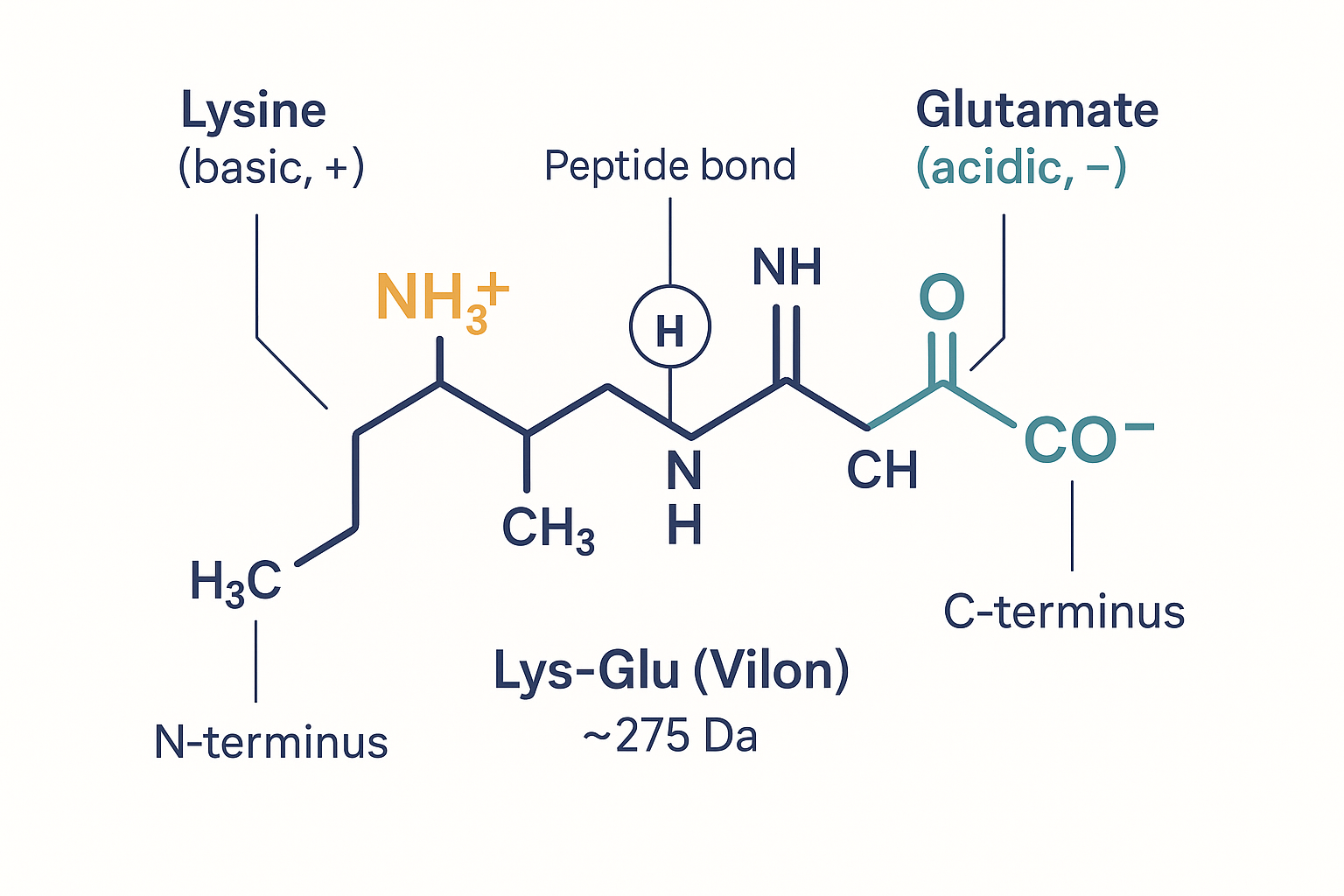 Vilon is the dipeptide lysine–glutamate: a positively charged lysine side chain (–NH₃⁺) and a negatively charged glutamate side chain (–COO⁻) joined by one peptide bond — a ~275 Da zwitterion. That built-in plus/minus is the whole basis of the DNA-binding hypothesis below.
That charge profile is the whole mechanistic story the Khavinson school tells. DNA's backbone is a string of negatively charged phosphate groups. A molecule presenting a localised positive charge (the lysine ε-amine) can form an electrostatic contact with that backbone, and the glutamate carboxylate can hydrogen-bond to exposed base edges in the major or minor groove. The hypothesis is that Lys-Glu is shaped to read a specific short DNA sequence — a chemically minimalist "sequence-recognition" unit. We return to whether that is plausible below.
Oral survivability — the dipeptide advantage
Most therapeutic peptides have near-zero oral bioavailability: gut proteases shred them in minutes and large peptides cannot cross the intestinal wall intact. This is the central problem with peptides as oral drugs.
Di- and tripeptides are the genuine exception, and not for hand-waving reasons. The small intestine evolved to absorb protein as di- and tripeptides, via a dedicated transporter — PepT1 (SLC15A1) — which actively pumps two- and three-residue peptides across the enterocyte membrane. The body treats dipeptides as food to be absorbed, not as foreign proteins to be destroyed. A Lys-Glu dipeptide is therefore a far more credible oral candidate than a 15-mer like BPC-157, let alone a protein.
This is the kernel of truth under the community claim that "it's so small it survives digestion". It is genuinely more defensible for Vilon than for almost any other peptide:
BasedBiohacker (@BasedBiohacker):
"vilon is a dipeptide — just two amino acids, lysine and glutamate (Lys-Glu)... because it's so small, it survives digestion and absorbs effectively when taken orally. no injection required. this is the same reason pinealon and epitalon work orally — these short-chain peptides slip through where larger molecules get nuked."
The honest caveat: PepT1 transports the dipeptide into the enterocyte, but a large fraction of absorbed di-/tripeptides is then hydrolysed inside the gut-wall cell by cytosolic peptidases before reaching the bloodstream intact. So "absorbs orally" and "survives to act systemically as intact Lys-Glu" are not the same claim. Some intact Lys-Glu plausibly reaches circulation; how much, and whether enough reaches target tissue nuclei, has no published human pharmacokinetic measurement. The community line ("the difference in bioavailability is made up for with appropriate dosing") is a reasonable bet, not a measured fact.
The Mechanism Hypothesis: Peptide as Gene-Switch
This is the load-bearing claim of the entire bioregulator paradigm, and it deserves first-principles scrutiny rather than either dismissal or credulity.
The hypothesis (Khavinson, Fedoreyeva, Vanyushin, Kolchina):
- Short peptides (2–7 residues) are small enough to cross the cell membrane and the nuclear envelope and reach DNA.
- Inside the nucleus they bind DNA in a sequence-specific way — recognising particular short motifs in gene promoters, and even discriminating methylated from unmethylated cytosine.
- By binding, they alter local chromatin structure ("de-heterochromatinise" — open up silenced regions) and modulate transcription of specific genes — up or down depending on the target.
- Because each peptide reads a different motif, each switches a different gene set — producing the tissue-specific "bioregulator" effect.
flowchart LR
P((Vilon<br/>Lys-Glu)) -->|crosses membrane| CYT[Cytoplasm]
CYT -->|crosses nuclear envelope| NUC[Nucleus]
NUC -->|"electrostatic + H-bond<br/>to a short DNA motif"| BIND["Sequence-specific<br/>DNA / chromatin binding"]
BIND --> OPEN["Local chromatin opens<br/>(de-heterochromatinisation)"]
OPEN --> GENE["Target genes modulated<br/>IGF1 up, irisin, TERT, NF-kB..."]
GENE --> EFFECT["Tissue-specific<br/>bioregulatory effect"]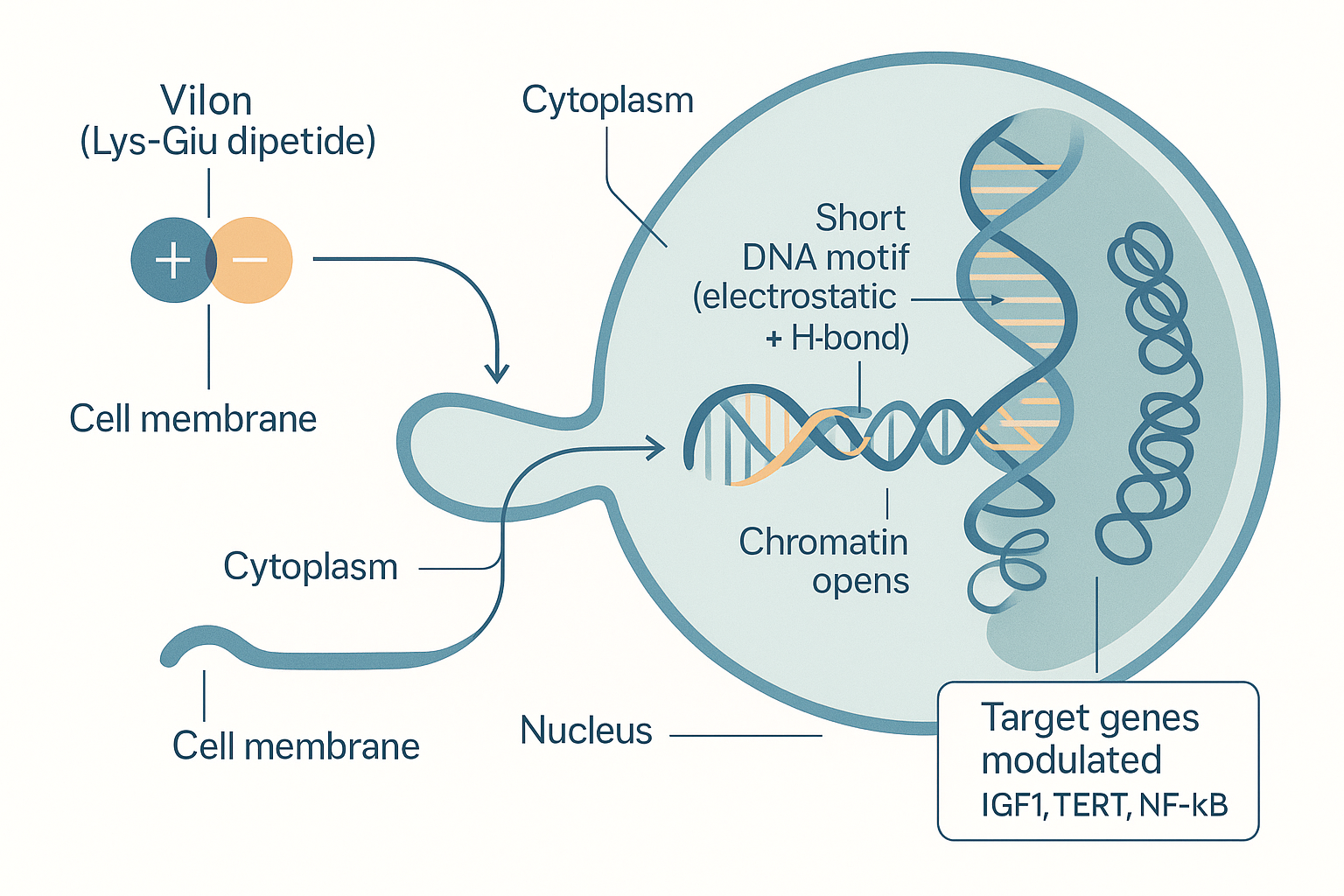 The peptide-as-gene-switch hypothesis: a charged dipeptide enters the nucleus and contacts a short DNA motif — chemically coherent, but sequence-specific reading by two residues is the hard part.
What independent evidence actually exists for this
This is where Vilon's class does slightly better than pure single-lab folklore — but read the detail.
- Fedoreyeva et al., 2011 (PMID 22117547, Biochemistry (Moscow)): FITC-labelled short Khavinson peptides (epithalon, pinealon, testagen, bronchogen) were tracked into the cytoplasm, nucleus and nucleolus of HeLa cells, and shown in vitro to interact differentially with labelled deoxyribooligonucleotides and DNA — discriminating between sequences and even recognising cytosine methylation status, with preferential binding to CNG motifs. This is real experimental support that short peptides can enter nuclei and do interact non-randomly with DNA. (Note: this paper tested several family members; Vilon specifically is covered more in modelling and cell-proliferation work than in this imaging study.)
- Kolchina et al., 2019: docking/modelling and binding work building spatial models of short-peptide–DNA complexes, including KE-type peptides binding specific sequences — the structural rationalisation of the above.
- Vilon up-regulating IGF1 (PMID 32399807): in aged human cell models, Vilon reportedly increased IGF1 gene expression markedly (community figures: ~3.5× in replicative ageing, ~5.2× in stationary ageing) and modulated a panel including FOXO1, TERT, NF-κB. This is the headline "it changes gene expression" datapoint.
First-principles assessment. Is the gene-switch hypothesis plausible? Partially.
In favour: a charged dipeptide genuinely can contact DNA electrostatically; di-/tripeptides genuinely can enter cells; the 2011 imaging is genuine evidence of nuclear localisation and non-random DNA interaction.
Against / unresolved: - Sequence-specificity from two residues is a stretch. Established sequence-specific DNA readers — transcription factors — use large, folded protein domains making a dozen-plus contacts to read ~6–10 bp with real specificity. A flexible dipeptide makes a handful of contacts. The thermodynamic specificity such a molecule can achieve is, on physical-chemistry grounds, modest. "Binds DNA" is easy for a cation; "binds one specific promoter selectively enough to be a clean switch" is the hard part, and it is the part the organ-specificity story depends on. - In-vitro binding ≠ in-vivo regulation. Showing a peptide perturbs DNA–dye fluorescence in a tube is a long way from showing it occupies a specific promoter in a living cell at achievable concentrations and changes that gene's output causally. - Concentration reality. For a dipeptide to act as a nuclear gene regulator, enough intact molecule must survive gut, blood, cytoplasm and nuclear import to reach effective nuclear concentrations. No human PK data addresses this.
Verdict on the mechanism: the hypothesis is not crankery — it has a coherent chemical logic and some genuine supporting data, much of it from outside pure clinical claims. But "short peptides can enter nuclei and interact with DNA non-randomly" is a far weaker and better-supported claim than "Vilon is an organ-specific epigenetic gene-switch for the thymus", which remains substantially a hypothesis carried by the originating school.
Why the Thymus Is a Sensible Target
Set the molecule aside for a moment. If you could safely nudge one organ to fight ageing, the thymus is a genuinely well-chosen target — this part of the story is solid mainstream immunology, not Khavinson lore.
The thymus is where T-cells are educated. Immature T-cell precursors arrive from the bone marrow, and thymic epithelial cells "train" them: select the ones that recognise foreign antigen, delete the ones that attack self. The output is a diverse repertoire of naïve T-cells — the immune system's precision-strike force, each clone tuned to a specific threat (a specific virus, a specific tumour antigen).
The catch is thymic involution: the thymus is one of the first organs to age, and it ages early. It begins shrinking after puberty and is progressively replaced by fat. By around age 40–50 much of its functional tissue is gone. As thymic output of fresh naïve T-cells falls, the immune system leans ever more on a fixed, ageing pool of memory cells.
This decline — immunosenescence — is real and consequential: poorer vaccine responses, worse infection outcomes, weaker tumour surveillance, and the chronic low-grade inflammation ("inflammaging") of older age. Reversing or slowing thymic involution is a legitimate, actively-researched anti-ageing goal (it is also why the TRIIM trial used growth hormone to try to regrow thymus). So the target is sound. The open question is only whether a Lys-Glu dipeptide hits it.
Vilon's specific claim: it acts on thymic epithelial cells — the trainer cells — signalling aged, involuted thymic tissue to resume activity, and shifting T-cell differentiation and cytokine output back toward a younger profile. Khavinson-group work reports Vilon promoting lymphocyte differentiation and normalising cytokine production in thymic-cell cultures. The mainstream-immunology selling point: a single androgen factor neatly explains a community observation — AAS users. Anabolic steroids accelerate thymic involution, which is why Vilon is pitched to that group specifically.
"epitalon is the pineal gland bioregulator, pinealon is the brain bioregulator, and VILON is the thymus bioregulator. the thymus is the organ that trains your T-cells, which is the immune system's precision strike force."
The Systemic Effects: Coagulation and Neuroendocrine
Two human/animal findings sit outside the thymus story and are worth examining on their own, because they are the most concrete data Vilon has — and both come from 2006 Advances in Gerontology (the Khavinson-adjacent journal).
Coagulation — the diabetes DIC paper (PMID 17152731)
Kuznik BI et al., 2006: in type-1 diabetics in a destabilised state — who develop a chronic low-grade disseminated intravascular coagulation (DIC) picture: accelerated clotting, depleted natural anticoagulants (antithrombin III, protein C), high fibrinogen and soluble fibrin-monomer complexes, suppressed fibrinolysis — standard antidiabetic therapy did not correct the coagulation abnormality. Vilon "significantly reduced or even totally eliminated" it: raising antithrombin III and protein C, restoring fibrinolysis. The effect was weaker in elderly patients with severe disease.
Mechanistically this fits the "thymomimetic" framing the paper uses — the thymus–haemostasis link is real in Russian physiology literature, and the endothelium is a plausible common node (Vesugen, the KED vessel peptide, is one residue longer). It is a human result, which is rare here. It is also small, single-group, in a niche population, with the usual caveats below.
This is the origin of the community's most-repeated mechanistic bullet list:
BowTied Biohacker (@BowTiedUM):
"Vilon ↑ AT-III · Vilon ↑ Protein C · Vilon stimulates fibrinolysis · Vilon regulates vascular permeability · Vilon enhances oxygen delivery... Russian Olympic athletes have been documented taking vilon and pinealon for performance enhancing purposes."
The "cleaner blood, better perfusion, more oxygen delivery without the hematocrit problems of EPO" framing is an extrapolation from the DIC paper's antithrombin/protein-C/fibrinolysis findings into athletic performance. The coagulation data is real; the endurance-performance leap is anecdote-plus-inference, not a measured outcome.
Neuroendocrine — the aged-rat sexual-function paper (PMID 17152729)
Kudriavtseva TA et al., 2006: old, hemi-castrated (hypogonadal-model) male rats given Vilon 50 µg/rat intraperitoneally for 18 days. Vilon restored sexual behaviour and shifted neuroendocrine and hypothalamic-neurotransmitter status.
Jamal Dinkoui (@BerbarianWizard) extracted the numbers:
"mounts +42%, first-session intromissions +59.2%, total intromissions +75.1%, ejaculations +31.3%; intromission latency −35.2%... LH 18-fold increase, prolactin −30.5%, ACTH +168%... noradrenaline −63%, serotonin −39%, dopamine normalized."
The paper's own interpretation is careful and worth keeping: restoration was attributed to a combination of neuroendocrine and neuromediator changes, with the prolactin drop singled out (age-related hyperprolactinaemia is a recognised driver of male sexual decline). The 18-fold LH rise and 168% ACTH rise are striking but are single-study rodent numbers in a contrived hypogonadal model — directionally interesting, not a human dose-response. This is the paper behind the community's "drive, vitality, aggression" reports, including stacking it with anabolics:
Jamal Dinkoui (@BerbarianWizard):
"The increase in drive/aggression and strength from Anavar and Vilon allowed me to train with much higher intensity... But now I'm feeling signs my nervous system is starting to crash, so I'm taking a week off."
(Note the crash — a useful reality check that "bioregulator = always gentle and self-correcting" is not how users actually experience aggressive stacking.)
The Inflammation Data — and a Genuine Independent Replication
The single most important paper for calibrating Vilon is one the community cites almost in passing.
Avolio, Martinotti et al., 2022 — Peptides Regulating Proliferative Activity and Inflammatory Pathways in the Monocyte/Macrophage THP-1 Cell Line, International Journal of Molecular Sciences 23:3607 (PMC8999041). An Italian group, independent of St. Petersburg, tested five Khavinson short peptides — Vilon among them — in human THP-1 monocyte/macrophage cultures. The findings: the peptides modulated proliferation, increased tyrosine phosphorylation of MAP kinases, and suppressed LPS-stimulated TNF and IL-6 expression in differentiated macrophages — i.e. acted as anti-inflammatory modulators and inducers of "TNF tolerance".
Why this matters more than its citation count suggests: it is independent, in human cells, peer-reviewed in a Western journal, and it shows a real, measurable effect of these dipeptides on a defined biological pathway. It is the Vilon-class equivalent of the 2025 independent Epithalon telomere paper described in the Pinealon & Epithalon deep dive: not proof of the grand longevity/thymus claims, but external confirmation that these molecules do something measurable to immune cells. That moves Vilon a notch above "single-lab folklore" — though only a notch, and only for the inflammation endpoint.
Evidence Calibration — Read This Before Believing Anything Above
This class is heavily hyped, and Vilon specifically is in a hype upswing. The honest picture:
1. The single-lab problem — but with cracks of independent light. Like BPC-157 (Sikiric/Zagreb) and Epithalon (Khavinson/St. Petersburg), the overwhelming majority of Vilon evidence originates from one institutional lineage — Khavinson's St. Petersburg school — published largely in Russian-language or Russian-edited journals (Advances in Gerontology, Bulletin of Experimental Biology and Medicine) under publication standards that differ from modern RCT norms. The cracks of independent light are real and worth weighting: Avolio 2022 (Italian, human cells, inflammation) and the broader Fedoreyeva/Vanyushin DNA-interaction work, some co-authored with agricultural-biotech rather than clinical groups. But there is no independent group reproducing the thymus-restoration or longevity claims.
2. Rodent and in-vitro, with thin human data. The strongest mechanistic and longevity claims are cell-culture (IGF1, DNA binding, TNF/IL-6) or rodent (sexual function). The two human datapoints are the diabetes coagulation paper (small, niche) and the broader Khavinson elderly-cohort mortality work. No large, registered, double-blind human RCT exists for Vilon for any indication. No NIA-ITP longevity testing. No human pharmacokinetics.
3. The "Russian Olympic athletes" and "Thymalin doubled COVID survival" claims — how to read them. - Athletes: essentially unfalsifiable folklore. Soviet/Russian sports-science used many peptide bioregulators, and Vilon may well have been among them, but "documented" here means anecdote and program lore, not a controlled performance trial. Treat as colour, not evidence. - Thymalin + COVID: there is genuine published work (Khavinson group and an International Journal of Immunology and Immunotherapy paper) reporting Thymalin improved outcomes in severe COVID in older patients, and the famous 2.5-fold mortality reduction figure comes from a real 6–8-year elderly cohort (n=266) combining Thymalin + Epithalamin. But: (a) Thymalin is the crude thymic extract, not Vilon — Vilon is at best one synthetic fragment of that mixture, so crediting Vilon with Thymalin's results is a category error the community repeatedly makes; (b) the mortality-cohort work is non-randomised and from the originating group; (c) the COVID RCT was small/early. The honest statement: Thymalin (extract) has suggestive but unreplicated human immune data; extrapolating it to the Lys-Glu dipeptide is an inference, not a finding.
4. Mechanistic plausibility vs claimed magnitude. Mirroring the Epithalon calibration: confidence that Vilon does something to immune cells and DNA is now moderate (independent + multi-paper). Confidence in the specific magnitudes and the grand "restores your thymus / makes you never get sick" narrative is low. The gap between "measurably modulates TNF/IL-6 in a dish" and "I've not been sick once in months of flights" is filled by anecdote, expectancy, and the genuinely confounded fact that the people trialling Vilon are health-optimisers doing many other things.
Bottom line on evidence: Vilon is better supported than the average research-peptide hype object (it has independent human-cell data and a coherent absorption rationale) and far less supported than its enthusiastic framing implies (no human RCT, no PK, thymus claims unreplicated, athlete/COVID claims misattributed). Calibrate accordingly.
How This Fits the Rest of the Database
Vilon's natural home is the bioregulator stack — the daily Khavinson protocol that recurs across the community, where each peptide owns one organ/time-of-day slot. The framing comes directly from BasedBiohacker: epitalon = pineal bioregulator, pinealon = brain bioregulator, Vilon = thymus bioregulator.
BasedBiohacker on the full daily stack:
"super synchronistic with pinealon, epitalon, and BPC-157: → vilon handles recovery and immune regulation → pinealon drives cognitive function through the day → epitalon targets the pineal gland at night → bpc-157 at night for tissue repair and gut healing. i've been doing 1-2mg capsules in 30 day cycles."
flowchart LR
    subgraph AM["Morning"]
      V["VILON (KE)<br/>thymus / immune / energy"]
      PN["Pinealon (EDR)<br/>brain / cognition"]
    end
    subgraph PM["Night"]
      EP["Epitalon (AEDG)<br/>pineal / circadian / longevity"]
      BPC["BPC-157<br/>gut + tissue repair"]
    end
    V --- PN
    EP --- BPC
The cross-links into the rest of the database:
- BPC-157 — the gut synergy. This is the most mechanistically coherent pairing. Vilon is claimed to enhance intestinal stem cell growth (PMID 11427924) — rebuilding gut architecture from the epithelial-renewal side — while BPC-157 rebuilds it from the angiogenesis side (restoring blood supply). Two different rate-limiters of gut repair, addressed together. BasedBiohacker: "this creates beautiful synergy with BPC-157. both rebuild gut architecture from completely different angles." It also ties into BPC-157's gut-brain axis logic: a better gut barrier means less LPS leakage, less neuroinflammation.
- Pinealon & Epithalon — the same class, the same caveats. Vilon is the third member of the trio. Read that deep dive's "Khavinson Problem" section — it applies to Vilon verbatim, with the one upgrade that Vilon's inflammation endpoint has independent (Avolio) support, paralleling Epithalon's 2025 independent telomere paper. The community even reports a shared irisin gene-expression effect linking Vilon and Pinealon.
- Thymalin — the parent extract. Critical distinction: Thymalin is the crude thymic polypeptide extract; Vilon is a synthetic dipeptide that is, at most, a distilled fragment of that biology. The "Thymalin doubled COVID survival" claim belongs to the extract — do not silently transfer it to Vilon (see calibration above).
- The "rabbit hole" framing. BasedBiohacker slots Vilon as the answer to one specific complaint: "have low energy and no supplement is helping? vilon." And the recursive restores-it thread: "weak immune system? vilon restores it. overactive immune system? vilon restores it." — the pure bioregulator-as-homeostat pitch. Treat that bidirectional "restores it either way" claim as the marketing edge of an unproven mechanism: it is exactly the kind of unfalsifiable framing the evidence section warns about.
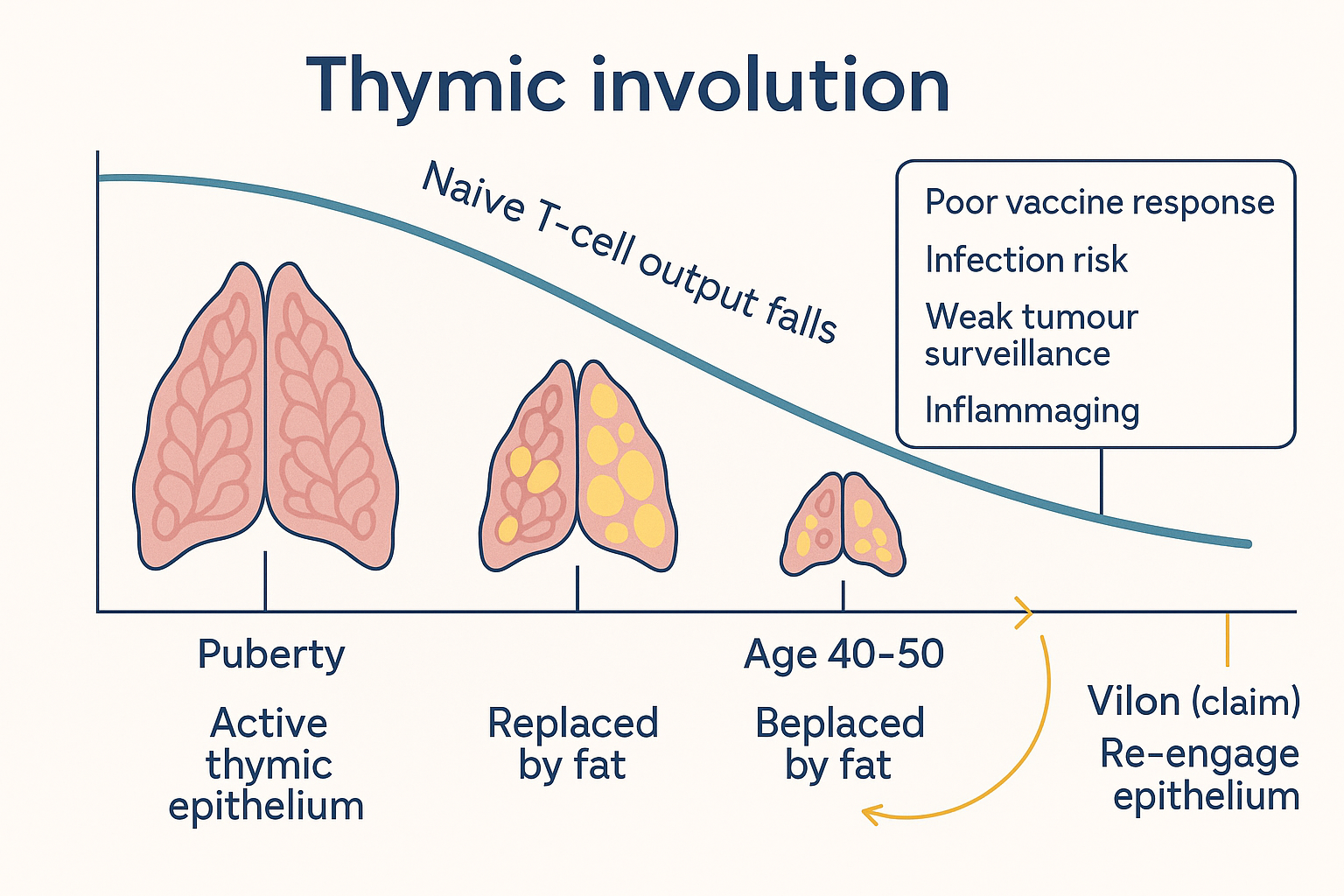 Thymic involution and immunosenescence — the legitimate target. Vilon's claim is to re-engage the aged thymic epithelium; the target is sound, the dipeptide's reach into it is the open question.
Practical Use
No clinical dosing exists; the following is community/Khavinson-protocol practice, presented as such.
| Parameter | Practice |
|---|---|
| Dose | 1–3 mg once daily (community: 1–2 mg capsules) |
| Timing | Morning, empty stomach — the acute "energy/drive" effect makes evening dosing poor for sleep |
| Route | Oral (the dipeptide/PepT1 rationale makes this the practical default) or subcutaneous (cheaper, modestly higher bioavailability) |
| Cycle | Khavinson protocol: 10-day courses every 3–6 months. Community: 10–30 day cycles; some "burst" 10 on / 2 weeks off |
| Tolerance | Reported none — the bioregulator logic is that effects accumulate and persist after cessation (claim, not measured) |
Oral vs injectable. Unlike most peptides this is a real choice rather than a forced one, because the dipeptide is a genuine PepT1 substrate. Oral is the community default. Injectable (subcutaneous) is used for slightly higher systemic exposure; the Russian research used parenteral routes (the rat papers were intraperitoneal). For a thymus/immune/gut target, oral is defensible.
Sourcing. Vilon is sold as a research peptide (and, increasingly, as an oral "bioregulator" capsule — BasedBiohacker trialled a then-unreleased oral formulation, "Protocol RESTORE / VitON"). Not approved for human therapeutic use in any jurisdiction. Quality markers, as for the rest of the class:
- ≥98% purity by HPLC; sequence confirmed by mass spectrometry
- Correct identity: Lys-Glu, ~275 Da
- Lyophilised powder; store cold; reconstituted injectable used within ~2–4 weeks
Safety. Anecdotally very well tolerated; a tiny endogenous-amino-acid dipeptide has low intrinsic toxicity concern. But: no human safety RCT, no long-term data, and two reasoned cautions — (a) the gene-expression/IGF1/TERT angle is the same theoretical telomere/proliferation question raised for Epithalon (relevant if active or recent malignancy), so the same risk-stratification applies; (b) the coagulation effects (antithrombin III, protein C, fibrinolysis) are real-enough to warrant care if you are on anticoagulants or have a bleeding/clotting disorder. "Bioregulators are inherently safe because they only restore baseline" is a marketing claim, not an established pharmacological property.
The Bottom Line
Vilon is a Lys-Glu dipeptide — about the smallest molecule that can credibly be called a peptide drug — pitched as the thymus bioregulator in Khavinson's organ-specific peptide family.
What stands up: - The chemistry of oral absorption is genuinely more defensible than for most peptides (PepT1 transports dipeptides; the "too small to be destroyed" claim has real basis). - The target is legitimate: thymic involution and immunosenescence are real, consequential, and a serious anti-ageing target. - There is some independent, human-cell evidence that these peptides do something measurable — Avolio 2022 (TNF/IL-6 suppression) and Fedoreyeva 2011 (nuclear entry, non-random DNA interaction) are not from the originating clinical group. - The coagulation finding is a real human result.
What does not stand up to the hype: - The organ-specific gene-switch mechanism is a chemically-coherent hypothesis, not an established fact — sequence-specific DNA reading by a dipeptide is, from first principles, a hard claim. - No human RCT, no human PK, no independent replication of the thymus or longevity claims. - The athlete and COVID claims are misattributed or unfalsifiable — the COVID data is Thymalin (extract), not Vilon (dipeptide). - "Never sick once in months" is anecdote layered on a confounded, motivated population.
Net: Vilon is one of the more interesting and slightly better-evidenced research peptides in this space — there is a real molecule, a real target, a coherent absorption story, and a thread of independent data — wrapped in a marketing narrative that runs well ahead of what has actually been shown in humans. If you use it, use it as the low-risk, low-certainty thymus/immune slot of a bioregulator stack (Vilon + Pinealon + Epitalon + BPC-157), eyes open about how much is hypothesis. Do not treat it as a proven immune therapy, and do not credit it with Thymalin's data.
Research Sources
Mechanism — DNA / gene expression: - Short peptides enter nuclei, interact non-randomly with DNA, recognise methylation (Fedoreyeva, Khavinson, Vanyushin, 2011): PMID 22117547 - Vilon up-regulates IGF1 in aged human cells: PMID 32399807 - Kolchina et al., 2019 — spatial models of short-peptide–DNA complexes (KE-type binding) - Khavinson group reviews on short peptides as epigenetic gene regulators (Bulletin Exp Biol Med; SpringerLink "Short Peptides Regulate Gene Expression")
Independent / Western: - Avolio, Martinotti et al., 2022 — five Khavinson peptides incl. Vilon suppress LPS-induced TNF/IL-6 in human THP-1 macrophages: PMC8999041 (IJMS 23:3607)
Systemic effects (Khavinson school, 2006): - Coagulation / DIC in type-1 diabetes — Vilon raises AT-III, protein C, fibrinolysis (Kuznik et al.): PMID 17152731 - Neuroendocrine / sexual function in aged hypogonadal male rats (Kudriavtseva et al.): PMID 17152729 - Intestinal stem cell / epithelial effects: PMID 11427924
Thymalin (parent extract — distinct from Vilon): - Thymalin in severe COVID-19, older patients (Int J Immunol Immunother) and Khavinson elderly-cohort mortality work (Thymalin + Epithalamin, n=266) — read as extract data, not Vilon data
Class overview: see the Pinealon & Epithalon deep dive for the full Khavinson-paradigm calibration.
All community quotes compiled from biohacking Twitter discussions. Educational purposes only. Not medical advice. Vilon is not approved for human therapeutic use in any jurisdiction.