The Autonomic Nervous System: Sympathetic, Parasympathetic, and the Vagus
The wiring that runs your organs without your permission — speeding the heart, calming the gut, switching inflammation on and off. Why a slow exhale lowers your heart rate, why chronic stress wrecks digestion, and how a single nerve lets your brain and body talk to each other.
Why this page exists
The earlier pages described chemical control — hormones drifting through the blood to reach distant organs. That is one of the body's two great control systems. This page covers the other: electrical control, the nervous system's direct, fast wiring to your organs. Where hormones are the slow postal service, nerves are the instant phone line.
This matters for biohacking because it answers a question the metabolism and gut pages kept raising: how exactly does a thought, a stress, or an emotion physically reach the heart, the gut, and the immune system? The answer is the autonomic nervous system (ANS) — and especially one remarkable nerve, the vagus, which turns out to be mostly a sensory cable carrying news from your organs to your brain. Understanding this system explains breathwork, cold plunges, heart-rate-variability training, why stress causes IBS, and the genuinely surprising fact that your nervous system has a direct dial on inflammation.
We start with what the system is.
What the autonomic nervous system is
Your nervous system splits, at the top level, into two functional halves:
- The somatic nervous system — the voluntary part. It carries the signals you consciously command: moving your arm, walking, speaking. You decide, it acts.
- The autonomic nervous system (ANS) — the involuntary part. It runs the functions you never consciously think about: heartbeat, breathing rate, digestion, sweating, pupil size, blood pressure, and — crucially — inflammation. "Autonomic" shares a root with "automatic": it runs itself.
A quick vocabulary primer, because the rest of the page depends on it:
- A neuron is a nerve cell — the basic wire of the nervous system, carrying electrical signals.
- A neurotransmitter is the chemical a neuron releases at its far end to pass its message to the next cell. The two that dominate this page are acetylcholine and noradrenaline (also called norepinephrine).
- A ganglion (plural ganglia) is a relay station — a cluster where one neuron hands its signal to the next. Autonomic signals travel in two neurons in series: a preganglionic neuron from the central nervous system out to the ganglion, then a postganglionic neuron from the ganglion to the target organ. (Which neurotransmitter is used at each step is the key detail that distinguishes the two branches.)
The ANS has two main branches that act in opposition — the sympathetic ("fight or flight") and the parasympathetic ("rest and digest") — plus a third, semi-independent network embedded in the gut wall, the enteric nervous system (introduced here, expanded on the forthcoming Gut-Brain Axis page).
flowchart TD
    NS[Nervous system] --> SOM["Somatic<br/>(voluntary: muscles, movement)"]
    NS --> ANS["Autonomic / ANS<br/>(involuntary: organs)"]
    ANS --> SYMP["Sympathetic<br/>'fight or flight'"]
    ANS --> PARA["Parasympathetic<br/>'rest and digest'"]
    ANS --> ENT["Enteric<br/>'the gut's own brain'"]
The sympathetic branch: "fight or flight"
The sympathetic nervous system is the body's accelerator — the emergency-mobilisation system. When you face a threat (real or merely stressful), it floods the body into a state built for fighting or fleeing.
The wiring. Sympathetic nerves exit the spinal cord from its middle region (the chest and upper-back segments — anatomically the thoracolumbar outflow). The two-neuron relay works like this: the preganglionic neuron releases acetylcholine at the ganglion, and then the postganglionic neuron releases noradrenaline onto the target organ. Noradrenaline is the signature sympathetic neurotransmitter at the organs.
There is also a hormonal arm that makes the response body-wide. The sympathetic system connects to the adrenal medulla (the core of the adrenal glands), and when activated, the adrenal medulla dumps adrenaline (epinephrine) directly into the bloodstream. This is why a fright produces a whole-body surge in seconds — the nerve signal is amplified into a circulating hormone that reaches every organ at once. (This is the fast, seconds-scale cousin of the slower cortisol/HPA stress response from the metabolism page — adrenaline is the spike, cortisol is the sustained follow-through.)
The effects, organ by organ, all serving "mobilise to survive a threat":
- Heart — beats faster and harder (more blood to muscles).
- Lungs — airways widen (bronchodilation) to take in more oxygen.
- Pupils — dilate (widen) to let in more light and sharpen distance vision.
- Digestion — shut down. Blood is diverted away from the gut (you don't digest lunch while running from a predator). This single fact explains why stress causes digestive misery.
- Blood — redirected to the large muscles; the liver releases glucose for fuel.
- Sweat glands — activate.
The sympathetic state is, in one line: spend energy now, deal with the threat, postpone everything non-urgent (digestion, repair, reproduction).
The parasympathetic branch: "rest and digest"
The parasympathetic nervous system is the brake and the recovery system — the opposite of the sympathetic in nearly every effect. It dominates when you are safe, calm, and well-fed, running the maintenance, digestion, and repair functions that the sympathetic state postpones.
The wiring. Parasympathetic nerves exit at the top and bottom of the central nervous system — from the brainstem and the very base of the spine (the craniosacral outflow). The distinguishing chemical fact: both neurons in the relay — preganglionic and postganglionic — release acetylcholine. So the parasympathetic system is, throughout, a cholinergic system (acetylcholine-driven). This is why acetylcholine and its precursors are relevant to "calm, rest-and-digest" states, and why the chemistry of this branch is entirely different from the noradrenaline-driven sympathetic one.
The effects, mirror-images of the sympathetic:
- Heart — slows down.
- Lungs — airways return to normal.
- Pupils — constrict (narrow).
- Digestion — switched on: stomach acid and enzyme secretion, peristalsis (the muscular waves that move food along, from the digestion page), and blood flow to the gut all increase.
- Body — shifts into repair, storage, and recovery.
The parasympathetic state, in one line: conserve and restore — digest, repair, recover, build.
How the two branches interact: tone, not a switch
A common misconception is that you are either in fight-or-flight or in rest-and-digest, flipping between them. The reality is more like a mixing desk than a light switch. Most organs receive input from both branches simultaneously, and their state is set by the balance between the two — what is called autonomic tone.
At every moment your heart, for instance, is receiving both a sympathetic "speed up" signal and a parasympathetic "slow down" signal, and its actual rate is the net result. Shift the balance toward sympathetic and the heart speeds; shift it toward parasympathetic and it slows. Health is not "always parasympathetic" — you need sympathetic activation to get out of bed, exercise, and focus. Health is flexibility: the ability to ramp up sympathetic tone when genuinely needed and then return cleanly to parasympathetic dominance for recovery. The modern problem is getting stuck in chronic low-grade sympathetic activation (chronic stress) and losing the ability to drop back into recovery — exactly the autonomic version of the stuck-loop theme from the metabolism page.
| Organ | Sympathetic ("fight/flight") | Parasympathetic ("rest/digest") |
|---|---|---|
| Heart rate | ↑ faster | ↓ slower |
| Airways | widen | normal/narrow |
| Pupils | dilate | constrict |
| Digestion | suppressed | stimulated |
| Blood flow | to muscles | to gut |
| Dominant chemical | noradrenaline | acetylcholine |
| Overall state | spend / mobilise | conserve / restore |
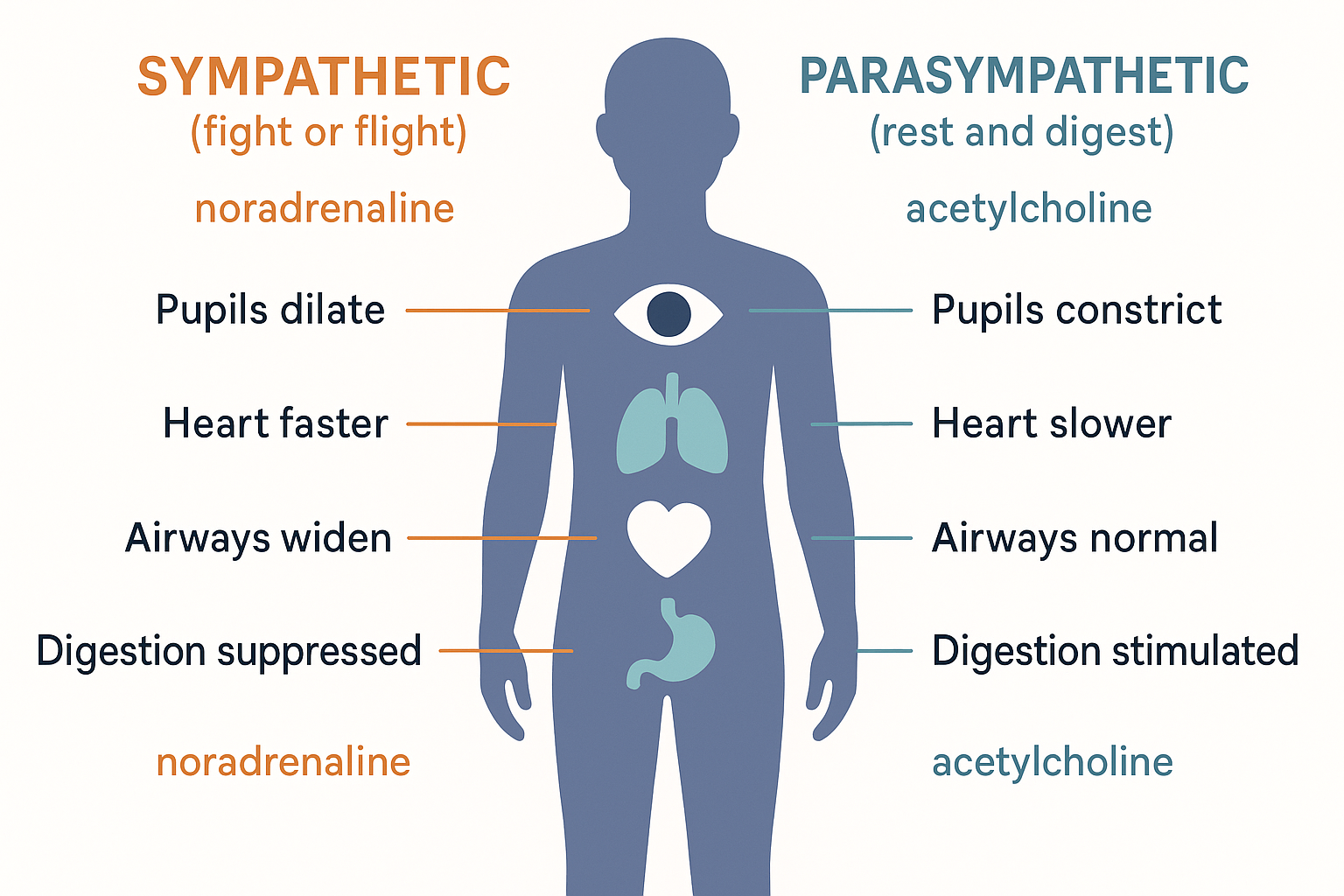 The two branches act on the same organs in opposite directions — your organ state at any moment is the balance between them.
This balance is measurable, and the main way we read it is through the vagus nerve — which we turn to now.
The vagus nerve: the body's master parasympathetic cable
If the parasympathetic system has a headquarters, it is the vagus nerve. "Vagus" means "wandering" in Latin, and the name fits: it is the longest nerve of the ANS, wandering from the brainstem down through the neck and chest into the abdomen, branching to touch nearly every internal organ — the heart, lungs, oesophagus, stomach, liver, pancreas, small intestine, and upper colon. It is formally the tenth cranial nerve, abbreviated CN X.
The vagus carries roughly 75% of all parasympathetic fibres — so when people talk about "activating the parasympathetic system," they are very largely talking about the vagus. It originates in the brainstem (the base of the brain, from a region called the dorsal motor nucleus, with sensory signals arriving at a region called the nucleus tractus solitarius — hold that name, it matters for breathwork).
Now the genuinely surprising fact, the one that reframes everything: the vagus is roughly 80% afferent. "Afferent" means carrying signals toward the brain (as opposed to efferent, away from the brain to the organs). So only about a fifth of the vagus is the brain telling organs what to do. The other four-fifths is the organs telling the brain what is happening — reporting on gut state, heart state, inflammation, fullness, and more.
This means the vagus is, primarily, a sensory cable — a vast information feed from your viscera to your brain. Your brain is constantly being briefed on the internal state of your body through this nerve, and that flow of "how are things down there" information shapes mood, anxiety, appetite, and the sense of calm or unease far more than most people realise. (This is the anatomical backbone of the gut-brain axis, the next foundations page.)
flowchart LR
subgraph BRAIN[Brainstem]
NTS["Nucleus tractus solitarius<br/>(receives sensory input)"]
DMN["Dorsal motor nucleus<br/>(sends commands)"]
end
ORGANS["Heart · Lungs · Stomach<br/>Liver · Pancreas · Gut"]
ORGANS ==>|"~80% AFFERENT<br/>(organs report to brain)"| NTS
DMN -->|"~20% efferent<br/>(brain calms organs)"| ORGANS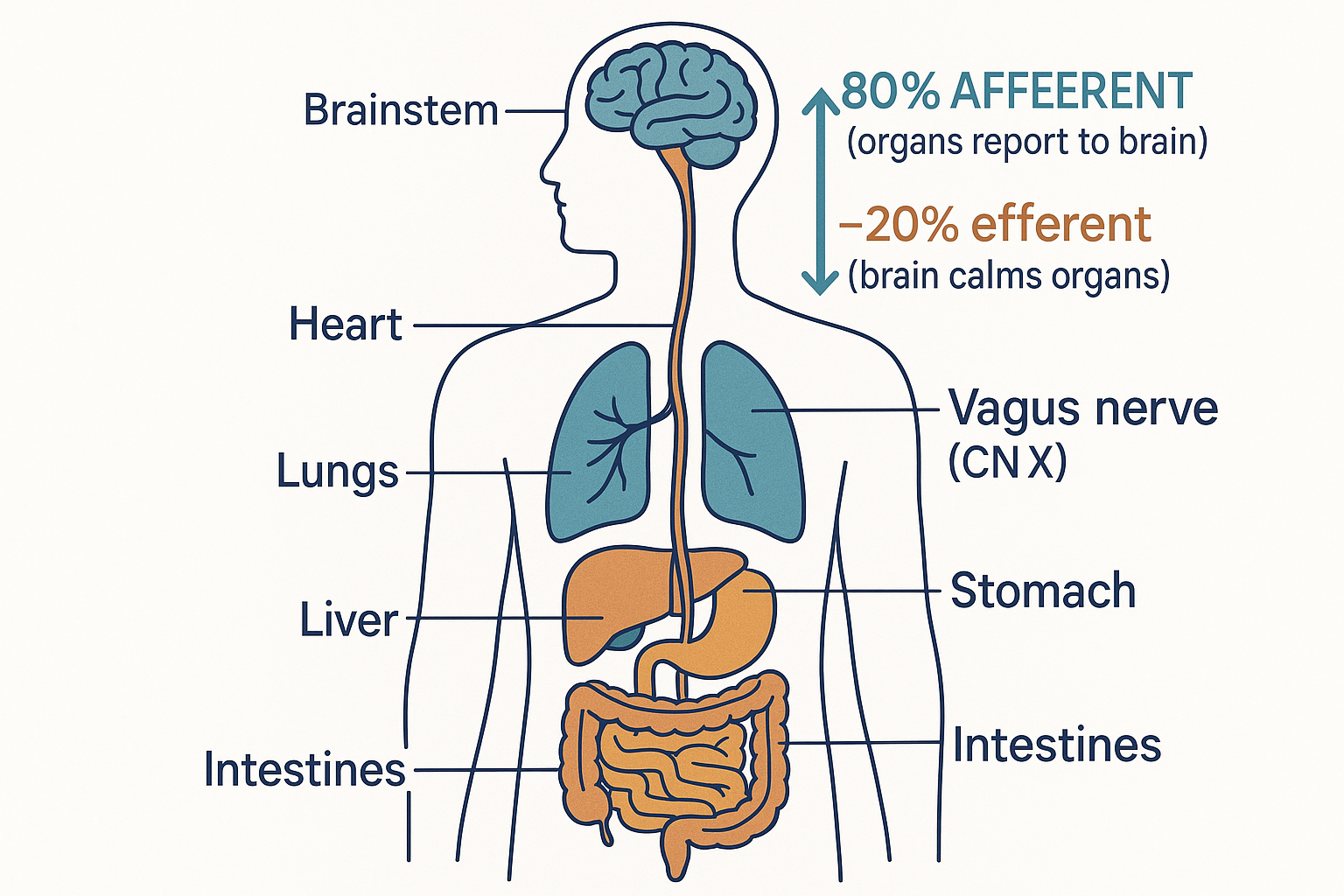 The vagus wanders to nearly every internal organ — but the surprising fact is that it is mostly a sensory cable, ~80% afferent, listening to your organs more than commanding them.
Vagal tone: the measurable dial of recovery
Vagal tone is the resting level of vagus-nerve activity — essentially, how strong your "rest and digest" signal is at baseline. It is one of the most useful single concepts in this whole area because it is measurable and it predicts a great deal.
The main way to measure it is heart rate variability (HRV) — the tiny beat-to-beat variation in the timing of your heartbeats. This sounds backwards but is profound: a healthy heart under strong vagal (parasympathetic) influence does not tick like a metronome; it speeds and slows slightly with each breath and moment. High variability = high vagal tone = good. A rigidly regular heartbeat signals low vagal tone and sympathetic dominance. This is why wearables track HRV as a recovery and stress metric — they are, in effect, measuring your vagal tone.
What high vagal tone is associated with:
- Better HRV and cardiovascular resilience.
- A stronger anti-inflammatory state (via the reflex described next).
- Better gut motility and digestion.
- Lower baseline cortisol and better stress recovery.
- Better emotional regulation and lower anxiety.
What low vagal tone is associated with: chronic inflammation, anxiety, poor digestion, worse stress recovery — a cluster that should look familiar, because it overlaps heavily with the metabolic stuck-loop. Low vagal tone is, in many ways, the nervous-system face of the same chronic-stress dysfunction.
The cholinergic anti-inflammatory reflex: a nerve that controls inflammation
This is the most important and least intuitive thing on the page, and it is worth slowing down for. Your vagus nerve can directly switch off inflammation. Not via hormones, not slowly — directly, neurally, in real time. The pathway is called the cholinergic anti-inflammatory reflex (cholinergic = acetylcholine-driven), and it works as a complete sensing-and-response loop:
- Sensing (afferent). When inflammation rises somewhere in the body, it releases inflammatory messenger molecules — cytokines like IL-1β and TNF-α (the same TNF-α from the gut endotoxin page). The vagus's sensory fibres detect these and carry the alarm up to the brainstem.
- Processing. The brainstem registers "inflammation is rising" and fires a response back down the efferent (motor) vagal fibres.
- Response (efferent). The signal travels to the spleen (a major hub of immune cells), via a relay. There, the signal ultimately causes the release of acetylcholine onto the immune cells called macrophages (the cells that produce inflammatory cytokines).
- The brake. The acetylcholine binds a specific receptor on the macrophages — the alpha-7 nicotinic acetylcholine receptor (α7nAChR) — and this binding tells the macrophage to stop producing TNF-α. Inflammation is dialled down.
So the body has a neural thermostat for inflammation: the vagus senses the inflammatory temperature and, when it climbs, actively turns it down. This is why high vagal tone is anti-inflammatory and low vagal tone permits chronic inflammation — the brake is either working well or working weakly.
This also explains an otherwise odd pharmacological fact: nicotine is anti-inflammatory in some contexts, because it activates that same α7 nicotinic receptor on macrophages — it pharmacologically mimics the vagal brake. (This is a mechanism, not an endorsement — see nicotine.) It is also why vagus nerve stimulation is being seriously investigated as a treatment for inflammatory diseases like rheumatoid arthritis.
flowchart TD
INFLAM["Inflammation rises<br/>(TNF-α, IL-1β cytokines)"] -->|afferent vagus senses| BRAIN[Brainstem]
BRAIN -->|efferent vagus responds| SPLEEN[Spleen]
SPLEEN -->|releases acetylcholine| MAC["Macrophages<br/>(α7 nicotinic receptor)"]
MAC -->|"ACh tells them to stop"| STOP["↓ TNF-α production<br/>= inflammation dialled down"]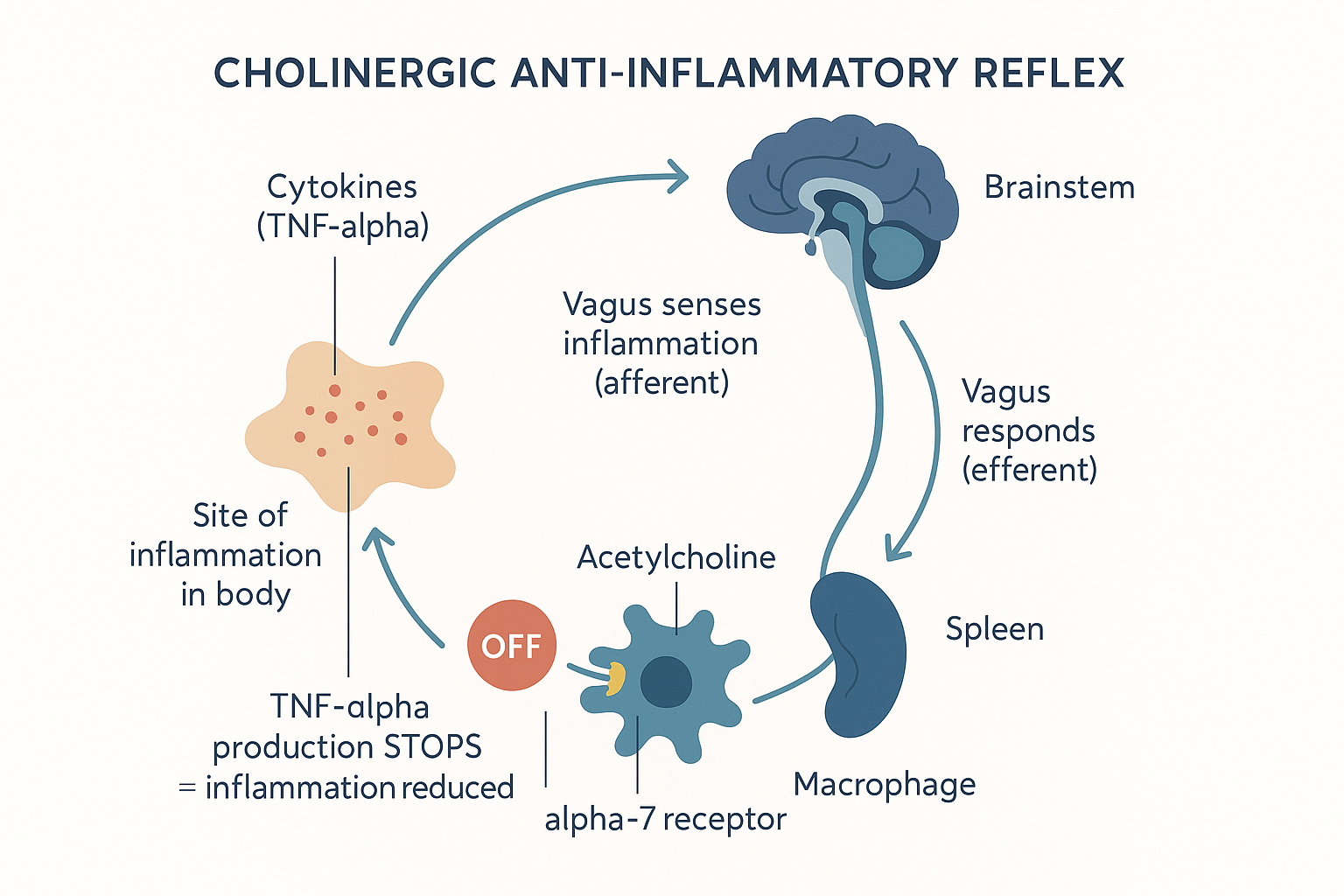 A neural thermostat for inflammation: the vagus senses rising cytokines and, via the spleen and acetylcholine, directly tells macrophages to stop producing them.
How to activate the vagus (and why it works)
Because vagal tone is trainable and beneficial, a whole set of practices aim to raise it. They split into electrical (clinical vagus-nerve stimulation devices, and transcutaneous stimulation of the vagus's skin branch in the ear) and — more relevant here — non-electrical, behavioural methods. The notable ones, and their mechanisms:
- Slow breathing, especially a long exhale. This is the most reliable. The vagus controls heart rate breath-by-breath: it is more active during exhalation (slowing the heart) and eases during inhalation. So deliberately lengthening the exhale directly increases vagal output and shifts you toward parasympathetic dominance. Slow breathing at around six breaths per minute maximises this effect. Mechanistically, the slow rhythmic stretch and the long exhale feed afferent signals to the nucleus tractus solitarius in the brainstem, which increases efferent vagal tone — a self-reinforcing calming loop you can consciously trigger. This is the physiological reason "take a deep breath" actually works.
- Cold exposure (cold water on the face or a cold plunge). Cold on the face triggers the diving reflex, a hard-wired vagal response that slows the heart — a direct parasympathetic activation.
- Humming, singing, chanting, gargling. The vagus branches innervate the throat and vocal apparatus, so vibration and activation there stimulate it.
- Meditation and slow, relaxed states. Sustained practice raises resting vagal tone over time (see meditation).
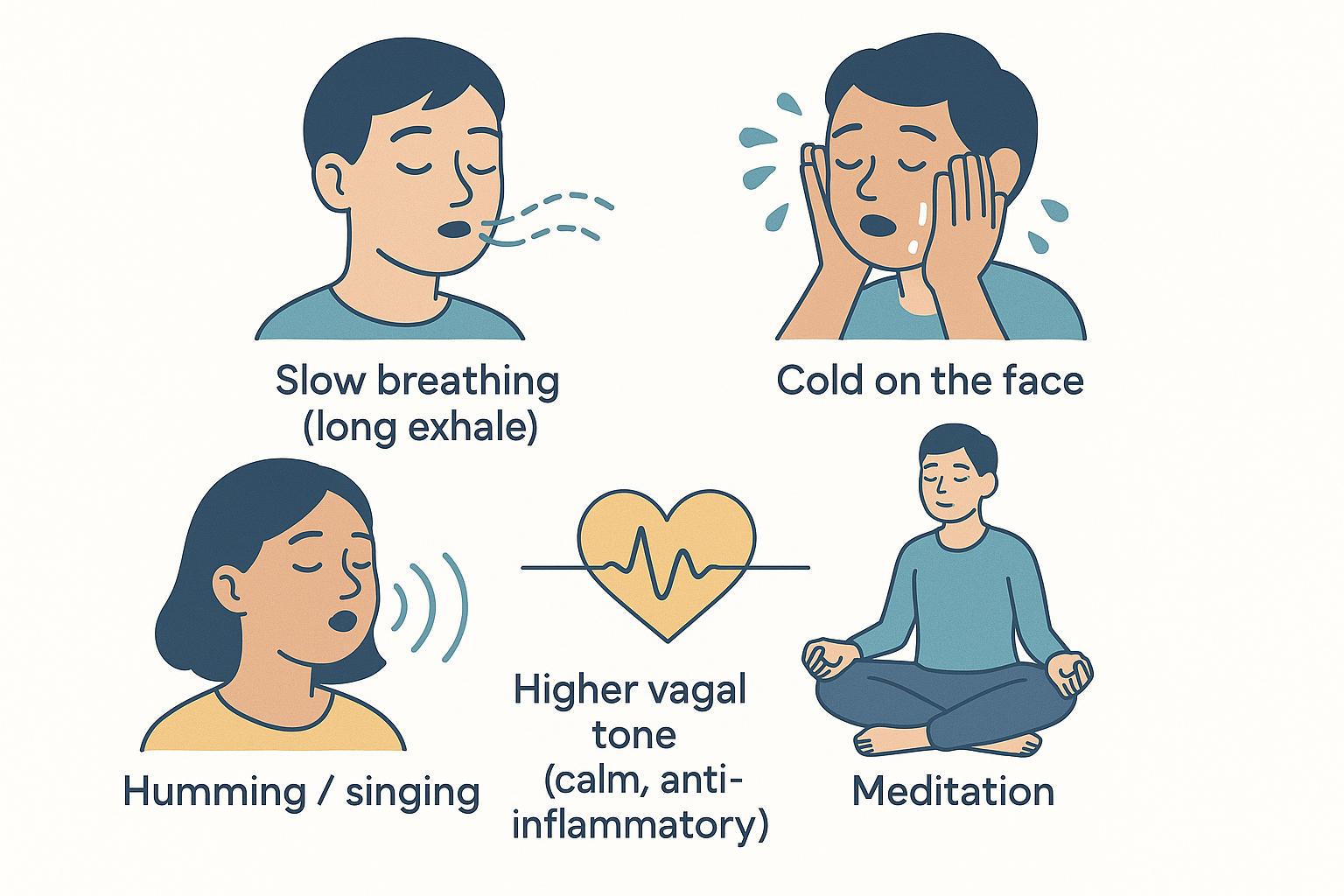 The accessible doors into the "involuntary" system: breath, face, throat, and sustained calm — each one a way to consciously raise vagal tone.
The common thread: most of these either drive afferent signals into the brainstem that increase efferent vagal output, or directly trigger a reflex that the vagus mediates. They are ways of consciously reaching into an "involuntary" system through the few doors — breath, face, throat — where it is accessible to deliberate control.
The CNS connection: why thoughts reach the organs
The final piece answers the deepest question: how do stress, anxiety, and emotion — events in the mind — physically change the heart, gut, and immune system? Through the ANS's connections up into the brain.
Three brain regions are the key controllers:
- The hypothalamus is the master integrator. It sits at the crossroads of all three control systems — autonomic (this page), endocrine (the HPA and HPT axes from the metabolism page), and behavioural — and coordinates them together. When the hypothalamus mounts a stress response, it simultaneously drives sympathetic activation, the cortisol axis, and behaviour. This is why stress is never just psychological — the same hub that registers it also fires the nerves and hormones.
- The amygdala is the threat detector. When it perceives danger (including purely psychological or social threat), it drives sympathetic activation — pushing the whole system toward fight-or-flight. An overactive amygdala (anxiety, trauma, chronic stress) keeps the sympathetic accelerator pressed.
- The prefrontal cortex is the top-down regulator. This is the thinking, reasoning front of the brain, and it can modulate vagal tone and inhibit the amygdala — calming the system through reappraisal, focus, and deliberate regulation. Strong prefrontal control over the amygdala is, in large part, what "emotional regulation" physically is.
flowchart TD
    THREAT[Perceived threat / stress] --> AMY[Amygdala<br/>threat detector]
    PFC[Prefrontal cortex<br/>top-down regulator] -.->|inhibits| AMY
    PFC -.->|raises| VAGUS
    AMY --> HYP[Hypothalamus<br/>master integrator]
    HYP --> SYMP[↑ Sympathetic<br/>+ cortisol axis]
    HYP --> VAGUS[Vagal tone]
    SYMP --> ORG["Fast heart · shut-down gut ·<br/>↓ anti-inflammatory brake"]
    VAGUS --> CALM["Slow heart · digestion ·<br/>inflammation braked"]
Put together, this closes the loop with everything before it: a perceived threat (amygdala) drives sympathetic activation and suppresses vagal tone; that shifts the body toward a fast heart, shut-down digestion, and reduced anti-inflammatory braking — so inflammation rises. Sustained, this is chronic sympathetic dominance with low vagal tone, which feeds directly into the gut (impaired barrier and motility), the inflammatory state (no vagal brake), and the metabolic stuck-loop (cortisol, insulin resistance). And the reverse is equally true: deliberately engaging the prefrontal cortex and the breath can raise vagal tone and pull the whole system back toward calm, digestion, and anti-inflammatory balance. The "involuntary" system has a few voluntary doors, and that is the entire basis of mind-body practice.
Putting it all together
- The ANS is the nervous system's involuntary control of organs, split into the sympathetic ("fight or flight," noradrenaline-driven, mobilise and spend) and the parasympathetic ("rest and digest," acetylcholine-driven, conserve and repair), plus the gut's own enteric network.
- Most organs get both inputs, and their state is the balance (autonomic tone) — health is flexibility, not permanent calm; the modern failure mode is getting stuck in chronic sympathetic activation.
- The vagus nerve is the master parasympathetic cable (~75% of parasympathetic fibres) — and is mostly (~80%) afferent, a sensory feed reporting organ state to the brain rather than commanding it.
- Vagal tone, measurable via heart rate variability, predicts inflammation, digestion, stress recovery, and emotional regulation — high is good, low tracks the chronic-stress cluster.
- The cholinergic anti-inflammatory reflex lets the vagus directly switch off inflammation (sensing cytokines → spleen → acetylcholine → α7 receptor → ↓ TNF-α) — a neural thermostat on the immune system.
- The vagus is trainable through the few accessible doors — slow breathing with a long exhale, cold on the face, humming, meditation — all of which raise vagal output.
- The brain reaches the organs via the hypothalamus (integrator), amygdala (threat → sympathetic), and prefrontal cortex (top-down calm) — which is precisely how stress and emotion physically alter heart, gut, and inflammation, and how mind-body practices push back.
The unifying idea: the autonomic nervous system is the fast, electrical bridge between your mental state and your physical organs — and the vagus is mostly listening, not commanding. Most of biohacking's "nervous system regulation" toolkit comes down to deliberately shifting autonomic tone toward parasympathetic recovery and raising the vagal brake on inflammation.
Related Compounds & Deep Dives
Parasympathetic / acetylcholine system
- Acetylcholine — the neurotransmitter of the entire parasympathetic branch and the cholinergic anti-inflammatory reflex.
- Choline and citicoline — precursors the body uses to build acetylcholine.
- Nicotine — activates the α7 nicotinic receptor on macrophages, pharmacologically mimicking the vagal anti-inflammatory brake (mechanism, not endorsement).
Calming / parasympathetic-shifting
- L-theanine — promotes a calm, alpha-wave state and shifts autonomic balance toward parasympathetic.
- Magnesium — calms sympathetic over-activation and supports HPA regulation (see the Magnesium deep dive).
- Glycine and taurine — inhibitory, calming amino acids.
- Oxytocin — promotes vagal, parasympathetic, "safe and social" states.
- CBD, phenibut — anxiolytics that shift autonomic balance (phenibut via GABA-B; use-cautions apply).
Sympathetic / stress side
- Caffeine — raises sympathetic tone and alertness (see the cognition page).
- Cortisol — the slower hormonal arm of the stress response that accompanies sympathetic activation.
Practices
- Meditation — raises resting vagal tone over time.
Related foundations
- Systemic Metabolism — the HPA/cortisol axis that runs alongside sympathetic activation, and the stuck-loop low vagal tone feeds.
- Gut Microbiome — the inflammation the vagal reflex brakes, and the gut the parasympathetic system runs.
- Gut-Brain Axis (forthcoming) — the afferent vagus and enteric nervous system in depth.