The Gut-Brain Axis
The gut and the brain are wired together by a real nerve, a real chemistry, and a real population of microbes — not a metaphor. How 500 million neurons in your gut wall, 90% of your body's serotonin, and your bacteria's metabolism of a single amino acid shape mood, anxiety, and cognition.
Why this page exists
"Gut feeling," "the second brain," "trust your gut" — the gut-brain connection has become a wellness cliché, which is a shame, because the underlying biology is concrete, mechanistic, and genuinely important. This page strips away the metaphor and shows the actual wiring.
It is also the capstone of the foundations series. It draws together three earlier pages: the autonomic nervous system (the vagus nerve, mostly afferent — listening to the gut), the gut microbiome (the bacteria, their SCFAs, and the LPS endotoxin), and the neuroscience of cognition (serotonin, the NMDA receptor, neuroinflammation). The gut-brain axis is where all three meet. By the end you should understand, mechanistically, why a disturbed gut can produce anxiety and low mood, why certain probiotics measurably affect the brain, and why gut inflammation and depression travel together.
We start with the surprising hardware: your gut has its own brain.
The enteric nervous system: the second brain is literally real
Embedded in the wall of your gut, running its entire length, is a nervous system so large and so independent that it is genuinely called the "second brain" — and this is a structural fact, not a figure of speech. It is the enteric nervous system (ENS), and it contains roughly 500 million neurons — more than the spinal cord, comparable to the brain of a small mammal.
The ENS is organised into two layers of interconnected nerve networks (a network of neurons is called a plexus):
- The myenteric plexus — sits between the muscle layers of the gut wall and controls motility: the peristaltic waves (from the digestion page) that move food along.
- The submucosal plexus — sits closer to the inner lining and controls secretion (enzymes, fluid) and local blood flow.
flowchart TD
ENS["Enteric nervous system<br/>~500 million neurons"] --> MYE["Myenteric plexus<br/>(between muscle layers)<br/>→ controls MOTILITY / peristalsis"]
ENS --> SUB["Submucosal plexus<br/>(near the lining)<br/>→ controls SECRETION + blood flow"]
ENS -. "can run digestion<br/>with NO brain input" .-> AUTO[Autonomous]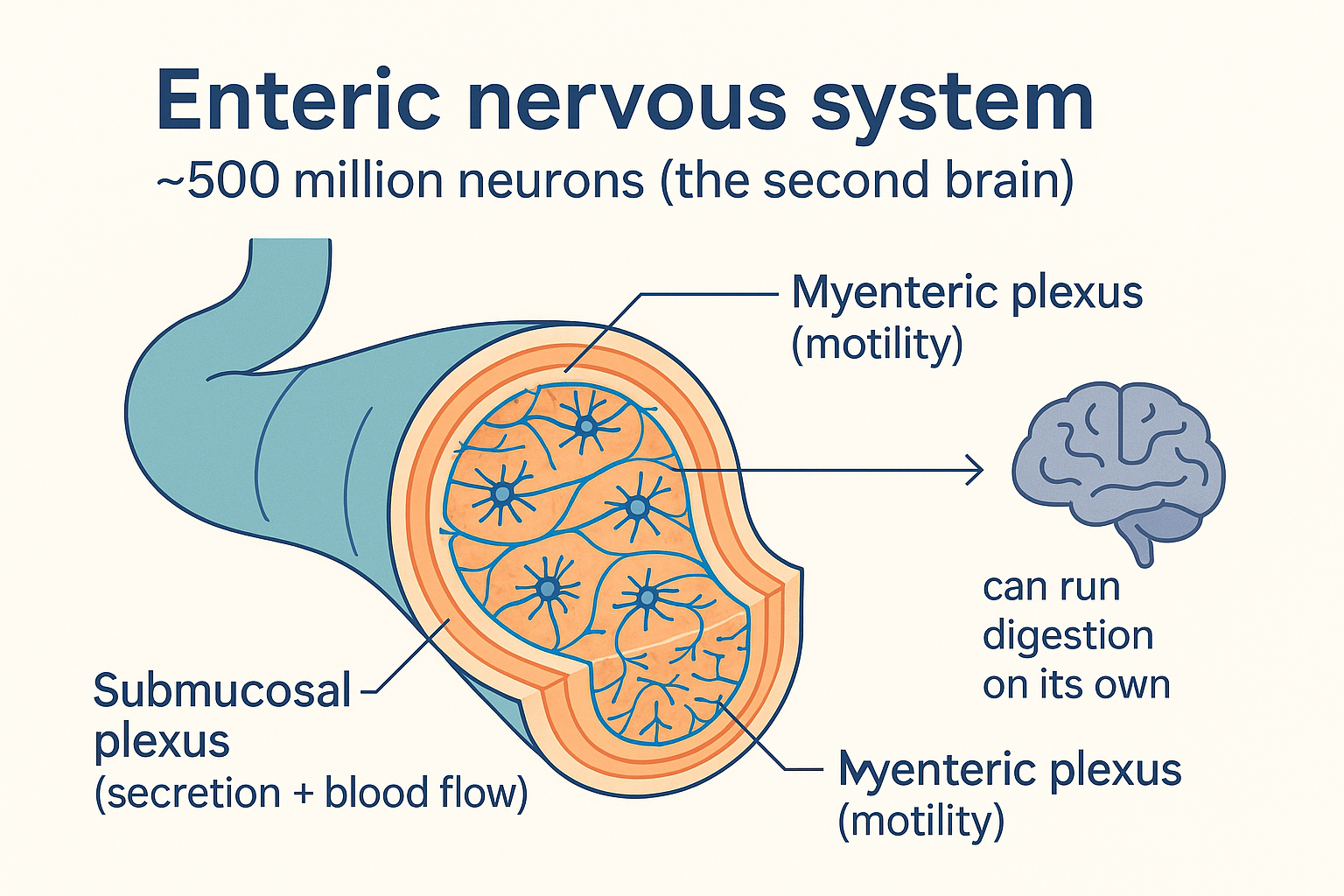 The second brain is literal: ~500 million neurons woven through the gut wall in two plexuses, able to run digestion entirely on their own.
The remarkable thing about the ENS is its autonomy. Unlike every other organ's nerves, the ENS can operate without any input from the brain at all. If you severed every connection between the gut and the central nervous system, the gut would still coordinate digestion — sensing its contents, contracting in sequence, moving food along. No other organ has this. The heart has automaticity but no decision-making network; only the gut carries a full, independent nervous system capable of running itself. This is why "second brain" is accurate: it is a real, autonomous neural computer in your abdomen.
But of course it does not work in isolation — it is in constant dialogue with the brain, and the nature of that dialogue is the rest of this page.
What the gut's neurons actually do — and how they talk to the brain
The ENS's local jobs are: coordinate peristalsis, regulate secretion and blood flow, and — crucially for this page — sense the contents of the gut. Specialised sensor cells in the gut lining, the enterochromaffin cells (and related enteroendocrine cells), constantly sample what is in the lumen — nutrients, bacterial metabolites, irritants, toxins — and convert that information into chemical and electrical signals.
Those signals then travel to the brain primarily up the vagus nerve. Recall the pivotal fact from the ANS page: the vagus is about 80% afferent — mostly carrying information from the body to the brain. The gut is one of its biggest information sources. So your brain is receiving a continuous, high-bandwidth feed about the state of your gut: what you have eaten, how digestion is going, whether there is inflammation, and — as we will see — what your bacteria are producing. This sensory feed shapes mood and behaviour far below the level of conscious awareness. The "gut feeling" is, mechanistically, this afferent vagal stream reaching brain regions that influence emotion.
Serotonin: 90% of it is in your gut
Here is the fact that reframes everything people think they know about serotonin. Serotonin is famous as the brain's "happiness/mood" neurotransmitter and the target of antidepressants (SSRIs). But roughly 90–95% of your body's serotonin is not in your brain at all — it is in your gut, manufactured by those enterochromaffin cells.
What is gut serotonin doing? Locally, it is a key regulator of the ENS — it drives peristalsis. Too much gut serotonin speeds the gut (a cause of diarrhoea and nausea — which is why drugs that block one serotonin receptor are used for both); too little slows it (constipation). It also feeds into the vagal signals going to the brain.
But here is the crucial nuance, and a correction to a widespread misconception: gut serotonin does not cross the blood-brain barrier. It is a separate pool from the serotonin in your brain. You cannot simply "raise brain serotonin" by making more gut serotonin — the two are physically partitioned. So the gut does not influence mood by shipping serotonin to the brain. Its influence is more indirect and more interesting: through the vagal signals, through inflammation, and — most importantly — through what it does with the raw material serotonin is made from. That raw material is the key to the whole gut-brain chemistry, and it is where we turn next.
The tryptophan fork: the master mechanism
This is the most important mechanism on the page, and it explains the deep link between gut inflammation and mood disorders. It centres on a single amino acid: tryptophan.
Tryptophan (from dietary protein) is the raw material for serotonin. But it sits at a fork in the road — it can be sent down one of two very different pathways, and the body's choice between them has enormous consequences:
- Route 1 — the serotonin path. Tryptophan → 5-HTP → serotonin → (at night) melatonin. This is the "good" path, producing the mood neurotransmitter and the sleep hormone.
- Route 2 — the kynurenine path. Tryptophan → kynurenine → and then onward to one of two further products. This path is controlled by an enzyme called IDO1, and here is the critical part: IDO1 is switched on by inflammation — specifically by the inflammatory signals (interferon-γ, TNF-α, LPS) that come from a leaky, dysbiotic gut (the gut microbiome page).
So when the gut is inflamed, IDO1 activates and diverts tryptophan away from serotonin and into the kynurenine pathway. This has a double cost, because of what kynurenine becomes. The kynurenine pathway forks again into two products with opposite effects on the brain:
- Quinolinic acid — an excitotoxic molecule. It is an NMDA receptor agonist — it over-activates the very glutamate receptor that the magnesium deep dive and cognition page described. Too much quinolinic acid over-excites and damages neurons (excitotoxicity), and is implicated in depression and neurodegeneration.
- Kynurenic acid — the opposite: an NMDA receptor antagonist, broadly neuroprotective.
Inflammation tends to push toward the quinolinic acid (harmful) branch. So chronic gut inflammation does something quietly devastating to brain chemistry — two hits at once:
- It depletes serotonin (tryptophan is being stolen for the kynurenine path), lowering mood and, downstream, melatonin/sleep.
- It increases excitotoxic quinolinic acid, over-stimulating NMDA receptors and damaging neurons.
flowchart TD
TRP[Tryptophan<br/>from diet] --> FORK{Which path?}
FORK -->|"normal"| SERO["Serotonin → Melatonin<br/>(mood, sleep)"]
FORK -->|"IDO1 — switched on<br/>by gut inflammation"| KYN[Kynurenine]
KYN --> QUIN["Quinolinic acid<br/>NMDA agonist — EXCITOTOXIC<br/>(linked to depression)"]
KYN --> KYNA["Kynurenic acid<br/>NMDA antagonist<br/>(neuroprotective)"]
INFLAM[Gut inflammation / LPS] -. drives .-> KYN
INFLAM -. pushes toward .-> QUIN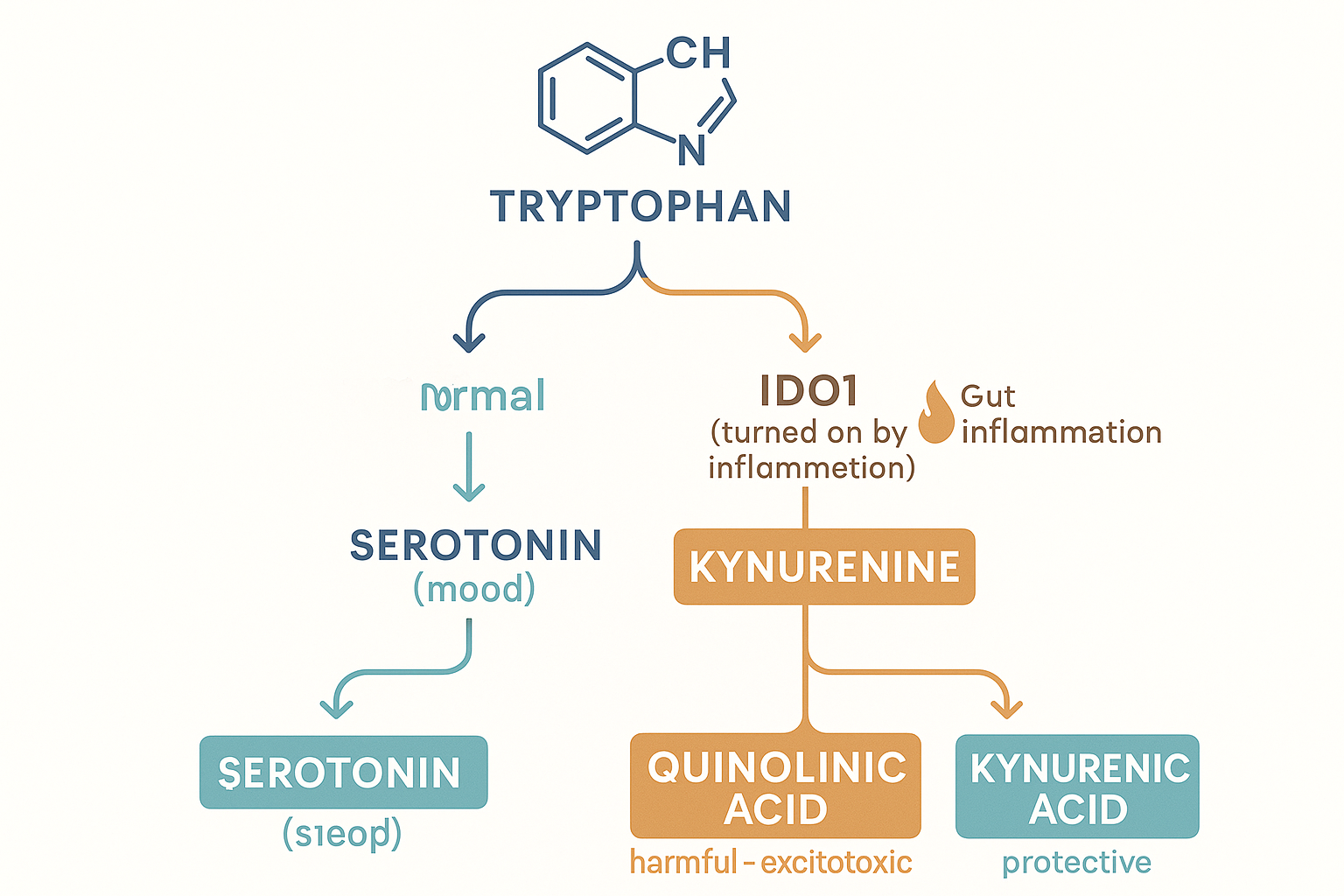 The fork that links gut inflammation to mood: inflammation flips IDO1 on, stealing tryptophan from the serotonin/melatonin path and routing it toward kynurenine — and, under inflammation, toward the excitotoxic quinolinic-acid branch rather than the protective kynurenic-acid one.
This single mechanism — inflammation diverting tryptophan from serotonin to excitotoxic kynurenine — is one of the most compelling biological explanations for why chronic inflammation (very often gut-derived) is so tightly linked to depression and anxiety. It is not "low serotonin" in the simplistic sense; it is the gut, via inflammation, hijacking the chemistry of an entire amino acid.
The four routes from gut to brain
The tryptophan fork is the deepest mechanism, but it is one of four distinct channels through which the gut microbiome reaches the brain. Putting them together:
- The vagal nerve route. Bacteria and their metabolites activate the gut's sensor cells (enterochromaffin/enteroendocrine), which signal up the afferent vagus to the brainstem — the fast, direct neural channel.
- The SCFA route. The short-chain fatty acids from fibre fermentation (the gut microbiome page) — especially butyrate and propionate — are small enough to cross the blood-brain barrier, where they have direct effects: they support the barrier's integrity, nourish the brain's own immune cells, and influence gene expression in neurons. Healthy SCFA production is broadly neuroprotective and anti-inflammatory in the brain.
- The immune/endotoxin route. LPS endotoxin from a leaky gut enters the blood, drives systemic inflammation, and — when the blood-brain barrier is itself inflamed or weakened — reaches the brain, where it activates the brain's resident immune cells, the microglia (covered below).
- The metabolite route. Bacteria directly produce or modulate neuroactive molecules — including the tryptophan/kynurenine handling above, and neurotransmitters like GABA (below).
flowchart TD
GUT[Gut microbiome] -->|"1. Vagus nerve<br/>(afferent signals)"| BRAIN[Brain]
GUT -->|"2. SCFAs<br/>(cross BBB, neuroprotective)"| BRAIN
GUT -->|"3. LPS endotoxin<br/>(inflammation → microglia)"| BRAIN
GUT -->|"4. Metabolites<br/>(tryptophan/kynurenine, GABA)"| BRAIN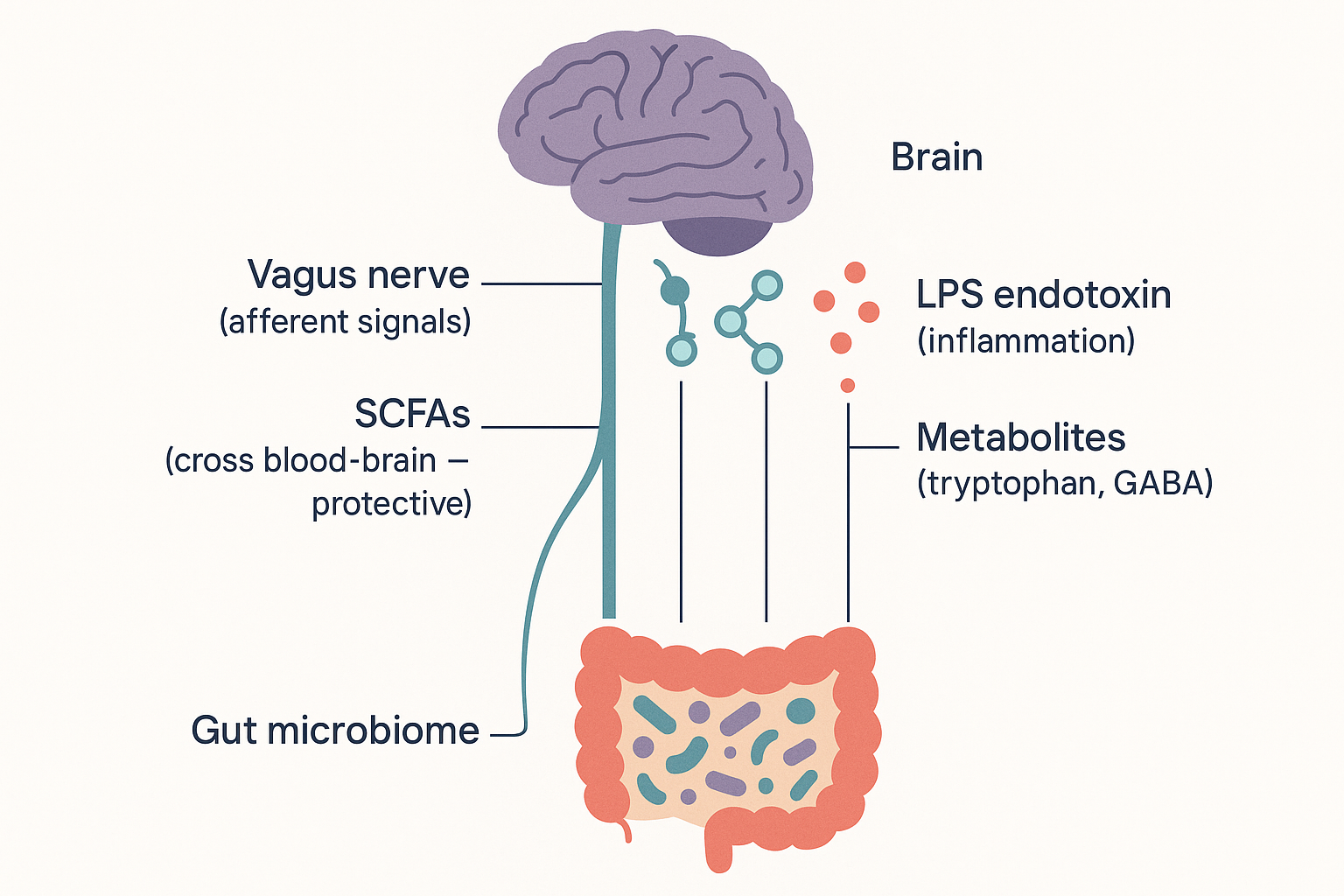 Four parallel channels carry the gut's influence upward — one neural (vagus), one protective (SCFAs), one inflammatory (LPS), and one chemical (metabolites).
Gut bacteria make neurotransmitters: the GABA example
It sounds far-fetched that your bacteria could manufacture brain chemicals, but several do. The clearest example is GABA — the brain's main inhibitory (calming) neurotransmitter, the one targeted by anti-anxiety drugs. Certain strains of Lactobacillus (notably Lactobacillus rhamnosus) and Bifidobacterium produce GABA directly in the gut.
The landmark demonstration: in a well-known study, mice fed Lactobacillus rhamnosus showed reduced anxiety- and depression-like behaviour and altered GABA receptor expression in the brain — and cutting the vagus nerve abolished the effect entirely. That last detail is the key: it proved the bacteria were influencing the brain through the vagus nerve (route 1 above), not by some vague mechanism. This is the kind of hard evidence that turned "gut-brain axis" from speculation into established neuroscience, and it is the basis of the term "psychobiotics" — probiotics with a measurable effect on mood and cognition.
Gut permeability and neuroinflammation: when the brain catches the gut's fire
The final mechanism connects leaky gut directly to brain inflammation. The brain has its own immune cells, the microglia — normally quiet caretakers that prune synapses and clear debris. But when LPS endotoxin from a leaky gut produces chronic systemic inflammation, and especially when the blood-brain barrier (the brain's own protective wall, analogous to the gut barrier) becomes inflamed and leaky in turn, that inflammatory signal reaches the brain and activates the microglia.
Activated microglia shift from caretaker to aggressor — releasing inflammatory cytokines inside the brain itself, a state called neuroinflammation. The consequences are exactly what you would not want:
- Impaired synaptic plasticity — the ability to form and strengthen connections (the basis of learning, from the cognition and magnesium material) is degraded.
- Reduced neurogenesis — the birth of new neurons (notably in the hippocampus, important for memory and mood) is suppressed.
- Altered neurotransmitter metabolism — including driving the very IDO1/kynurenine diversion described above.
So a leaky, dysbiotic gut does not just affect the brain through signals — in the worst case it sets the brain itself on fire with low-grade inflammation, degrading its structure and chemistry. This is increasingly understood as a contributor to depression, brain fog, and cognitive decline — and it is why "heal the gut" has become a serious (not merely alternative) strategy in psychiatry and neurology.
The full loop: it runs both ways
Everything so far has described gut → brain. But the axis is bidirectional, and closing the loop completes the picture and ties back to the stress pages.
The brain → gut direction works through the systems of the earlier pages:
- Stress (the brain) degrades the gut. From the ANS and metabolism pages: psychological stress drives sympathetic activation and cortisol, which impair the gut barrier (promoting leak), alter motility (the churning gut of anxiety), reduce gut blood flow, and even shift the microbial composition toward dysbiosis. Chronic stress literally makes the gut leakier and more dysbiotic.
- That damaged gut then feeds back on the brain through the four routes above — more LPS, more inflammation, more tryptophan diverted to kynurenine, less serotonin, more neuroinflammation.
So the gut and brain form a self-reinforcing loop, for better or worse:
flowchart LR
STRESS[Stress / anxiety<br/>in the brain] -->|"cortisol, sympathetic<br/>(brain → gut)"| LEAK[Leaky, dysbiotic gut]
LEAK -->|"LPS, kynurenine,<br/>↓ serotonin (gut → brain)"| NEURO[Neuroinflammation,<br/>low mood]
NEURO -->|worsens| STRESS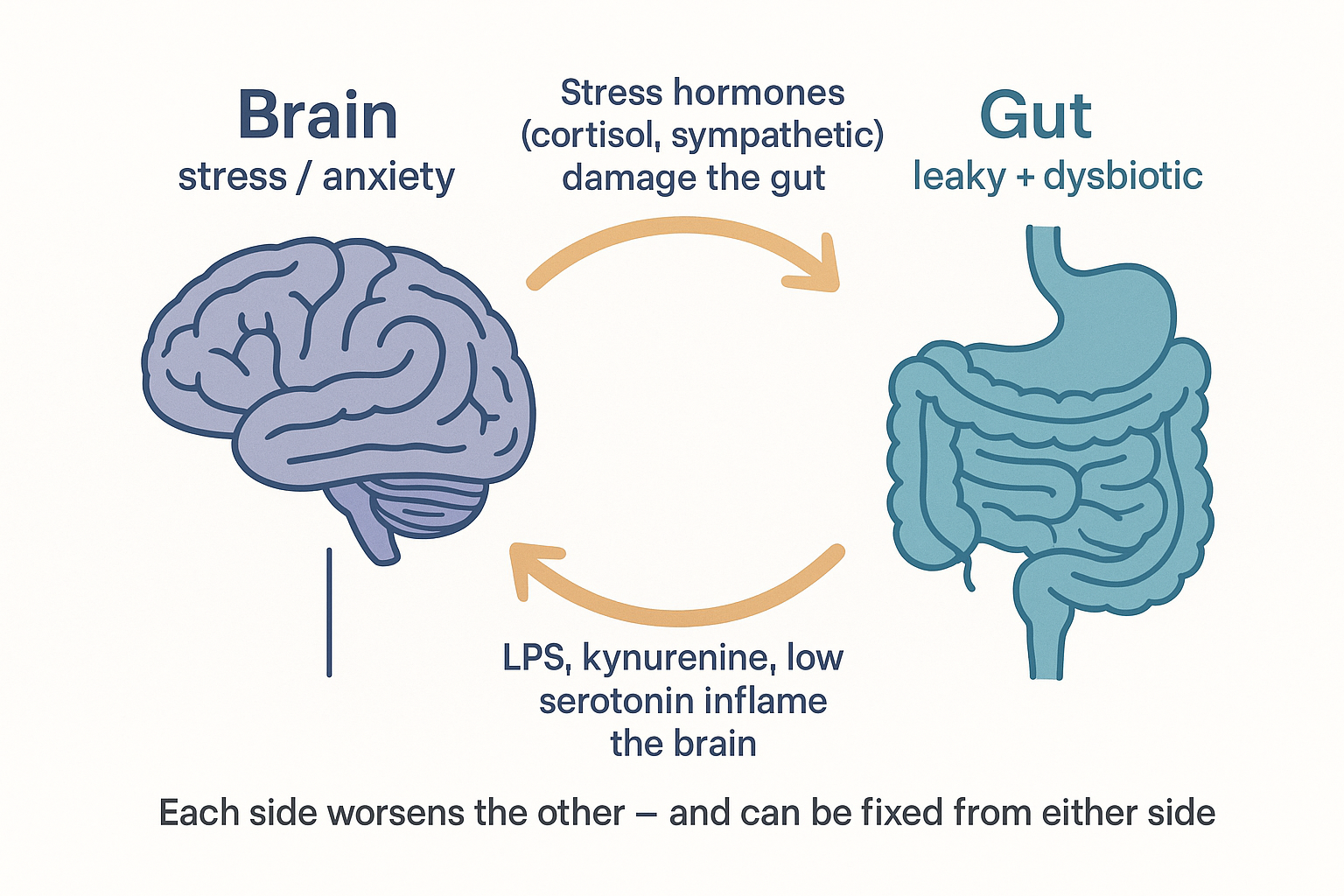 The loop runs both ways: stress degrades the gut, and the degraded gut inflames the brain — which is also why it can be broken from either end.
This is the same stuck-loop architecture as the metabolic master loop — and indeed they overlap heavily (gut inflammation drives both insulin resistance and neuroinflammation). It also explains why the breaking points are multiple: you can intervene on the brain side (stress reduction, raising vagal tone — the ANS page's breathwork and meditation) or the gut side (healing the barrier, fixing dysbiosis, feeding SCFA producers) and improve the whole loop, because they are one connected system.
Practical implications
The mechanisms above explain a range of observations:
- Why antibiotics can cause mood changes — wiping the microbiome (gut microbiome page) disrupts GABA-producing strains, SCFA production, and tryptophan handling.
- Why some probiotics measurably reduce anxiety ("psychobiotics") — via vagal signalling and neurotransmitter production.
- Why gut-healing protocols often improve mental clarity and mood — reducing endotoxin reduces neuroinflammation and the kynurenine diversion.
- Why fermented foods and SCFA-supporting fibre have neurological benefits — feeding the routes that are protective.
- Why stress management improves digestion and vice versa — because the loop runs both ways.
Putting it all together
- The gut has its own brain — the enteric nervous system, ~500 million neurons in two plexuses, capable of running digestion autonomously. "Second brain" is literal.
- It talks to the brain mostly by listening being reported upward — the gut's sensor cells (enterochromaffin) feed the ~80%-afferent vagus, a continuous stream shaping mood below awareness.
- ~90% of the body's serotonin is in the gut, where it drives peristalsis — but it does not cross into the brain; the two serotonin pools are separate.
- The tryptophan fork is the master mechanism: inflammation (via IDO1) diverts tryptophan away from serotonin into the kynurenine pathway, simultaneously lowering serotonin and raising excitotoxic quinolinic acid — a powerful biological link between gut inflammation and depression.
- Four routes carry the gut's influence to the brain: the vagus nerve, SCFAs (protective, cross the BBB), LPS endotoxin (inflammatory), and metabolites including bacterially-made GABA.
- A leaky gut can inflame the brain itself — LPS activates microglia, producing neuroinflammation that impairs plasticity, neurogenesis, and neurotransmitter balance.
- The axis is bidirectional and self-reinforcing — stress degrades the gut, the degraded gut inflames the brain, which worsens stress — and it can be broken from either side.
The unifying idea: the gut and brain are one connected system, not two organs that occasionally interact. Wired by the vagus, chemically linked through tryptophan and serotonin, and mediated by the trillions of microbes that produce neuroactive molecules and either protect or inflame — your mental state and your gut state are, to a degree most people never appreciate, the same state viewed from two ends.
Related Compounds & Deep Dives
Serotonin / tryptophan pathway
- L-tryptophan — the amino acid at the fork; raw material for both serotonin and the kynurenine pathway.
- Melatonin — the downstream product of the serotonin path; the sleep hormone.
Psychobiotics (mood-active bacteria)
- Probiotics, Lactobacillus, L. rhamnosus — strains shown to influence anxiety via the vagus (the GABA example).
- Saccharomyces boulardii — supports a healthy microbial balance.
Barrier & anti-inflammatory (reduce the LPS/neuroinflammation route)
- Butyrate — the SCFA that crosses the BBB and seals both the gut and (indirectly) supports brain health.
- L-glutamine, BPC-157, lactoferrin — repair the gut barrier, reducing endotoxin reaching the brain (see the Lactoferrin & Colostrum deep dive).
- Curcumin, NAC, glutathione — reduce systemic and neuro-inflammation.
- Fish oil, vitamin D — modulate inflammation and support the blood-brain barrier.
Calming / NMDA tuning
- Magnesium — blocks the NMDA receptor that quinolinic acid over-activates (see the deep dive).
- L-theanine, glycine, inositol — calming neuroactive compounds.
Related foundations
- Autonomic Nervous System — the vagus nerve that carries the gut's signals to the brain.
- Gut Microbiome — the bacteria, SCFAs, and LPS endotoxin at the heart of this axis.
- Neuroscience of Cognition — the serotonin, NMDA, and neurotransmitter systems the gut reaches into.