Pinealon & Epithalon — Deep Dive
Category: Peptide Bioregulators / Longevity / Neuroprotection
Origin: St. Petersburg Institute of Bioregulation and Gerontology, Prof. Vladimir Khavinson
Classification: Short-chain cytomedins (organ-specific peptide bioregulators)
| Epithalon | Pinealon | |
|---|---|---|
| Sequence | Ala-Glu-Asp-Gly (AEDG) | Glu-Asp-Arg (EDR) |
| Length | Tetrapeptide (4 AA) | Tripeptide (3 AA) |
| MW | ~390 Da | ~432 Da |
| Primary angle | Telomere extension / longevity | Neuroprotection / cognition |
| Timing | Evening | Morning |
The Khavinson System — What These Are
To understand Pinealon and Epithalon, you need to understand the scientific framework that produced them. They are not random peptides. They are part of a deliberate research programme developed across 50+ years in Soviet and post-Soviet Russia.
Vladimir Khavinson's central hypothesis: as organs age, they produce fewer of the short peptide signals that regulate their own function and repair. The cascade of age-related decline is partly a consequence of this peptide deficit. The intervention: identify the specific short peptides produced by each organ, synthesise them, and administer them back — restoring the organ's regulatory signals from the outside.
These are called peptide bioregulators or cytomedins (cytomins). Khavinson's group has produced bioregulators for virtually every major organ: thymus (Thymalin), brain cortex (Cortexin), pineal gland (Epithalamin → Epithalon), epithelial tissue (Vilon), prostate (Prostatilen), retina (Retinalamin), and many others.
Both Pinealon and Epithalon are derived from the pineal gland — the neuroendocrine organ responsible for melatonin production and circadian rhythm orchestration. They are not the same thing, and they operate through different mechanisms despite the shared origin tissue.
Epithalon (AEDG) — The Telomere Compound
What It Is
Epithalon is a synthetic tetrapeptide (four amino acids: Ala-Glu-Asp-Gly) modelled on Epithalamin — a polypeptide extract from bovine pineal gland that Khavinson's group isolated in the 1970s. Epithalon is the purified, reproducible, synthetic equivalent. It is the most researched of all Khavinson bioregulators.
Primary Mechanism: Telomerase Activation
Epithalon's headline effect — and the one that drives most community interest — is activation of telomerase, the enzyme that extends telomeres.
Telomeres are the protective caps on chromosome ends. They shorten with every cell division. When telomeres reach a critical minimum length, the cell enters senescence (stops dividing) or apoptosis. Telomere shortening is one of the core hallmarks of ageing; accelerated shortening correlates with age-related disease and shorter lifespan.
Epithalon appears to upregulate hTERT — human Telomerase Reverse Transcriptase, the catalytic subunit of telomerase — restoring telomerase activity in cells where it has been suppressed with age.
The 2025 independent study (Biogerontology, Al-Dulaimi et al.): confirmed dose-dependent telomere length extension in human cell lines via both telomerase upregulation and alternative lengthening of telomeres (ALT) activity. This is the first published confirmation of the telomere extension mechanism from a research group independent of Khavinson — a significant milestone given the single-lab concerns discussed below.
Secondary Mechanism: Melatonin Restoration
The pineal gland's melatonin output declines sharply with age — approximately 10–15% per decade from mid-life, with near-complete suppression common in elderly populations. This decline disrupts:
- Circadian rhythm regulation
- Nocturnal antioxidant defence (melatonin is a potent free radical scavenger)
- Immune modulation (melatonin is immunostimulatory at physiological night-time concentrations)
Epithalon stimulates melatonin production from the pineal gland — not by delivering exogenous melatonin, but by restoring the gland's endogenous output. This is mechanistically distinct from melatonin supplementation and is why users report circadian rhythm normalisation that persists after cycling off.
flowchart TD
EPI((Epithalon)) -->|"upregulates hTERT"| TEL["Telomerase activated"]
TEL --> EXT["Telomeres extended<br/>→ delays cell senescence (longevity)"]
EPI -->|"restores pineal output"| MEL["↑ endogenous melatonin"]
MEL --> CIRC["Circadian rhythm normalised ·<br/>nocturnal antioxidant defence ·<br/>immune modulation"]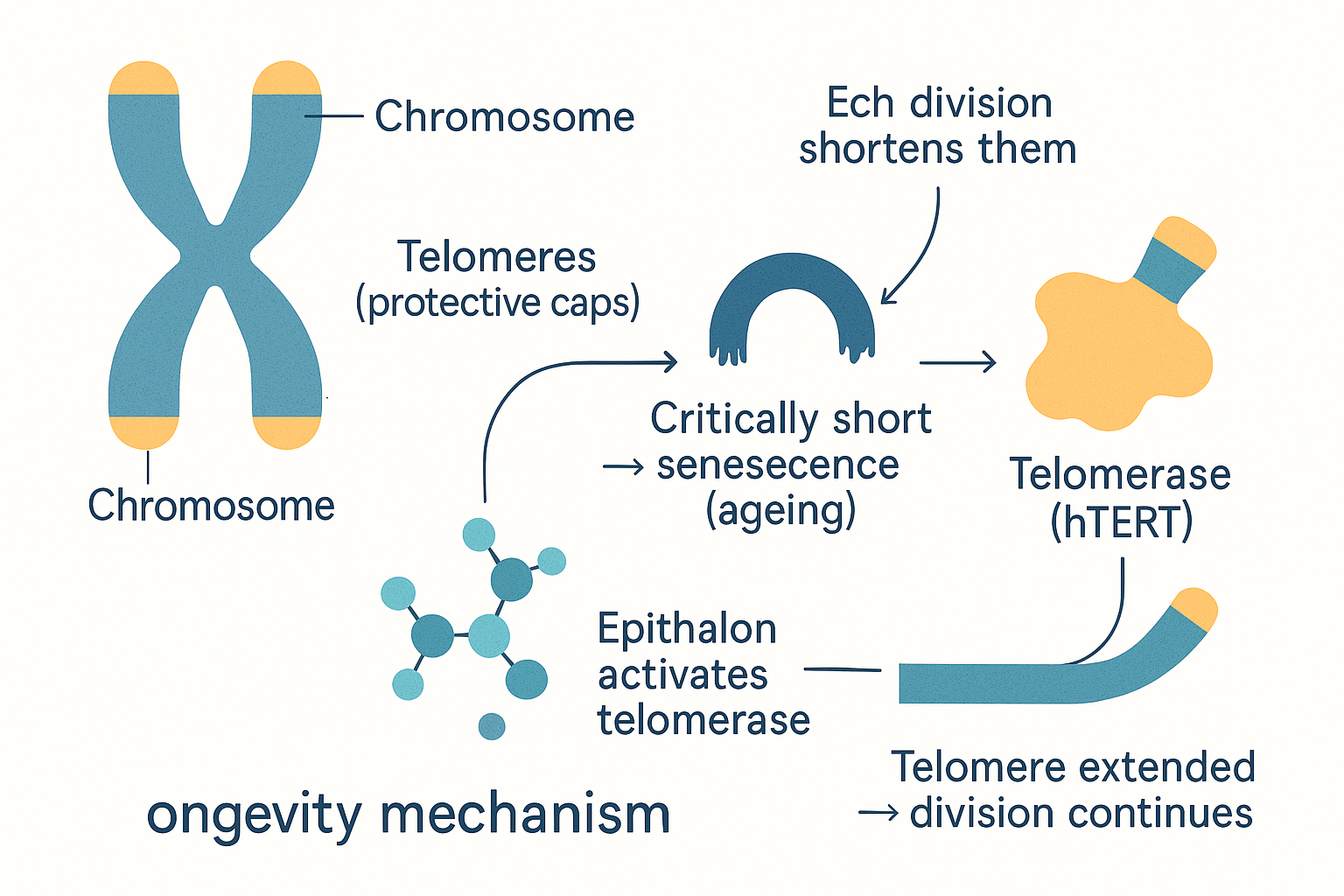 The longevity mechanism: telomere caps shorten each division until the cell senesces; Epithalon activates telomerase (hTERT) to rebuild them.
BowTied Biohacker (@BowTiedUM):
"I'm always on epitalon even when I'm not. The circadian regulation and anti-aging benefits last for weeks if not months after. When that starts to dwindle, I throw it back in."
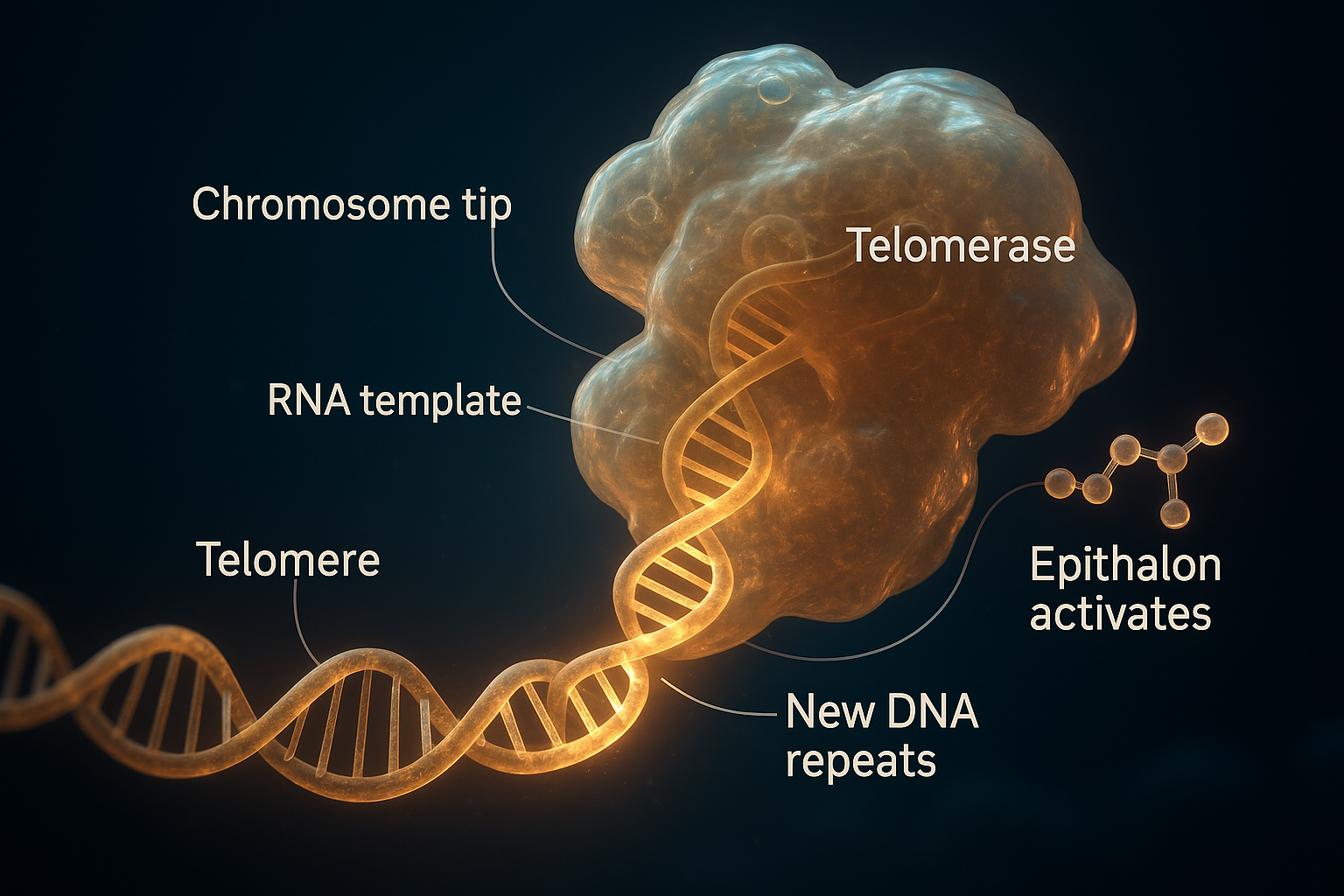 Telomerase caught in the act: the enzyme clamps onto the single-stranded tip of a chromosome and, using its own built-in RNA template as a guide, lays down fresh telomere DNA repeats to rebuild the cap. Epithalon is proposed to switch this enzyme back on — the mechanism behind its longevity claims (which, as the studies below show, rest largely on a single research group).
Lifespan Studies
The most compelling animal data (Anisimov and Khavinson group):
- 13.3% mean lifespan extension in female rats — chronic administration, reduced spontaneous tumour incidence (PMID 12946225)
- 25% mean lifespan extension in female rats, 18% in males (Annals of the NYAS, 2006)
- Drosophila melanogaster: significant lifespan extension at multiple doses
- Longest-lived human cohort study (40-year follow-up, n=266): Khavinson group reports significantly reduced all-cause mortality in those who received peptide bioregulator treatment
The 13–25% lifespan extension figures are striking. The caveats are equally important: all studies originate from the Khavinson/Anisimov group; none have been replicated by the NIA Interventions Testing Programme (the gold standard for longevity compound validation); and rodent lifespan interventions frequently fail to translate to humans (see Resveratrol, Rapamycin controversies). The 2025 telomere cell-line data provides partial independent validation but is mechanistic, not lifespan.
Pinealon (EDR) — The Neuroprotective Bioregulator
What It Is
Pinealon is a synthetic tripeptide (Glu-Asp-Arg) — also derived from pineal gland tissue. Where Epithalon targets cellular longevity via telomerase, Pinealon operates more acutely on neuronal function and neuroprotection.
Mechanism: Epigenetic Modulation
Khavinson's proposed mechanism for short bioregulatory peptides: at 3–4 amino acids, these molecules are small enough to penetrate cell membranes, enter the nucleus, and interact directly with regulatory DNA sequences — functioning as epigenetic modulators that upregulate or downregulate specific gene expression patterns.
For Pinealon specifically, research documents:
- ROS reduction in neuronal cultures — attenuates reactive oxygen species accumulation under oxidative stress conditions
- MAPK pathway modulation — regulating cellular stress response and survival signalling (referenced in PMID 21978084)
- Mitochondrial membrane potential preservation — neurons under hypoxic stress maintain mitochondrial function with Pinealon present
- Neuroprotection under ischaemia — reduces neuronal apoptosis markers in rodent brain ischaemia models
- Retinal neuroprotection — well-documented in neonatal retina degeneration models; may have application in age-related retinal decline
The Acute Experience
Unlike Epithalon's slow-arc longevity mechanism, Pinealon has distinctly acute cognitive effects that users describe in concrete terms:
BowTied Biohacker (@BowTiedUM):
"Every time I take some time off and start again — colors get brighter, motivation and mood skyrocket. Go from dragging my feet to speed running life."
BasedBiohacker (@BasedBiohacker) on the cognitive stack:
"2 mg oral pinealon: obliterates brain fog, heightens stress-resistance + focus, helps you sleep deeper."
Morph (@doctormorphh) on neuroplasticity:
"Pinealon. You will literally have child-like learning again." — in the context of recovering adult brain plasticity alongside Magtein and Bacopa.
The "colours look brighter" subjective report appears independently from multiple users — consistent with the hypothesis that Pinealon restores mitochondrial efficiency in photoreceptor and visual cortex neurons.
The Khavinson Problem — And the 2025 Exception
The same single-lab dominance issue that affects BPC-157 (Sikiric group) applies here, but more acutely.
Virtually every published study on both Pinealon and Epithalon originates from Khavinson's group at the St. Petersburg Institute. This is decades of internally consistent data — but the independence problem is real. The regulatory and scientific standards for Russian research publications of that era (1970s–2000s) differ from current RCT requirements. No NIA-ITP longevity testing has been conducted.
The 2025 exception: The Al-Dulaimi et al. study in Biogerontology confirming Epithalon's telomere extension in human cell lines was conducted by a research group independent of Khavinson. The finding of hTERT upregulation and ALT activity provides the first external mechanistic validation. It does not confirm lifespan extension, but it confirms the core mechanism is real in human cells.
Calibration: The mechanistic plausibility (telomerase activation) is now independently validated. The lifespan claims (13–25% rodent extension) remain unreplicated externally. The neuroprotective effects of Pinealon remain almost entirely Khavinson-group data. Confidence in the mechanism is higher than confidence in the magnitude of effect.
Dosing and Cycling
BasedBiohacker (@BasedBiohacker):
| Compound | Dose | Timing | Protocol |
|---|---|---|---|
| Epithalon | 6mg oral | Evening | 30 days on → 2 months off |
| Pinealon | 2mg oral | Morning | 30 days on → 2 months off |
The cycling rationale mirrors Bromantane's — both operate via persistent downstream effects (telomerase gene regulation for Epithalon; epigenetic modulation for Pinealon) that outlast the peptide's plasma half-life. The 2-month off period allows the regulatory state to consolidate before the next cycle.
Injectable vs oral: Both are available as injectables (subcutaneous) and oral capsules. Injectable is the route used in most research. Oral bioavailability for short peptides is debated — Pinealon's tripeptide structure is small enough that meaningful absorption is plausible. Community reports suggest oral is effective, though no comparative PK data exists. Nasal administration is also used by some community members for potentially faster CNS delivery.
Higher dose protocols: Some users run Epithalon at 10mg/day injectable for defined cycles (the Khavinson research protocol). BasedBiohacker's 6mg oral is at the lower end — emphasising long-term sustainable use over short high-dose cycles.
Community Stacks
BasedBiohacker — The 80/20 Cognitive Enhancement Stack
- 150mg Armodafinil (morning — wakefulness + focus)
- 250mg Citicoline (acetylcholine support)
- 200mg Caffeine
- 800mg L-Theanine
- 144mg Magnesium L-Threonate
- 2mg Pinealon (morning — brain fog, stress resistance, sleep quality)
- 6mg Epithalon (evening — circadian reset, cortisol reduction, longevity)
"You could run this 5 days on, 2 days off pretty much indefinitely without building tolerance. Cycle pinealon and epitalon 30 days on → 2 months off."
BasedBiohacker — Performance + Longevity Stack
- Meldonium 500–1000mg (metabolic efficiency)
- Tadalafil 5mg (cerebral blood flow)
- Bromantane 50mg sublingual (dopamine production capacity)
- Modafinil 100–200mg (acute focus)
- Pinealon + Epithalon (sleep and longevity foundation)
"Add pinealon and epitalon for sleep and you might get the midas touch."
BasedBiohacker — Advanced Neuroprotection Stack
Morning: amantadine, royal jelly, tadalafil, selanık 500mcg, epitalon 4mg, vilon 1mg, mexidol, ALCAR
Mid-day: cerebrolysin 5ml (10-day course), agmatine
Evening: guanfacine, magnesium L-threonate
Focused on neuroprotection, dopaminergic optimisation, glutamate mitigation, and systemic cellular longevity — Epithalon sits in the morning neuroprotection cluster at a slightly lower dose than his standard protocol.
limitlesstack — Longevity Core
Bromantane + Epithalon + Meldonium + Pinealon + Royal Jelly + Low-dose Tadalafil
BasedBiohacker — Tier Ranking
A TIER: "Epithalon — bioregulator activating telomerase and restoring circadian rhythm synchronization for cellular longevity and enhanced recovery."
Notably, Pinealon does not appear in this tier list — Epithalon is the one BasedBiohacker rates explicitly by mechanism, suggesting he views the longevity/telomerase angle as the primary value.
The Cancer Question — Telomere Extension and Malignancy
This is the most nuanced safety consideration for Epithalon, and it cuts differently from the BPC-157 VEGF concern.
Telomere shortening is firmly associated with ageing and with cancer — specifically, critically short telomeres drive genomic instability, which is a cancer driver. This creates a paradox: telomere shortening causes cancer; but telomere extension enables cellular immortality, which is also a hallmark of cancer.
Cancer cells upregulate telomerase (via hTERT) to maintain their telomeres indefinitely — that is precisely what makes them immortal. The concern: could exogenous Epithalon accelerate the telomere maintenance of a pre-cancerous or cancerous cell clone?
The counterargument from Khavinson's data: the 2003 lifespan rat study (PMID 12946225) reported reduced spontaneous tumour incidence in Epithalon-treated animals alongside lifespan extension. If Epithalon were straightforwardly tumour-promoting, this result would not appear.
The proposed resolution: Epithalon restores telomerase in ageing normal cells (preventing senescence-driven genomic instability) while the already-maximal hTERT in cancer cells is not further elevated. This remains a hypothesis, not established fact.
Practical risk stratification: - Healthy individuals, no cancer history: theoretical concern, mild; animal data suggests tumour incidence reduction - Active or recent cancer: contraindicated — any intervention touching telomere/telomerase biology is a concern in malignancy context - Family history: legitimate reason for caution and monitoring
The ALT (alternative lengthening of telomeres) activity confirmed in the 2025 study adds a nuance: ALT is a telomerase-independent telomere maintenance mechanism predominantly found in cancer cells. The fact that Epithalon activates ALT in normal cell lines warrants further investigation — it may be beneficial or neutral in healthy cells, but the intersection with cancer biology is real.
Differentiating the Two: When to Use Which
| Epithalon | Pinealon | |
|---|---|---|
| Time horizon | Slow-arc, months to years | Acute to subacute, days to weeks |
| Primary target | Cellular longevity, circadian | Neuroprotection, cognition |
| Effect persistence | Months after cycling off | Effects present while dosing |
| Research strength | Stronger (2025 independent validation) | Weaker (mostly Khavinson group only) |
| Cancer concern | Moderate (telomerase/ALT) | Low (no pro-proliferative mechanism) |
| Community verdict | Always on in background | Acute nootropic, "speed running life" |
These are complementary, not substitutes. The standard community protocol runs both simultaneously on the same cycle precisely because they address different timescales: Epithalon handles the long-arc regulatory foundation while Pinealon provides the immediate neuroprotective and cognitive layer.
Sourcing
YourProtocol.co — referenced directly by BasedBiohacker as his personal source for both: - Pinealon: yourprotocol.co/products/pinealon - Epithalon: yourprotocol.co/products/epitalon
UK/EU suppliers: CosmicNootropic, Peptide Sciences (US, ships internationally), community forums (r/Peptides, Longecity) maintain updated regional lists.
Quality markers: - ≥98% purity by HPLC - Sequence confirmation by mass spectrometry - Lyophilised powder; store −20°C, use within 30 days of reconstitution
Research Sources
Epithalon: - Lifespan extension (rats, 13.3%): PMID 12946225 — Anisimov et al. 2003 - Lifespan extension (rats, 25%): Anisimov & Khavinson, Annals NYAS, 2006 - 2025 independent telomere study: Biogerontology — Epitalon increases telomere length via telomerase/ALT - Khavinson bioregulator system overview: Alzheimer's Drug Discovery Foundation cognitive vitality report
Pinealon: - MAPK / antioxidant modulation: PMID 21978084 - Neuroprotection research guide: sourcepeptides.co - Superpower.com Pinealon guide: superpower.com/guides/pinealon
System overview: - Khavinson bioregulator catalogue: calcmypeptide.com - Epithalon longevity evidence summary: gethealthspan.com
All community quotes compiled from biohacking Twitter discussions. Educational purposes only. Not medical advice. These compounds are not approved for human therapeutic use in any jurisdiction.