Carbon Dioxide: The Misunderstood Gas of Life
The molecule everyone calls "waste" is in fact the end-product of every clean-burning cell, the body's main acid-base buffer, and — counter-intuitively — the thing that actually forces oxygen out of your blood and into your tissues. This page builds the real physiology from the ground up, then turns to the heterodox bioenergetic (Ray Peat) view of CO₂ as a protective, pro-metabolic molecule — and calibrates, honestly, which claims the mainstream already agrees with and which are extrapolations.
A short history
Carbon dioxide was the first gas ever distinguished from ordinary air. In the 1750s the Scottish chemist Joseph Black heated chalk and magnesia (calcium and magnesium carbonates) and found they lost weight, giving off an "air" he called "fixed air" — air that had been locked inside the solid. He showed this fixed air extinguished a flame, could not support life, and was present in the breath you exhale. That was carbon dioxide, and its discovery effectively opened the science of the respiratory gases.
For a long time afterwards CO₂ was treated as simply the rubbish of breathing — the spent ash of combustion. The picture changed dramatically around the turn of the twentieth century. In 1904 Christian Bohr (with Karl Hasselbalch and August Krogh, in Copenhagen) discovered that carbon dioxide changes how tightly haemoglobin — the oxygen-carrying protein in red blood cells — holds onto oxygen: more CO₂ makes haemoglobin release its oxygen. This is the Bohr effect. A decade later, around 1914, John Scott Haldane and colleagues described the mirror-image relationship (the Haldane effect): oxygenation changes how much CO₂ the blood can carry. Together these two discoveries revealed that O₂ and CO₂ are not independent — they are two ends of a single coupled trading system. In the 1930s the enzyme carbonic anhydrase was identified (Meldrum and Roughton, 1933), explaining how the body interconverts CO₂ and bicarbonate fast enough to matter.
Today CO₂ is anything but a settled "waste" story. Active research areas include permissive hypercapnia — deliberately allowing blood CO₂ to run high in critically ill patients on ventilators, because gentle ventilation that lets CO₂ rise turns out to save lives in acute respiratory distress syndrome (review) — and the use of CO₂ as the dominant minute-to-minute controller of cerebral blood flow in neurocritical care. The molecule Joseph Black wrote off as the air that kills flames is now understood as one of the most tightly regulated and physiologically active substances in the body.
Why this page exists
The cellular energy page followed a molecule of fuel all the way to ATP and noted, almost in passing, that carbon is stripped off and "breathed out as CO₂." This page is about that exhaust — and the central surprise is that it is not merely exhaust at all.
Three facts, taken together, overturn the schoolroom picture of "O₂ good, CO₂ bad":
-
CO₂ is the signature of clean, oxidative metabolism. A cell fully burning fuel with oxygen produces CO₂. A cell stuck in stress-metabolism (glycolysis without finishing the job) produces lactate instead. So in a real sense, more CO₂ relative to lactate is a marker of a healthier, more energetic cell — a theme the metabolism page will recognise.
-
You need CO₂ to deliver oxygen. Through the Bohr effect, CO₂ is what prises oxygen off haemoglobin and hands it to the tissues. Blow off too much CO₂ by over-breathing and — paradoxically — your tissues get less oxygen, not more.
-
CO₂ is the body's primary acid-base buffer and the main driver of breathing. Your urge to breathe is set almost entirely by CO₂, not by oxygen. CO₂ tunes the pH of your blood second by second, and it controls the diameter of your blood vessels, especially in the brain.
The page has two clearly separated halves. Part 1 is mainstream, uncontroversial textbook physiology: where CO₂ comes from, how the blood carries it, the Bohr and Haldane effects, and how it controls breathing and blood flow. Part 2 is the bioenergetic / Ray Peat view — CO₂ reframed as a protective "gas of life" — presented as a distinct and more speculative layer, with each claim flagged for how strongly the established science actually supports it.
We start where the CO₂ itself starts: inside the mitochondria.
Part 1 — The established physiology of CO₂
Where CO₂ comes from: the exhaust of oxidative metabolism
Recall the core of the cellular energy page: fuel is broken down, carbon by carbon, and the carbons leave as carbon dioxide. CO₂ is produced at specific, named steps — all of them decarboxylations, meaning "removal of a carboxyl (–COOH) group as CO₂." A decarboxylation is simply a reaction that snips a carbon off a molecule and releases it as CO₂.
There are three main CO₂-producing stations, and all sit inside the mitochondrion (the cell's power station):
-
The pyruvate dehydrogenase complex (PDH). When pyruvate (the three-carbon product of glucose breakdown) enters the mitochondrion, PDH strips one carbon off it as CO₂, leaving a two-carbon fragment (acetyl-CoA) to be burned. This step depends absolutely on vitamin B1 (thiamine) — see the thiamine deep dive. One CO₂ per pyruvate, so two per glucose.
-
The Krebs cycle, twice. Inside the citric-acid cycle, two further decarboxylations occur — at the enzymes isocitrate dehydrogenase and α-ketoglutarate dehydrogenase (α-KGDH) (also thiamine-dependent). Each releases one CO₂. Because the cycle turns twice per glucose, that is four more CO₂.
So a single glucose molecule, fully oxidised, yields six molecules of CO₂ — exactly matching its six carbons (C₆H₁₂O₆ → 6 CO₂). Nothing is destroyed; the carbon you eat as sugar leaves, almost entirely, through your lungs as gas.
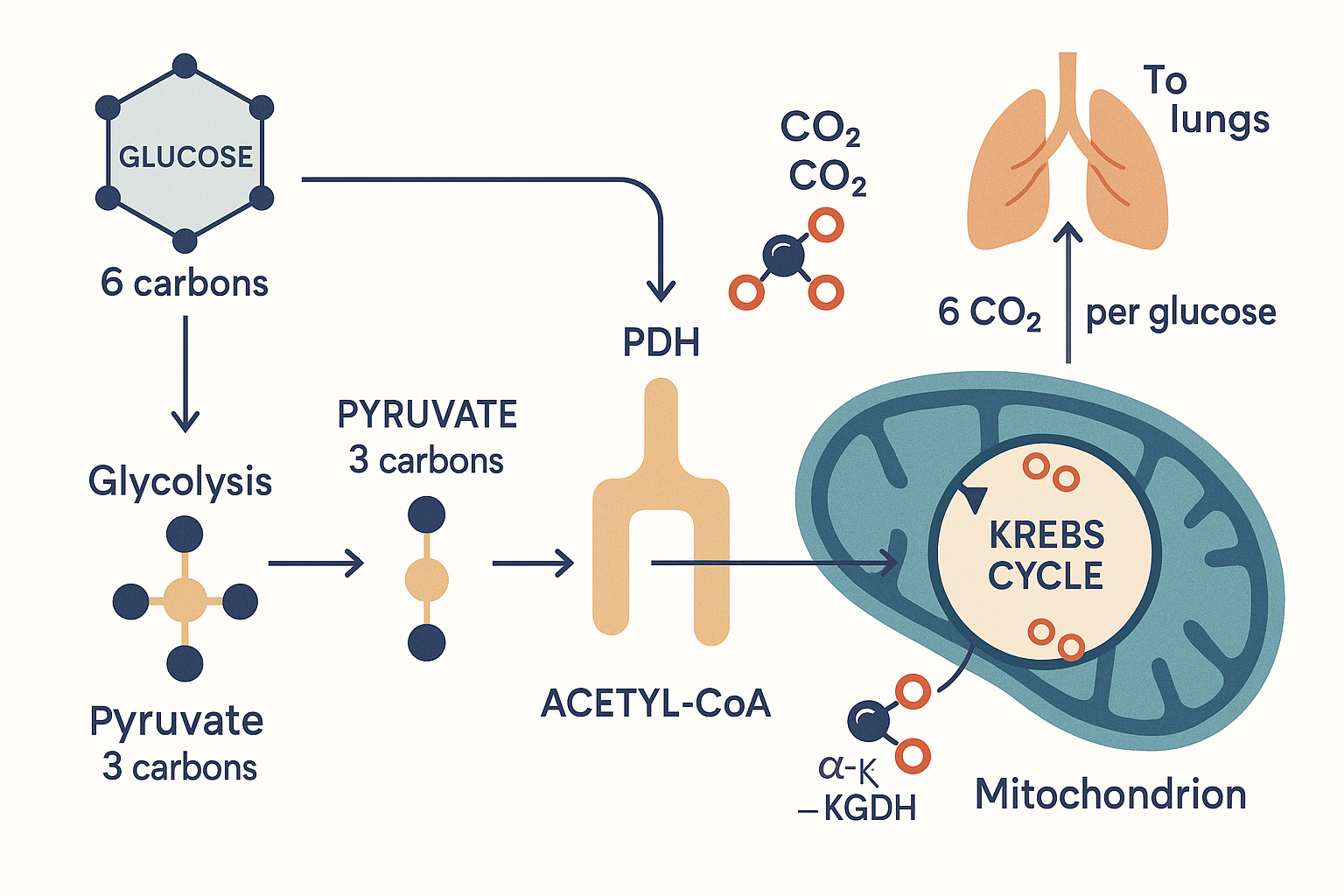 Every carbon in a glucose molecule leaves as CO₂: one pair at the PDH gate, two more pairs inside the Krebs cycle — the PDH and α-ketoglutarate dehydrogenase (α-KGDH) decarboxylations both requiring vitamin B1 (thiamine). CO₂ is the direct chemical signature of fuel being fully oxidised.
How much, and why fat makes less CO₂ per breath of oxygen
At rest, your whole body produces roughly 200 millilitres of CO₂ per minute and consumes roughly 250 millilitres of O₂ per minute. Over a day that adds up to close to a kilogram of CO₂ (around 2 lb) breathed out — far more mass than you excrete by any other route. CO₂ is, by tonnage, the body's largest metabolic waste product.
The ratio of CO₂ produced to O₂ consumed is called the respiratory quotient (RQ) — a number that quietly tells you which fuel a tissue is burning:
- Burning glucose gives RQ ≈ 1.0. The equation C₆H₁₂O₆ + 6 O₂ → 6 CO₂ + 6 H₂O uses six O₂ and makes six CO₂ — a one-to-one trade.
- Burning fat gives RQ ≈ 0.7. A typical fat (palmitate) burns as C₁₆H₃₂O₂ + 23 O₂ → 16 CO₂ + 16 H₂O — twenty-three O₂ for only sixteen CO₂, a ratio of about 0.70.
Why the difference? Because fat is a more "reduced" fuel — its carbons are wrapped in hydrogen and carry very little oxygen of their own. Oxidising those carbon–hydrogen bonds takes a lot of inhaled O₂, but the carbon count (and so the CO₂ output) is comparatively modest. Sugar already carries oxygen on every carbon, so it needs less inhaled O₂ to finish, and the CO₂-to-O₂ trade comes out even.
This has a real, often-overlooked consequence that recurs in Part 2: for the same amount of oxygen breathed, oxidising sugar generates more CO₂ than oxidising fat. A mixed diet sits around RQ 0.8. Pure fasting and fat-burning pull RQ down toward 0.7; a sugar-rich, high-metabolic state pushes it up toward 1.0 — and produces more of the CO₂ that, as we are about to see, is essential rather than incidental.
How blood carries CO₂: three forms and the bicarbonate buffer
CO₂ made in the tissues has to be carried back to the lungs. Blood does this in three ways at once.
-
Dissolved CO₂ (~5–10%). A small fraction simply dissolves in the watery plasma, exactly as fizz dissolves in a soft drink. CO₂ is about twenty times more soluble than O₂, so this fraction is not trivial — and it is the dissolved CO₂ that sets the pressure (PaCO₂) the body actually senses and regulates.
-
Carbamino compounds (~5–10%). Some CO₂ binds directly onto protein, chiefly onto the amino ends of haemoglobin (the iron-containing protein inside red blood cells that normally carries oxygen). Note this is a different site from where haemoglobin carries oxygen — CO₂ rides on the protein chains, O₂ rides on the iron. This matters for the Haldane effect below.
-
Bicarbonate (~70–80%) — the main route. The bulk of CO₂ is carried not as CO₂ at all, but converted into bicarbonate ion (HCO₃⁻). This conversion is the single most important piece of acid-base chemistry in the body:
CO₂ + H₂O ⇌ H₂CO₃ ⇌ H⁺ + HCO₃⁻
Read left to right: carbon dioxide plus water makes carbonic acid (H₂CO₃), which immediately splits into a hydrogen ion (H⁺, i.e. acid) and a bicarbonate ion (HCO₃⁻). Read right to left for the reverse. The double arrows mean it runs both ways, settling wherever the balance is pushed.
Left on its own, the first step (CO₂ + H₂O) is sluggish. The body speeds it up roughly a million-fold with an enzyme called carbonic anhydrase — one of the fastest enzymes known, packed inside red blood cells. This is why the conversion can keep pace with blood rushing through a capillary in under a second.
flowchart LR
subgraph TC["Tissue capillary"]
CO2in["CO2 from tissues"] --> RBC1["Red blood cell"]
RBC1 -->|"carbonic anhydrase"| RX["CO2 + H2O to H2CO3 to H+ + HCO3-"]
RX --> HCO3out["HCO3- exits to plasma"]
RX --> Hbuf["H+ buffered on haemoglobin"]
end
HCO3out -->|carried to lungs| LUNG
subgraph LC["Lung capillary"]
LUNG["reaction runs in reverse"] -->|"H+ + HCO3- to CO2 + H2O"| CO2out["CO2 exhaled"]
end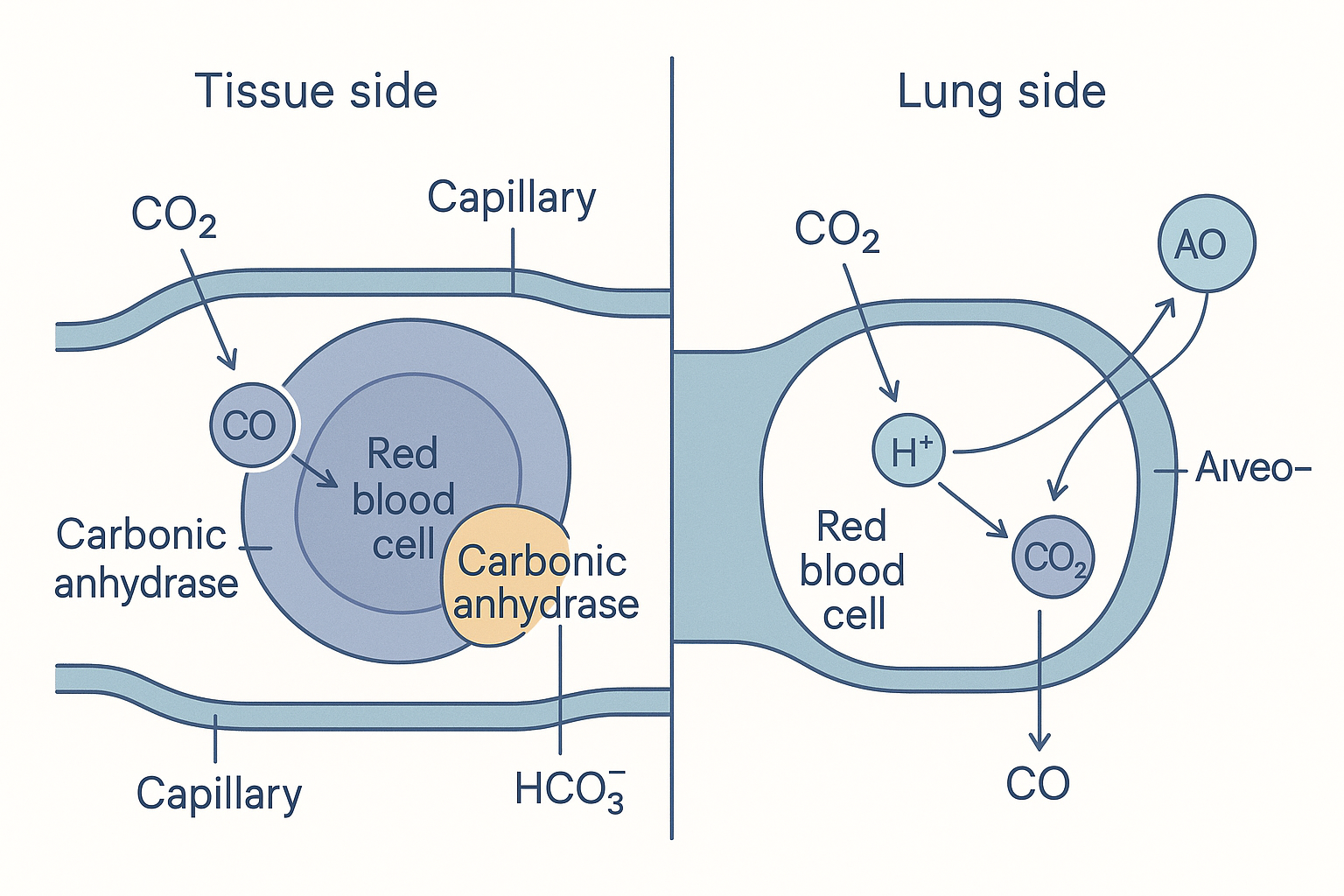 Most CO₂ travels as bicarbonate. Carbonic anhydrase inside red blood cells converts CO₂ to HCO₃⁻ and H⁺ in the tissues, and runs the reaction backwards in the lungs to release CO₂ for exhaling.
CO₂ as the body's primary acid-base buffer
Notice what that equilibrium really means: CO₂ and acidity (H⁺) are directly linked. Add CO₂ and you push the reaction rightwards, generating more H⁺ — the blood becomes more acidic (pH falls). Remove CO₂ (by breathing it off) and you pull the reaction leftwards, mopping up H⁺ — the blood becomes more alkaline (pH rises).
This is the foundation of how the body controls its pH, which must stay in a startlingly narrow band — arterial blood sits at pH 7.40, and life-threatening trouble begins outside roughly 7.0–7.7. The bicarbonate buffer system is the body's first and largest defence of that band, and it has two control knobs:
- The lungs control CO₂ (fast, minutes). Breathe faster and you blow off CO₂, raising pH. Breathe slower and CO₂ accumulates, lowering pH. The brainstem adjusts breathing continuously to hold pH steady — this is respiratory control.
- The kidneys control bicarbonate (slow, hours to days). They retain or excrete HCO₃⁻ to compensate — this is metabolic control.
This gives the four classic acid-base states, worth knowing because they appear throughout physiology:
| State | Cause | What happens |
|---|---|---|
| Respiratory acidosis | Too little breathing → CO₂ builds up | pH falls (more acidic) |
| Respiratory alkalosis | Over-breathing → CO₂ blown off | pH rises (more alkaline) |
| Metabolic acidosis | Acid load (e.g. lactate, ketones) or HCO₃⁻ loss | pH falls; breathing speeds up to compensate |
| Metabolic alkalosis | Loss of acid (e.g. vomiting) or excess HCO₃⁻ | pH rises; breathing slows to compensate |
The lactate connection is worth pausing on, because it returns in Part 2. When a cell runs the anaerobic shortcut (glycolysis without finishing in the mitochondria — the cellular energy page's lactate detour), it produces lactic acid rather than CO₂. Lactic acid is a metabolic acid that the bicarbonate buffer must neutralise, consuming HCO₃⁻ and forcing the lungs to blow off CO₂ to compensate. So the two end-products of metabolism have opposite acid-base meanings: CO₂ is the marker of complete oxidation; lactate is the marker of incomplete, stress metabolism that the body then has to buffer.
The Bohr effect: why you need CO₂ to deliver oxygen
Here is the counter-intuitive heart of the page. We tend to imagine oxygen delivery as purely an oxygen problem — breathe oxygen in, ship it to the tissues. But haemoglobin does not simply pick up oxygen and drop it wherever; it has to be told where to let go. The signal that tells it to let go is CO₂ and acidity — and that is the Bohr effect.
Haemoglobin's grip on oxygen is described by the oxygen–haemoglobin dissociation curve — an S-shaped curve showing how saturated haemoglobin is at any given oxygen pressure. The Bohr effect is the discovery that this curve shifts:
- In a tissue that is working hard, CO₂ and H⁺ are high (that tissue is burning fuel and producing acid). High CO₂/H⁺ shifts the curve to the right, meaning haemoglobin's affinity for oxygen falls — it loosens its grip and dumps more oxygen exactly where it is most needed.
- In the lungs, CO₂ is low (it is being exhaled). Low CO₂ shifts the curve back to the left, raising affinity so haemoglobin grabs oxygen tightly for the journey.
flowchart LR
subgraph Lungs["In the lungs (low CO2)"]
L1["High affinity:<br/>Hb GRABS O2"]
end
subgraph Tissue["In active tissue (high CO2 + H+)"]
T1["Low affinity:<br/>Hb RELEASES O2"]
end
L1 -->|"blood travels<br/>loaded with O2"| T1
T1 -->|"O2 delivered<br/>to the cell"| CELL["working cell gets oxygen"]
T1 -. "more CO2 = more unloading<br/>(Bohr effect)" .-> CELL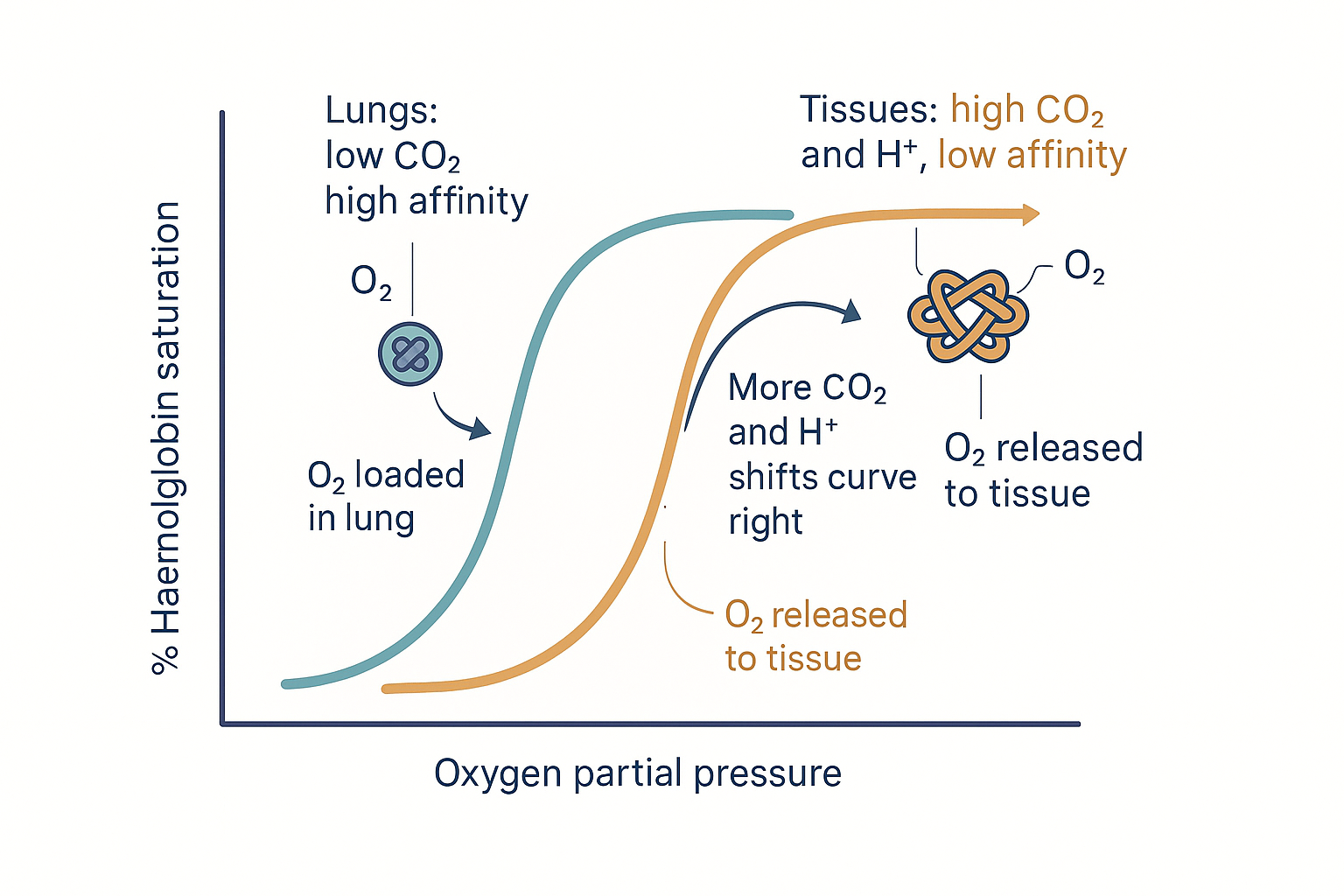 The Bohr effect: CO₂ and acid in hard-working tissue shift haemoglobin's curve rightward, forcing it to release oxygen where demand is highest. Without local CO₂, haemoglobin holds its oxygen and the tissue stays starved.
The practical punchline is profound and widely misunderstood: CO₂ is not the opposite of oxygen delivery — it is the trigger for it. A tissue rich in CO₂ is a tissue being generously supplied with oxygen. This is why the intuition "I'll breathe hard to get more oxygen to my brain" is exactly backwards (see hyperventilation below): blowing off CO₂ raises haemoglobin's affinity, so it clings to its oxygen and releases less to the tissues.
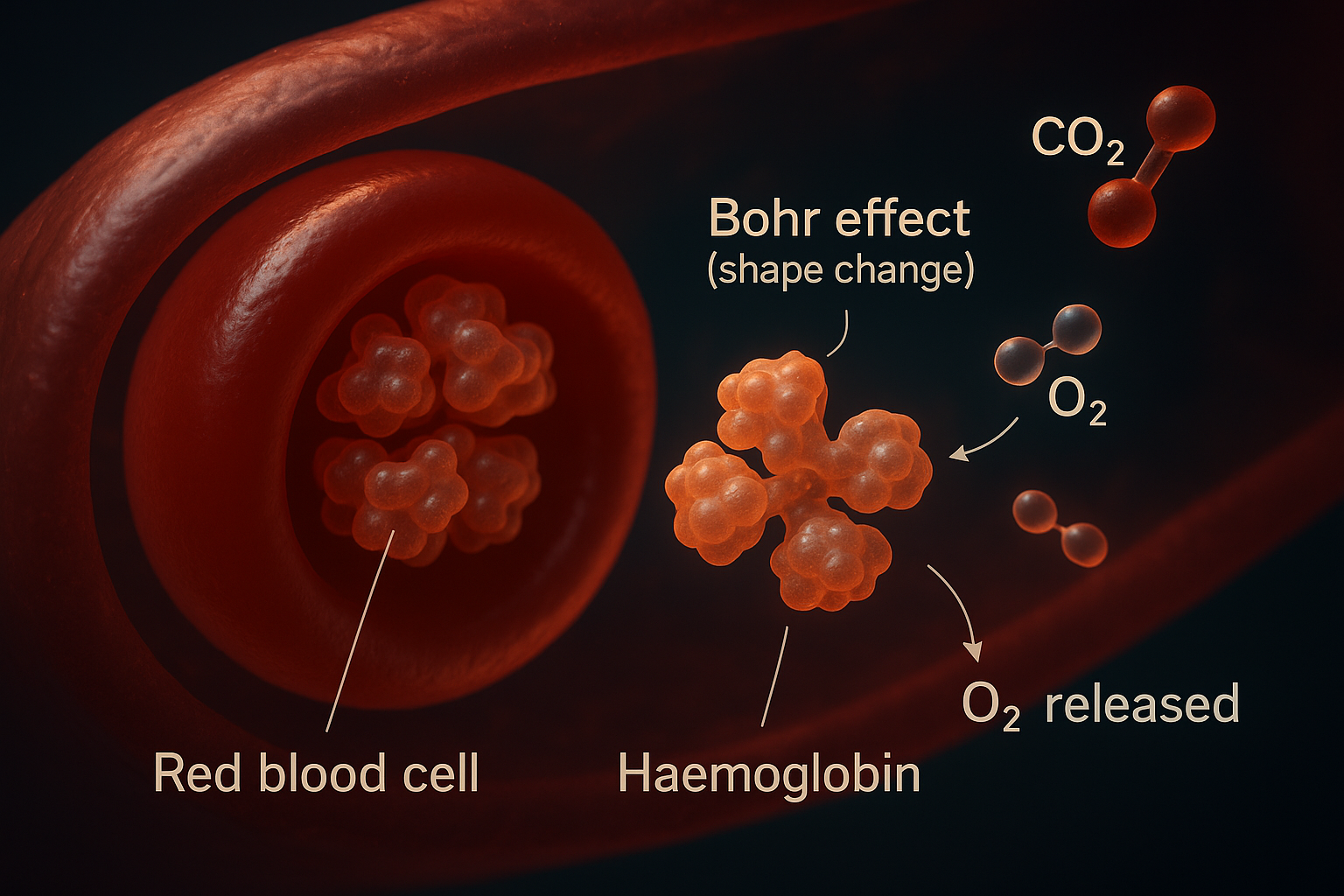 What that curve looks like in the blood: inside a red blood cell, each haemoglobin is a four-subunit machine. When CO₂ and H⁺ from busy tissue arrive, they nudge haemoglobin to change shape and let go of its oxygen — the Bohr effect as a physical, mechanical release, not just a line on a graph.
The Haldane effect: the same trade, run the other way
The Haldane effect is the mirror image, and it makes the system elegantly self-completing. It states that deoxygenated blood carries CO₂ better than oxygenated blood. When haemoglobin gives up its oxygen in the tissues, it simultaneously becomes better at picking up CO₂ (both as carbamino compounds and by buffering the H⁺ that frees up bicarbonate). When it reloads with oxygen in the lungs, it releases CO₂ for exhaling.
So the two effects interlock into one coupled cycle:
- In the tissues: high CO₂ helps unload O₂ (Bohr) and the unloading of O₂ helps load CO₂ (Haldane). Both push the same way — deliver oxygen, collect carbon dioxide.
- In the lungs: loading O₂ helps dump CO₂ (Haldane) and low CO₂ helps grab O₂ (Bohr). Again both push together — collect oxygen, release carbon dioxide.
O₂ and CO₂ are not two separate gases passing each other in traffic. They are two sides of a single reciprocal exchange, with haemoglobin as the trading desk.
CO₂, blood vessels, and the control of breathing
CO₂ is a vasodilator — especially in the brain
CO₂ relaxes the smooth muscle in blood-vessel walls, widening them (vasodilation) and increasing blood flow. Nowhere is this more important than the brain, where CO₂ is the dominant minute-to-minute regulator of cerebral blood flow. Within the normal range, brain blood flow changes by roughly 2–4% for every 1 mmHg change in arterial CO₂.
The direction matters enormously:
- High CO₂ (hypercapnia) → cerebral vessels dilate → more brain blood flow.
- Low CO₂ (hypocapnia, from over-breathing) → cerebral vessels constrict → less brain blood flow.
This is why a bout of rapid breathing makes you light-headed: you have blown off CO₂, constricted your cerebral arteries, and reduced the blood (and therefore oxygen) reaching your brain — compounded by the Bohr effect making the haemoglobin that does arrive cling harder to its oxygen. Two mechanisms, same direction: over-breathing starves the brain.
Why CO₂ — not oxygen — is the main drive to breathe
Most people assume we breathe because we run low on oxygen. We do not, under normal conditions. The primary, moment-to-moment drive to breathe is rising CO₂, detected as rising acidity.
The sensing is done by chemoreceptors — specialised cells that monitor blood chemistry:
- Central chemoreceptors, in the brainstem (medulla), are the main ones. They do not sense CO₂ directly; they sense the pH of the cerebrospinal fluid, which falls when CO₂ rises (because, per the bicarbonate equilibrium, CO₂ generates H⁺). CO₂ crosses into the cerebrospinal fluid readily, so these receptors are exquisitely tuned to it. Roughly 70% of the breathing drive comes from here.
- Peripheral chemoreceptors, in the carotid and aortic bodies (in the neck and chest), respond mainly to a large drop in oxygen — but this is a backup alarm that only fires when O₂ falls dramatically (arterial O₂ pressure below ~60 mmHg). They also sense CO₂ and pH, more quickly than the central ones.
The hierarchy is the key insight: CO₂ is the everyday throttle; oxygen is the emergency brake. Your breathing rate is set to hold CO₂ — and therefore blood pH — constant, with oxygen only taking over the controls in a genuine crisis.
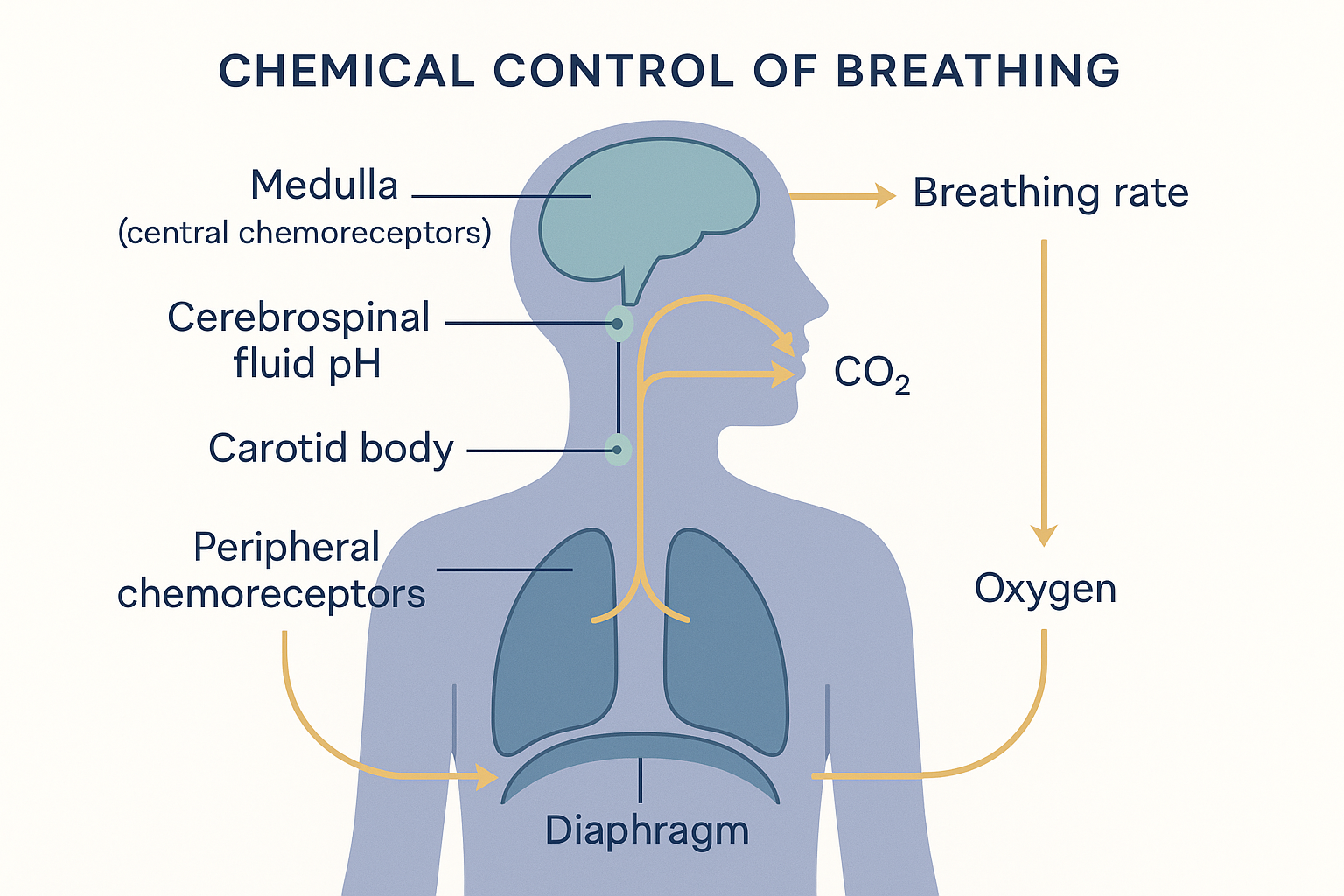 Breathing is a feedback loop tuned mainly to CO₂: central chemoreceptors in the medulla sense the pH change CO₂ causes in the cerebrospinal fluid, while peripheral chemoreceptors act as an oxygen backup alarm — together they set how hard the diaphragm and lungs work.
This explains the physiology of several familiar states:
flowchart TD
    HV["Voluntary over-breathing<br/>(hyperventilation)"] --> LOWCO2["CO2 blown off<br/>(hypocapnia)"]
    LOWCO2 --> ALK["Blood more alkaline<br/>(respiratory alkalosis)"]
    LOWCO2 --> VC["Cerebral vessels constrict"]
    LOWCO2 --> BOHR["Bohr curve shifts left:<br/>Hb holds O2 tighter"]
    VC --> LESS["Less blood to brain"]
    BOHR --> LESS2["Less O2 released to brain"]
    ALK --> TET["Low ionised calcium:<br/>tingling, spasm"]
    LESS --> DIZ["Dizziness, fainting"]
    LESS2 --> DIZ
TET --> DIZ-
Hyperventilation (over-breathing). Breathing faster than metabolism requires blows off CO₂, raising pH (respiratory alkalosis), constricting cerebral vessels and tightening haemoglobin's oxygen grip. The result is dizziness, visual disturbance, tingling (paraesthesia) and even muscle spasm (tetany) — the last because alkalosis lowers the free, ionised calcium in the blood. Crucially, none of this is from lack of oxygen; it is from lack of CO₂. Breathing into a paper bag works by letting you re-inhale your own CO₂ to restore it.
-
Breath-holding. The agonising urge to breathe during a breath-hold is driven by rising CO₂, not by falling oxygen. This is also why hyperventilating before an underwater dive is dangerous: it blows off CO₂ and delays the urge to breathe, allowing a diver to keep swimming until oxygen falls dangerously low before the CO₂ alarm finally fires — the cause of "shallow-water blackout."
-
Altitude. At high altitude the thin air means less oxygen, so the peripheral chemoreceptors finally fire and drive you to breathe harder — which blows off CO₂ and produces a respiratory alkalosis. The body acclimatises over days by having the kidneys excrete bicarbonate to bring pH back down. This interplay of low oxygen, low CO₂ and renal compensation is the whole story of altitude physiology — and, as we will see, a recurring reference point in the bioenergetic view.
-
Permissive hypercapnia in intensive care. In severe lung injury, ventilating gently with small breaths lets CO₂ climb above normal — and this improves survival. Part of the benefit is mechanical (gentler on the lungs), but high CO₂ also improves tissue oxygen delivery (Bohr), and appears to dampen inflammation (by inhibiting the master inflammatory switch NF-κB) and reduce cellular calcium overload and reperfusion injury (review). Hold onto those last two — they are exactly the protective effects the Ray Peat view builds upon, and they come straight from mainstream critical-care literature.
Part 2 — The bioenergetic / Ray Peat view of CO₂
Everything above is settled physiology. What follows is a distinct interpretive layer associated with the biologist Ray Peat (1936–2022) and the "bioenergetic" community he influenced. Peat took the established facts of Part 1 and built them into a larger thesis: that CO₂ is not waste but a protective, anti-inflammatory, pro-metabolic molecule — a measure of metabolic health itself — and that much of ageing and disease is a story of declining CO₂ and rising lactate.
This section is more speculative than Part 1, and is flagged as such. After each idea, a calibration note states honestly how strongly the mainstream evidence supports it. The reader should treat Part 1 as the load-bearing physiology and Part 2 as an interpretive frame — illuminating and partly evidence-backed, but extending well beyond what is established.
A note on quotation: the verbatim Peat quotes below are drawn from his articles (notably "Protective CO₂ and aging" and "Altitude and Mortality") at raypeat.com, from a recorded talk ("The Biology of Carbon Dioxide", transcribed at raypeat.rodeo — spoken-word quotes are marked "as transcribed"), and from his newsletters as compiled at Functional Performance Systems (functionalps.com) and raypeatexplained.com.
CO₂ as "the gas of life"
Peat's central reframing was to invert the cultural ranking of the two gases. Where popular intuition says oxygen is the good gas and CO₂ the bad one, Peat argued that CO₂ is fundamental to life and that an excess of oxygen, with too little CO₂, is what damages tissue. In a spoken talk he put it as bluntly as possible: "For us, like the primitive organisms, it's more essential than oxygen" (The Biology of Carbon Dioxide, as transcribed).
In "Protective CO₂ and aging" he summarises its actions in one sentence: "Carbon dioxide has antioxidant effects, and many other stabilizing actions, including protection against hypoxia and the excitatory effects of intracellular calcium and inflammation" (Protective CO₂ and aging). And in "Altitude and Mortality" he frames the over-breathing problem directly: "Breathing too much oxygen displaces too much carbon dioxide, provoking an increase in lactic acid" (Altitude and Mortality) — describing a spiral in which CO₂ loss and lactate accumulation feed each other.
The mechanistic claims underpinning the "gas of life" framing are the ones from Part 1, simply taken seriously rather than treated as footnotes: CO₂ is required to release oxygen to tissues via the Bohr effect — "at high altitude, the slight tendency toward carbon dioxide-retention acidosis decreases the blood's affinity for oxygen, making it more available to the tissues" (Altitude and Mortality) — CO₂ "relaxes blood vessels, prevents edema... and increases the efficiency of oxidative metabolism" (same source), and CO₂ stabilises cells against several forms of stress (below).
Calibration. The component mechanisms — Bohr effect, CO₂ vasodilation, hypocapnia harming the brain — are well established (Part 1). The framing of CO₂ as a master "hormone" and a global good is Peat's interpretive synthesis: defensible as a unifying picture, but stronger as rhetoric than as a single proven claim.
CO₂ versus lactate: the two faces of metabolism
This is the spine of the bioenergetic view, and it follows directly from the cellular energy page. There are two ways for a cell to extract energy:
- Oxidative metabolism — fuel fully burned in the mitochondria with oxygen, yielding ~30+ ATP per glucose and releasing CO₂. Efficient, clean, the hallmark of a healthy cell.
- Glycolytic (anaerobic) metabolism — the fast shortcut that stops short of the mitochondria, yielding only 2 ATP per glucose and releasing lactate. The fallback of a stressed, oxygen-starved, or damaged cell.
Peat's framing: CO₂ is the exhaust of the good engine; lactate is the exhaust of the stressed engine — and the two are mutually antagonistic. As he put it in "Altitude and Mortality," "Carbon dioxide inhibits the production of lactic acid, and lactic acid lowers carbon dioxide's concentration" (Altitude and Mortality). A high CO₂-to-lactate ratio signals a cell running on efficient oxidative metabolism; a shift toward lactate signals stress, ageing and disease — "Prolonged stress similarly decreases carbon dioxide and increases lactate" (Protective CO₂ and aging). In a later newsletter he tied CO₂ directly to the cell's metabolic mode: "When CO2 is increased, the redox balance shifts toward oxidation, glucose use for growth is inhibited, and the Krebs cycle is activated" (Newsletter, July 2016, via raypeatexplained). He often connected this to the Warburg effect — the observation, by Otto Warburg in the 1920s, that cancer cells preferentially run glycolysis and pour out lactate even when oxygen is available. In the bioenergetic reading, the Warburg shift from a CO₂-producing to a lactate-producing metabolism is a general signature of the diseased, de-energised state, not a cancer-specific quirk.
This is also where thyroid enters. Because thyroid hormone (T3) sets the overall tempo of oxidative metabolism (see metabolism), a person with a high metabolic rate burns fuel oxidatively and produces abundant CO₂; a hypothyroid, low-metabolism person shifts toward glycolysis and lactate — "When carbon dioxide production is low, because of hypothyroidism, there will usually be some lactate entering the blood even at rest" (Altitude and Mortality). Peat made the thyroid link explicit: "The thyroid hormone is the most important promoter of carbon dioxide formation" (Newsletter, 1998, via raypeatexplained). So in his framing, CO₂ production is a readout of thyroid-driven metabolic rate, and "raising your CO₂" and "raising your metabolism" are nearly the same instruction.
Calibration. The biochemistry (oxidative→CO₂, glycolytic→lactate) is textbook-correct. The Warburg effect is real and well-documented. The leap — that a CO₂/lactate ratio is a meaningful general index of health and ageing across the whole body — is a plausible extrapolation that is directionally supported (elevated lactate genuinely tracks with many disease and stress states) but not validated as a clinical metric the way Peat's framing implies.
CO₂ as protector: calcium, free radicals, and inflammation
Peat argued that CO₂ does not merely mark a healthy metabolism but actively defends the cell, through three mechanisms:
-
Against calcium overload. A cell that loses energy cannot keep calcium out, and excess intracellular calcium drives a cascade of damage (over-excitation, enzyme activation, cell death). CO₂ helps restrain this calcium entry and stabilise the cell. Peat grouped it with his other favoured protectors: "The neuroprotective steroids and magnesium and carbon dioxide all protect against excitotoxicity and related excess of intracellular calcium" (Newsletter, Dec 1999, via raypeatexplained).
-
Against free-radical / oxidative damage. In the bioenergetic view, an excess of oxygen relative to CO₂ promotes the generation of reactive oxygen species and the peroxidation of polyunsaturated fats in membranes (the same lipid-peroxidation chemistry discussed in the vitamin E deep dive). CO₂, by ensuring oxygen is used productively (handed off to tissues and burned in the mitochondria) rather than sitting around to form radicals, is cast as antioxidant in effect — "Carbon dioxide protects not only against free radicals, lipid peroxidation", and he cites an experiment in which "people increased the CO2 in the tissues three times normal and saw that the normal amount of lipid peroxides went down to zero" (The Biology of Carbon Dioxide, as transcribed).
-
Against inflammation. CO₂ is framed as broadly anti-inflammatory and tissue-protective: "It can reduce inflammation caused by endotoxin/LPS, by lowering the formation of tumor necrosis factor" and IL-8 (Ray Peat on CO₂, Longevity, and Regeneration, FPS) — note the endotoxin/TNF link to the gut microbiome and inflammation pages.
The striking thing is how well two of these align with mainstream critical-care findings. The permissive-hypercapnia literature explicitly reports that high CO₂ reduces intracellular calcium excess and reperfusion injury, and inhibits the inflammatory master-switch NF-κB (review). Peat was, on these specific points, pointing at real effects that the establishment independently documents.
Calibration. The anti-inflammatory effect (NF-κB inhibition) and the calcium/reperfusion-protection effect are supported by mainstream hypercapnia research — a genuine point in Peat's favour. The antioxidant framing is partly mechanistic, partly extrapolated: the link between hypocapnia, oxygen excess and lipid peroxidation is more inferential than directly proven. The claim that these add up to CO₂ being a broad anti-ageing tonic is the weakest, most extrapolated layer — directionally coherent, but not established.
The breathing practices: Bohr, Buteyko, bags and bicarbonate
The bioenergetic view yields a set of practical interventions aimed at raising or conserving CO₂. Their mechanistic rationale comes straight from Part 1; their broader benefits are where calibration is needed.
-
Slow / nasal / reduced breathing (the Buteyko method). The Russian physician Konstantin Buteyko built a whole therapeutic system on the premise that habitual over-breathing chronically depletes CO₂, and that breathing less — slowly, through the nose, with gentle air hunger — restores it. The mechanism is pure Part 1: more CO₂ means better oxygen unloading (Bohr) and better blood flow (vasodilation). Peat endorsed the underlying logic that most people over-breathe and would benefit from retaining more CO₂.
-
Bag breathing. Re-breathing one's own exhaled air from a paper bag raises inhaled CO₂ and thus blood CO₂ — the same manoeuvre used clinically to abort a hyperventilation attack, repurposed by the community as a deliberate CO₂-raising practice. Peat reported striking anecdotal effects: "Just by breathing in a paper bag a few times a day [people] bring their blood pressure down 30 points" (The Biology of Carbon Dioxide, as transcribed).
-
Bicarbonate, carbonated water, baking-soda baths. Sodium bicarbonate (baking soda) adds bicarbonate to the blood, shifting the buffer equilibrium and supplying the HCO₃⁻ side of the CO₂ system. Peat grouped several of these together as his suggested protocol: "Carbon dioxide (breathing in a bag, or drinking carbonated water, or bathing in water with baking soda) followed by thyroid supplementation, would be the appropriate therapy" (FPS), and noted that "an adequate supply of calcium, and sometimes supplementation of salt and baking soda, can increase the tissue content of CO2" (Protective CO₂ and aging).
-
Altitude and "bag therapy." Peat was fascinated by epidemiological data suggesting lower mortality from several diseases at moderate-to-high altitude — "People who live at very high altitudes live significantly longer; they have a lower incidence of cancer... and heart disease" (Altitude and Mortality). His article explores the paradox that thinner air (less oxygen) correlates with better health outcomes, and proposes that the adaptive increase in CO₂ retention and the metabolic shifts of altitude living — not oxygen deprivation per se — may be protective. The bag practice is, in this framing, a way to mimic an altitude-like CO₂ environment at sea level.
Calibration. The acute mechanisms are solid: bag breathing and reduced breathing genuinely raise CO₂, and CO₂ genuinely improves oxygen unloading and blood flow. Buteyko breathing has reasonable clinical evidence for asthma symptom control, though much of that is via reduced hyperventilation and breathing-pattern normalisation rather than proven systemic CO₂ benefits. The altitude-mortality correlations are real in the epidemiology but heavily confounded (populations, selection, lifestyle, sunlight), and the causal attribution to CO₂ is speculative. Bicarbonate has narrow established uses (specific acidosis, athletic buffering) and the broad "raise your CO₂ pool" rationale is extrapolated.
The cultural conflation: "CO₂ the pollutant" versus CO₂ the metabolite
A point the bioenergetic community stresses — and one worth handling carefully and neutrally — is that the popular image of CO₂ as simply a pollutant (from its role as a greenhouse gas in the atmosphere) has quietly contaminated how people think about CO₂ in the body. The mental shortcut "CO₂ = bad gas, O₂ = good gas," imported from environmental vulgarisation, is then applied to physiology, where it is simply wrong at the cellular level.
The two contexts are entirely separate questions. Whatever one concludes about atmospheric CO₂ as a climate variable (a matter of climate science, not physiology, and outside this page's scope), it has no bearing on the role of CO₂ inside a living cell — where, as Part 1 established without controversy, CO₂ is essential: it delivers your oxygen, buffers your blood, regulates your breathing, and dilates your vessels. A cell starved of CO₂ is a cell in trouble. Confusing the planetary-scale debate with the cellular one leads people to the genuinely harmful intuition that they should "breathe more to get more oxygen and clear out CO₂" — which, as the hyperventilation cascade showed, does the opposite of what they intend.
Calibration. This is not a scientific claim so much as a conceptual clarification, and on the physiology it is correct and uncontroversial: cellular CO₂ and atmospheric CO₂ are different topics, and the "CO₂ is just a pollutant" frame does not belong in human metabolism. The page takes no position on climate science.
Putting it all together
Step back and the misunderstanding dissolves:
- CO₂ is the exhaust of clean combustion. It is produced by decarboxylation at PDH and twice in the Krebs cycle — six CO₂ per glucose, close to a kilogram a day. Its production tracks which fuel you burn (RQ ~1.0 on sugar, ~0.7 on fat) and how fast your metabolism runs.
- CO₂ is carried mostly as bicarbonate, interconverted by carbonic anhydrase, and this same chemistry makes CO₂ the body's primary, fast-acting acid-base buffer, controlled by the lungs in minutes and the kidneys over days.
- CO₂ delivers oxygen. Through the Bohr effect it prises O₂ off haemoglobin exactly where tissues are working; through the Haldane effect the same exchange runs in reverse to load CO₂ for exhaling. O₂ and CO₂ are one coupled system, not opponents.
- CO₂ runs your breathing and your brain's blood supply. It is the main drive to breathe (oxygen is only the emergency backup) and the dominant dilator of cerebral vessels — which is why over-breathing, by blowing off CO₂, makes you dizzy and starves the brain.
- The bioenergetic view takes these facts and reframes CO₂ as a protective, pro-metabolic molecule — the marker of oxidative (versus lactic) metabolism, a stabiliser against calcium overload, oxidation and inflammation, and something to be conserved through slow breathing. The acute mechanisms and the anti-inflammatory / anti-calcium effects are genuinely supported (even by critical-care research); the broad anti-ageing and altitude claims are plausible extrapolations that outrun the current evidence.
The single sentence to keep: CO₂ is not the opposite of oxygen — it is the molecule that makes oxygen useful. Treat it as waste and you will reliably reason backwards about breathing, blood flow and metabolic health.
Related Compounds & Deep Dives
These pages connect directly to the CO₂ physiology above:
The metabolism that produces CO₂
- Cellular Energy: From Fuel to ATP — the decarboxylations at PDH and in the Krebs cycle that are the source of CO₂; the oxidative-vs-glycolytic (CO₂-vs-lactate) split.
- Systemic Metabolism — thyroid hormone sets the metabolic tempo and therefore how much CO₂ (vs lactate) you produce.
- The Liver — handles lactate (gluconeogenesis) and the acid-base load when oxidative metabolism falters.
- Thiamine deep dive and thiamine — vitamin B1 (as TPP) is the required cofactor for PDH and α-KGDH, the two thiamine-dependent decarboxylations that release CO₂.
Oxygen, oxidation and protection
- Oxygen — the other half of the coupled gas exchange; the Bohr/Haldane partner to CO₂.
- Vitamin E deep dive and vitamin E — the lipid-peroxidation chemistry that the bioenergetic view says CO₂ helps restrain.
- Methylene blue — supports oxidative (mitochondrial) electron flow, the CO₂-producing mode of metabolism.
- CoQ10 / ubiquinol — electron-transport-chain carriers whose job is to keep metabolism oxidative (CO₂-producing) rather than glycolytic.
- Niacinamide — supports the NAD⁺/NADH balance that keeps metabolism oxidative.
Bioenergetic / Ray Peat staples linked to the CO₂ thesis
- Aspirin deep dive — a Peat staple held to reduce lactate and support oxidative metabolism.
- Progesterone deep dive and pregnenolone deep dive — protective steroids in the bioenergetic framework, associated with a high-CO₂, anti-stress metabolic state.
- T3 and T4 — thyroid hormones that raise the oxidative metabolic rate and, in the bioenergetic view, raise CO₂ production.
- Salt — discussed alongside CO₂ and bicarbonate in the bioenergetic handling of acid-base and stress physiology.