Sleep Architecture & the Stages
Sleep is not one thing, and it is not "off". It is a precisely ordered sequence of distinct brain states — light sleep, deep slow-wave sleep, and the paradoxical, dreaming state of REM — that the brain marches through four to six times a night in a fixed, purposeful shape. This page builds that architecture from the electrical signals that define it, then answers the question that actually matters: why does each stage exist, and what is it doing to you while you lie there apparently inert?**
For most of human history sleep looked like a single thing: you were awake, then you were not. The first crack in that picture came in 1953, when Eugene Aserinsky, a graduate student in Nathaniel Kleitman's lab in Chicago, noticed that the eyes of sleeping subjects periodically began to dart rapidly beneath their closed lids, accompanied by an EEG that looked almost awake. He and Kleitman had discovered rapid-eye-movement (REM) sleep — and with it the realisation that sleep contains an active, distinct state, the one in which vivid dreaming happens. Four years later, in 1957, William Dement and Kleitman mapped the whole night, showing that sleep is not a flat plateau but a cyclic descent and ascent through EEG-defined stages, repeating roughly every ninety minutes. They had found sleep's architecture.
The next half-century was about standardising what they saw. In 1968 Allan Rechtschaffen and Anthony Kales published the "R&K" manual, dividing NREM sleep into four numbered stages (1–4). In 2007 the American Academy of Sleep Medicine (AASM) revised this into the scheme used worldwide today: three NREM stages — N1, N2, N3 — plus REM, with old stages 3 and 4 merged into a single deep stage, N3 (slow-wave sleep). That AASM vocabulary is what your sleep clinic, your research papers, and — loosely and often wrongly — your wrist tracker all speak.
The last fifteen years have transformed sleep from a behavioural curiosity into one of the most mechanistically rich topics in biology. We now have strong evidence that deep sleep is when the brain replays and consolidates the day's memories (the hippocampus literally re-running its activity into the cortex); that it is when the brain's glymphatic waste-clearance system flushes out metabolic debris including the amyloid-beta of Alzheimer's disease (covered on the lymphatic system page); and — from a striking 2025 study in Cell — that tiny rhythmic waves of the arousal chemical noradrenaline during deep sleep are the pump that drives that clearance, a pump that common sleeping pills switch off. Sleep architecture is no longer just a label for the night. It increasingly looks like the machinery of repair itself.
Why this page exists
The brain-waves page ended on a promise: that the EEG "staircase" of the night — alpha giving way to spindles, then delta, then the paradoxical fast rhythm of REM — would get its own full treatment. This is that treatment. That page explained how the brain generates each rhythm (the thalamocortical loop, the inhibitory interneurons, the descent into hyperpolarisation); this page assumes those mechanisms and asks the next question: what is each stage for?
This matters because almost every sleep intervention people reach for — magnesium, glycine, melatonin, lavender oil, the obsessive chasing of a "deep sleep" number on a tracker — implicitly assumes a model of what the stages do. If you do not know why N3 exists, you cannot reason about whether a compound that increases it is helping or merely sedating you. If you do not know that alcohol trades REM for fragmented light sleep, you will misread a hangover. And if you do not know how badly a wrist tracker estimates sleep stages, you will optimise a number that is partly fiction.
So we build it in order: how sleep is measured and staged → the stages one by one, with their electrical signatures → the ninety-minute cycle and the shape of the night → why each stage exists (the functions — the heart of the page) → how the brain switches between states → and finally what wrecks the architecture, with an honest look at trackers and the "maximise deep sleep" hype.
This page is one leaf of a small cluster. Its siblings cover when you sleep and why you get sleepy: the circadian clock (the body's 24-hour timer), adenosine and sleep pressure (the molecule that makes you tired the longer you are awake), and melatonin (the darkness hormone that opens the gate). This one is about what happens once you are asleep — the internal structure of the night itself.
How sleep is measured: polysomnography
You cannot stage sleep by watching someone. The stages are defined by what the brain and body are doing electrically, and reading that requires polysomnography (PSG) — literally "many-sleep-writing", the simultaneous recording of several physiological signals through the night. Three of them define the stages, and it is worth being precise about what each one measures, because the entire staging scheme is built on their combination.
- EEG — the electroencephalogram (electrodes on the scalp) reads the brain's electrical rhythms. As established on the brain-waves page, the EEG does not measure individual neurons firing; it measures the summed, synchronised electrical fields of millions of aligned cortical cells. A big, slow EEG wave means a huge population is idling in lock-step; a small, fast wave means cells are busy and desynchronised. This is the single most important fact for reading a hypnogram: deep sleep produces the biggest waves not because the brain is most active, but because it is most synchronised.
- EOG — the electrooculogram (electrodes beside the eyes) reads eye movement. The eyeball is a tiny electrical dipole (the cornea is positive relative to the retina), so when the eyes move, the EOG deflects. This is how REM's defining feature — the darting eyes — is detected, and how the slow, rolling eye movements of early sleep are distinguished from the sharp saccades of waking.
- EMG — the electromyogram (electrodes on the chin and often the legs) reads muscle tone. Skeletal muscle has a baseline electrical "hum" of low-level activity that falls as you relax and sleep — and, crucially, collapses almost to zero during REM, the signature of REM muscle paralysis.
A full PSG adds more channels — an electrocardiogram for the heart, airflow and oxygen sensors for breathing (essential for diagnosing sleep apnoea), a pulse oximeter — but the EEG/EOG/EMG triad is the core that defines the stages themselves.
The recording is then carved into 30-second epochs, and each epoch is assigned a single stage according to the AASM rules (a convention inherited from the era of paper traces moving at a fixed speed). A trained technician — or, increasingly, an algorithm — reads the whole night epoch by epoch and produces a hypnogram: a step-graph of stage against time, the canonical picture of a night's sleep. We will spend the rest of this page learning to read it.
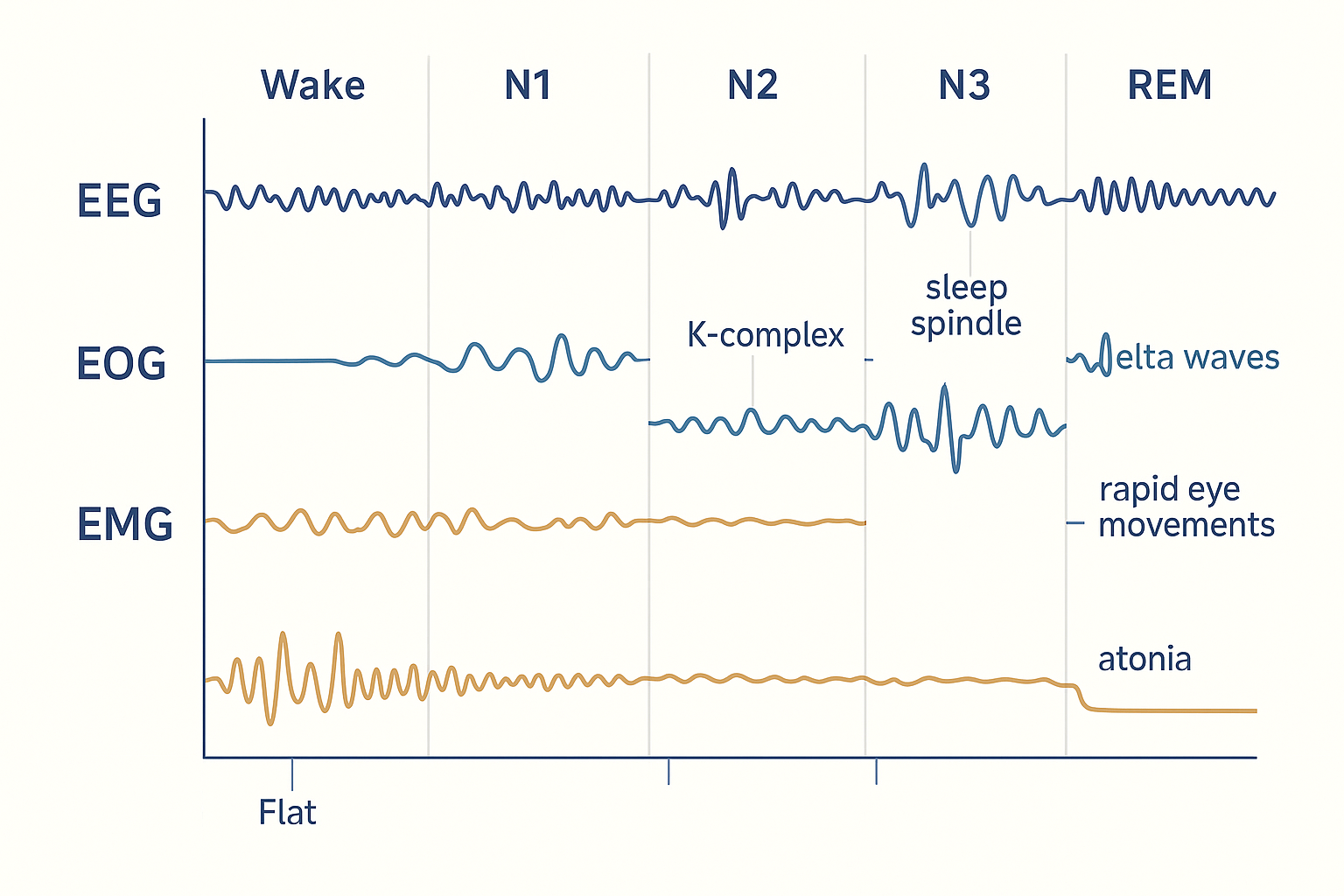 The three signals that define every stage. EEG (brain rhythm), EOG (eye movement), and EMG (muscle tone) read together: N2 is marked by spindles and K-complexes, N3 by tall slow delta, and REM by a near-awake EEG plus darting eyes plus a flat, atonic EMG — the paradox that names it.
The two great divisions: NREM and REM
Before the four stages, grasp the deepest split. Sleep divides into two fundamentally different kinds of brain state, as different from each other as either is from waking:
- NREM (non-REM) sleep — stages N1, N2, N3. The brain progressively synchronises and slows. The body keeps its muscle tone and can move (this is when people shift position, sleepwalk, or talk in their sleep). Metabolic rate, heart rate, and brain temperature fall. Think of NREM as the brain idling and powering down, most extremely in N3.
- REM sleep — the paradoxical state. The EEG speeds up to resemble waking, the brain's metabolic rate climbs back to near-waking levels, vivid narrative dreaming occurs — and yet the body's voluntary muscles are actively paralysed (REM atonia). The brain is hyperactive inside a body that has been switched off. This is why REM is also called paradoxical sleep: by the EEG it looks awake; by the body it is more deeply "gone" than deep sleep.
These two states are generated by different brainstem circuits, serve different functions, are favoured at different times of night, and are disrupted by different things. Almost every confusion about sleep dissolves once you hold the NREM/REM distinction firmly. The four AASM stages are really three depths of NREM plus the one wholly separate state of REM.
The stages, one by one
N1 — the threshold (≈5% of the night)
N1 is the doorway: the brief transition from wake into sleep, usually lasting only a few minutes at each entry and making up roughly 5% of total sleep time. On the EEG, the steady ~10 Hz alpha rhythm of relaxed, eyes-closed wakefulness fades and breaks up, replaced by lower, slower, mixed-frequency activity with theta (4–7 Hz) emerging. The eyes show slow, rolling movements on the EOG; muscle tone begins to drop on the EMG.
N1 is the lightest sleep — woken from it, people often deny they were asleep at all. It is also the home of two familiar experiences: the hypnic jerk (the sudden whole-body twitch as you drop off) and hypnagogic imagery (the drifting half-dreams at the edge of sleep). N1 is mostly a transition stage; its main significance is as the gate you pass through, and as a marker of fragmentation — a night broken up by frequent awakenings shows excess N1 as the sleeper keeps falling back through the doorway.
N2 — the workhorse (≈45–55% of the night)
N2 is where you spend most of your life asleep — roughly half the night. Its EEG background is the low, mixed theta of light sleep, but it is defined by two distinctive electrical events that appear here and nowhere else in waking life, both introduced on the brain-waves page:
- Sleep spindles — brief (~0.5–1 second) bursts of 11–16 Hz waves that wax and wane like a spool of wound wool. They are generated by the thalamic reticular nucleus pacing the thalamocortical loop, and they are far more than a curiosity: spindles are deeply implicated in memory consolidation and in protecting sleep from disturbance (see the functions section).
- K-complexes — large, sharp, lone biphasic waves (a steep down-then-up deflection), often triggered by an external stimulus such as a noise. A K-complex is thought to be the sleeping cortex's way of evaluating a potential disturbance and suppressing arousal — a "stay asleep" reflex — and it frequently ushers in a spindle.
N2 is genuine sleep — arousal threshold is meaningfully higher than N1 — but it is not the deepest. Functionally it is best understood as light, stable, protected sleep that also does real consolidation work, and as the connective tissue between the deeper states: you pass through N2 on the way down into N3 and on the way up into REM, so it brackets every cycle.
N3 — slow-wave (deep) sleep (≈15–25% of the night)
N3 — also called slow-wave sleep (SWS) or deep sleep, and corresponding to the old stages 3 and 4 — is the deepest, most restorative NREM state, making up roughly 15–25% of a young adult's night (and declining steeply with age). Its EEG signature is unmistakable: large, slow delta waves of 0.5–2 Hz and very high amplitude (up to ~200 microvolts). The AASM defines an epoch as N3 once these slow waves fill 20% or more of it.
Each delta wave reflects the entire cortical sheet oscillating between a near-silent "down state" (almost every neuron briefly stops firing) and a synchronous "up state" (the population reactivates together) — the global, slow, lock-step idling that produces the tallest waves the brain ever makes. This is the hardest stage to wake someone from; roused out of N3, people are groggy and disoriented (sleep inertia). It is also the stage from which sleepwalking, night terrors, and bedwetting arise, because they are disorders of partial arousal out of deep NREM — the body's motor systems switch on while the cortex stays largely asleep.
N3 is the stage everyone wants more of, and as we will see its functions justify that — but it is also the most misunderstood, because it cannot simply be willed or supplemented into existence. It is front-loaded into the early night and is the first casualty of age, alcohol, and fragmentation.
REM — paradoxical sleep (≈20–25% of the night)
REM sleep is the separate state. Its EEG is low-amplitude, fast, mixed-frequency — strikingly similar to drowsy waking or N1, often with a theta rhythm (and, in some species, a clean hippocampal theta). The eyes produce their defining rapid, darting movements on the EOG, and the chin EMG goes flat — voluntary muscle tone is actively abolished (REM atonia, detailed below). Breathing and heart rate become irregular; the brain's oxygen and glucose consumption climb back to waking levels or higher; in males, penile erections occur (a fact used clinically to distinguish physical from psychological erectile dysfunction). And this is the stage of vivid, narrative, emotionally charged dreaming — not the only stage in which dreams occur, but the one whose dreams are most story-like and bizarre.
REM makes up 20–25% of a healthy adult's night and is back-loaded — scarce in the first cycle, dominant in the last. It is named for the eyes, but its essence is the paradox: a brain running hot, generating rich experience, inside a body it has deliberately paralysed.
A compact comparison of the four states:
| Stage | EEG signature | EOG (eyes) | EMG (muscle) | % of night | Arousal threshold |
|---|---|---|---|---|---|
| N1 | Alpha breaks up; theta emerges | Slow, rolling | Slightly reduced | ~5% | Very low |
| N2 | Theta + spindles + K-complexes | Mostly still | Reduced | ~45–55% | Moderate |
| N3 | High-amplitude delta (0.5–2 Hz) | Still | Low | ~15–25% | Highest (hard to wake) |
| REM | Low-amplitude fast, mixed, theta | Rapid darting | Atonia (flat) | ~20–25% | Variable (low to internal stimuli) |
The ninety-minute cycle and the shape of the night
Here is the architecture proper. Sleep does not descend to N3 and sit there; it cycles. A healthy night consists of 4–6 cycles, each lasting roughly 90 minutes (commonly 90–110), and within each cycle the brain runs through NREM stages and then into REM before starting over. The standard descent in an early cycle is:
Wake → N1 → N2 → N3 → (back up) N2 → REM → repeat.
But the cycles are not identical, and the way they change across the night is the single most important structural fact about sleep:
- Deep sleep (N3) is front-loaded. The first one or two cycles are rich in N3 — long stretches of delta in the first three hours of the night. By the second half of the night, N3 has largely vanished; late cycles may contain almost none.
- REM is back-loaded. The first REM period is short (often just a few minutes) and arrives ~70–90 minutes after sleep onset. With each successive cycle the REM episode lengthens — the last REM period before waking can run 30–60 minutes. The bulk of your REM, and your most vivid dreaming, happens in the final third of the night, just before you wake.
flowchart LR
    W["Wake<br/>(alpha)"] --> N1["N1<br/>transition / theta"]
    N1 --> N2["N2<br/>spindles, K-complexes"]
    N2 --> N3["N3<br/>delta / deep"]
    N3 -->|ascend| N2b["N2"]
    N2b --> REM["REM<br/>paradoxical, atonia"]
    REM -->|next cycle, ~90 min| N1
    N3 -. "more N3 early in night" .-> N3
    REM -. "more REM late in night" .-> REM
Why this shape? It reflects the two pressures that govern sleep (developed fully on the sibling pages and below). Sleep pressure — built up by the molecule adenosine during waking — is highest at the start of the night and discharges first; deep slow-wave sleep is the discharge, so it dominates early. As that pressure drains over the night, the brain spends less time in N3 and proportionally more in REM, whose timing is gated by the circadian clock and peaks in the biological early morning. The practical corollary is sharp: cut your night short and you cut mostly REM (you wake out of the REM-rich final third); deprive yourself of sleep entirely and the next night rebounds with extra N3 first (the body prioritises deep sleep when desperate). The architecture is not arbitrary — it is a queue, and the order of the queue tells you what the brain treats as most urgent.
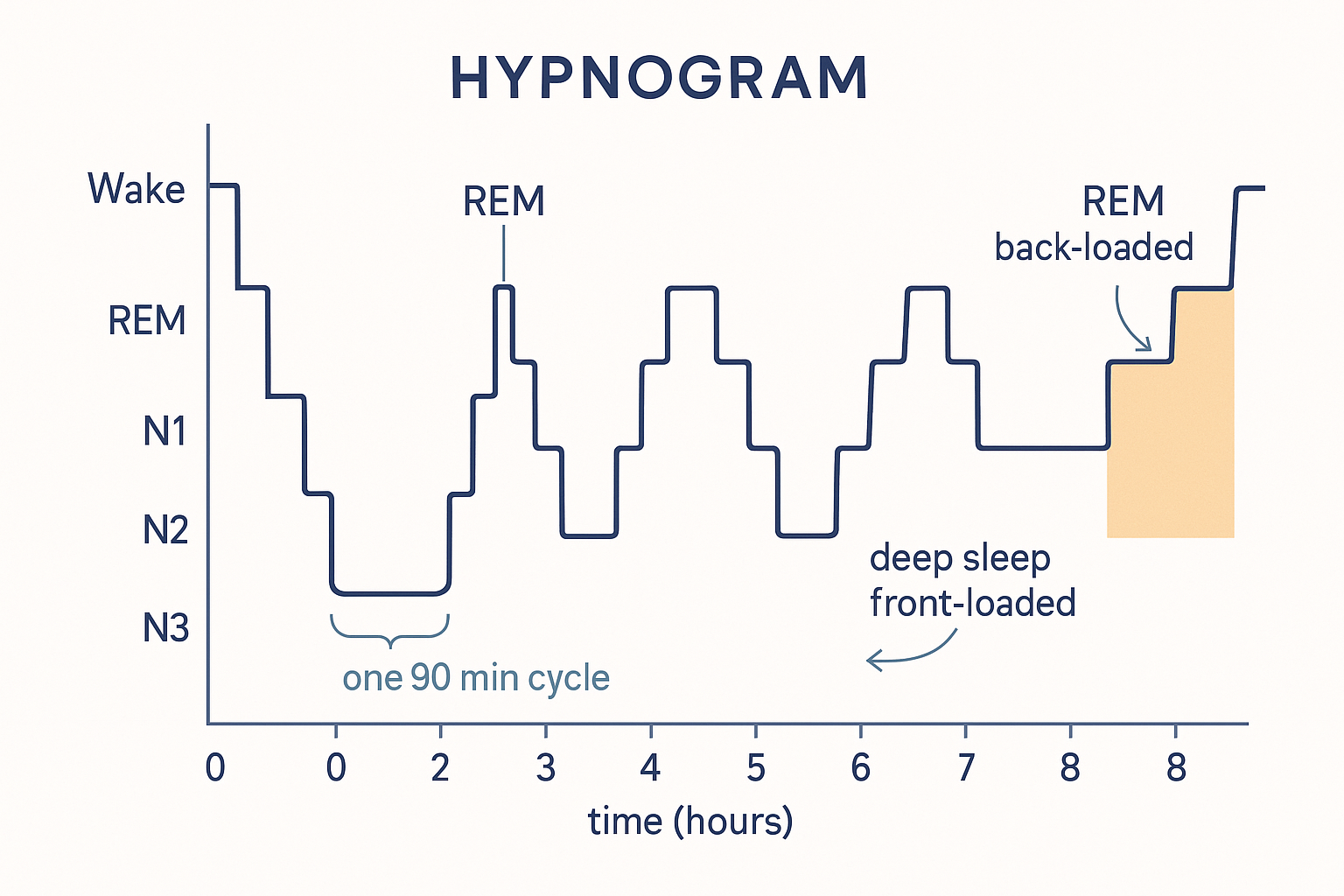 The shape of a night. Each descent-and-ascent is one ~90-minute cycle. Deep N3 (bottom) clusters in the first two cycles; REM plateaus (near the top) lengthen with each successive cycle, dominating the final third before waking. This front-loaded-deep / back-loaded-REM pattern is the signature of healthy sleep architecture.
Why each stage exists — the functions
This is the heart of the page. Sleep is metabolically and evolutionarily expensive — hours of lying unconscious and defenceless every day — so the question is not academic: whatever each stage does must be worth that cost. The honest state of the science is that we understand N3's functions best, REM's least, and that several functions overlap. But the picture is now detailed enough to take stage by stage.
N3 (slow-wave sleep): restoration, memory transfer, and the nightly rinse
Deep sleep does at least four distinct jobs, and they are the strongest answers we have to "why sleep at all".
1. Synaptic homeostasis — turning the gain back down. The leading framework here is the synaptic homeostasis hypothesis (SHY) of Giulio Tononi and Chiara Cirelli. The idea: while you are awake and learning, synapses (the connections between neurons) are strengthened across the brain — you are constantly encoding experience, and net synaptic strength ratchets upward all day. This cannot continue indefinitely: ever-stronger synapses consume more energy and space, saturate the capacity to learn anything new, and worsen the signal-to-noise ratio (everything is shouting). SHY proposes that the slow waves of N3 perform a global downscaling — synapses are proportionally weakened during deep sleep, the strong preserved relatively over the weak, restoring spare capacity and sharpening signal against noise. The down-states of each delta wave (the cortex-wide silences) are thought to be the mechanism. On this view N3 is renormalisation: it rescues the brain's ability to learn tomorrow by gently turning down the gain on everything learned today. This connects directly to the slow-wave generation explained on the brain-waves page.
2. Declarative memory consolidation — moving memories from cache to disk. Distinct from (and complementary to) downscaling, N3 is when the brain consolidates the day's facts and events. The mechanism is one of the most beautiful in neuroscience and is detailed on the brain-waves page: a precisely timed three-rhythm choreography. The cortical slow oscillation (the up/down state of delta) sets the master clock; in its up-states it triggers thalamic sleep spindles; and nested inside the spindles come hippocampal sharp-wave ripples — brief, high-frequency bursts in which the hippocampus replays the neural sequences it recorded during the day, at high speed. This slow-oscillation–spindle–ripple coupling is thought to be the literal act of transferring memories from the hippocampus (a fast, temporary store, the "cache") into the cortex (slow, permanent storage, the "disk"). The evidence is strong: the amount of N3 and the density of spindles predict how much you remember the next day, and stimulating slow waves during deep sleep can improve overnight retention. This is the mechanism behind "sleep on it" — the night does not merely preserve what you learned; it actively reorganises and files it.
3. Glymphatic clearance — the brain's nightly rinse. The lymphatic system page covers this in full, so only the link is made here: during deep slow-wave sleep, the spaces between brain cells widen, and cerebrospinal fluid is driven through the brain tissue along the glymphatic route, flushing out the metabolic waste of a day's neural work — including amyloid-beta and tau, the proteins that aggregate in Alzheimer's disease. The 2025 Cell finding sharpens the mechanism: slow rhythmic oscillations of noradrenaline (from the brainstem's locus coeruleus) during NREM drive a slow vasomotion — a rhythmic narrowing and widening of blood vessels — that acts as the pump propelling fluid through the tissue. Deep sleep is, quite literally, when the brain power-washes itself, and this is among the most compelling mechanistic reasons that chronic deep-sleep loss may, over decades, raise neurodegenerative risk.
4. Growth-hormone release and bodily repair. The largest pulse of growth hormone (GH) of the entire 24-hour day is released during the first episode of N3, shortly after sleep onset (see the hormones page). GH drives tissue growth and repair, protein synthesis, and the mobilisation of fat for fuel. This is the physiological kernel behind "deep sleep is when the body repairs itself" — and it is tightly coupled to the timing of N3: because the big GH pulse rides the first deep-sleep episode, going to bed late or fragmenting early sleep blunts it. Deep sleep is restorative for the body, not just the brain.
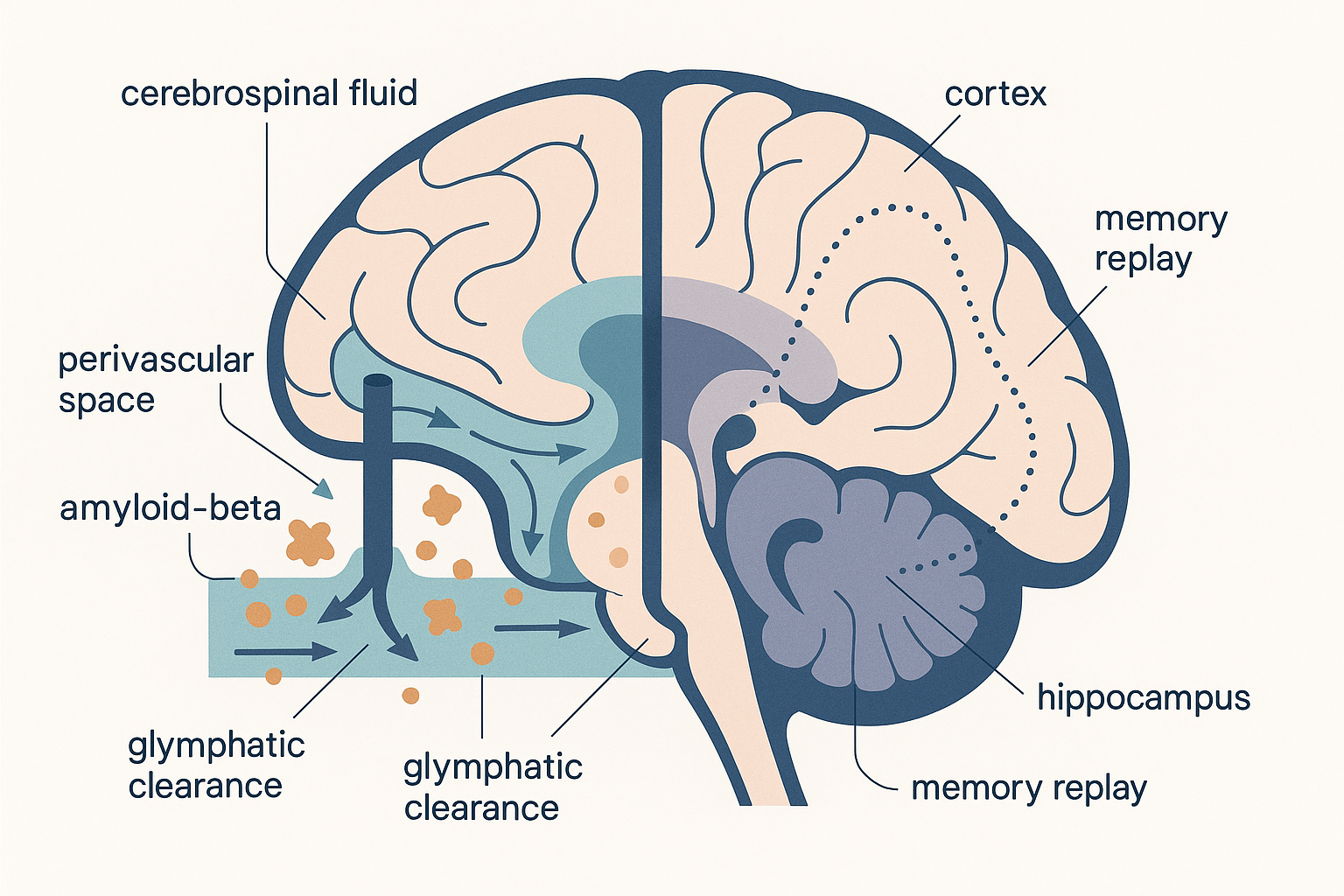 What deep sleep is actually doing, in space. Two jobs run together during N3: cerebrospinal fluid is driven through the widened tissue to flush metabolic waste (amyloid-beta) along the glymphatic route, while the hippocampus replays the day's experience into the cortex through coordinated slow waves, spindles, and ripples — cleaning and filing the brain on the same night shift.
REM sleep: emotion, integration, and the paradoxical brain
REM's functions are harder to pin down — you can survive surprisingly well on suppressed REM, and the dreams themselves resist easy interpretation — but several threads are now well supported.
1. Emotional regulation — overnight therapy. The most robust theory casts REM as the brain's emotional processing state. During REM, the emotional and memory circuits (amygdala, hippocampus) are highly active, while the brain's noradrenaline system is switched off — REM is the only time in 24 hours that the brain is entirely free of this stress chemical. The proposal (Matthew Walker's "overnight therapy") is that REM lets the brain re-process emotional memories in a neurochemically calm state, stripping the visceral charge from a difficult experience while keeping the information. You remember what happened, but it stops hurting as much. Consistent with this, REM deprivation worsens emotional reactivity and the recognition of others' emotions, and disrupted REM is a feature of depression and PTSD (where, on this model, the de-charging fails and emotional memories keep their sting).
2. Procedural and creative memory. Where N3 specialises in declarative memory (facts, events), REM is more associated with procedural memory (skills, motor sequences — the "how") and with integrative, creative processing: finding non-obvious connections, abstracting rules, and solving problems that need a recombination of existing knowledge. People woken from REM are better at anagram and associative tasks; sleep rich in REM improves the integration of newly learned material into existing knowledge networks. If N3 files the day, REM cross-references it.
3. Synaptic maintenance and pruning. REM appears to do its own form of synaptic housekeeping, complementary to N3's downscaling — selectively pruning weak or redundant synapses while strengthening and maintaining the connections tagged as important, particularly those formed during the day's learning. In developing brains REM is especially abundant (newborns spend ~50% of sleep in REM), consistent with a role in wiring and refining neural circuits during the period of most intense brain development.
4. Dreaming and the neurochemistry of the paradox. The bizarre, vivid, narrative quality of REM dreams falls out of REM's unusual neurochemistry, captured in one phrase: cholinergic-on, aminergic-off. During REM, acetylcholine (the neuromodulator associated with cortical activation and plasticity, from the cognition page) surges to waking or higher levels, driving the activated, dreaming cortex. Simultaneously, the aminergic systems — noradrenaline and serotonin — fall almost completely silent. Since those systems normally support logical sequencing, self-monitoring, and the laying-down of new long-term memories, their absence explains REM dreaming's hallmarks: the brain is internally hyperactive and richly associative (cholinergic) but uncritical, illogical, and amnesic (aminergic-off) — which is why dreams feel vivid yet make no sense and are forgotten within minutes of waking unless you wake during them.
5. REM atonia — and why it must exist (and what happens when it fails). During REM the brainstem actively paralyses the body's voluntary muscles: specialised neurons in the pons drive inhibitory (glycine- and GABA-mediated) signals onto the spinal motor neurons, switching them off. The purpose is protective — the dreaming brain is sending out vigorous motor commands (running, fighting, falling), and atonia is the safety interlock that stops you from physically acting out your dreams. The disorders prove the point:
- REM sleep behaviour disorder (RBD) — atonia fails, and the person physically enacts their dreams: punching, kicking, leaping from bed, sometimes injuring themselves or a partner. RBD is clinically important because it is a strong early predictor of Parkinson's disease and related neurodegeneration, often appearing years before any other sign — the same brainstem regions are affected.
- Sleep paralysis — the mirror failure: atonia persists into waking. You become conscious but the body is still switched off, often with frightening hypnagogic hallucinations — a brief, harmless intrusion of REM physiology into wakefulness.
- Narcolepsy — the gate between states is broken (loss of orexin neurons, below): REM intrudes into wakefulness, producing cataplexy (sudden atonia triggered by emotion — the dream-paralysis circuit firing while awake), sleep paralysis, and hypnagogic hallucinations, alongside the overwhelming daytime sleepiness.
N1 and N2: transition, sensory gating, and the protection of sleep
The lighter stages are not merely "shallow N3". N2 in particular does specific work:
- Spindles gate the senses and protect sleep. Sleep spindles, generated by the thalamic reticular nucleus, are thought to close the thalamic gate through which sensory information reaches the cortex — when a spindle is firing, an external sound is less likely to wake you. People with higher spindle density are more resistant to being woken by noise. Together with the K-complex's "suppress this arousal" reflex, this makes N2 an actively sleep-protecting state: it is light, but it is built to keep you asleep.
- Spindles and motor memory. Beyond their role in N3 consolidation, N2 spindles are specifically linked to consolidating motor skills — the overnight improvement in a practised movement (a piano passage, a sports technique) correlates with N2 spindle activity over the relevant motor cortex. Some of the "sleep makes you better at it tomorrow" effect for skills lives in N2, not just REM.
- Transition and orchestration. N1 is the gateway; N2 is the hub that brackets every cycle, the state you must pass through descending into deep sleep and ascending into REM. Its connective role is itself functional — it is the antechamber in which the brain organises each transition between the two great states.
flowchart TD
    N3S["N3 SLOW-WAVE SLEEP<br/>(delta, front-loaded)"]
    N3S --> F1["Synaptic downscaling (SHY)<br/>renormalise, restore capacity"]
    N3S --> F2["Declarative memory<br/>hippocampus to cortex transfer<br/>(SO-spindle-ripple coupling)"]
    N3S --> F3["Glymphatic clearance<br/>amyloid-beta, tau washed out"]
    N3S --> F4["Growth hormone pulse<br/>bodily repair"]

    REMS["REM SLEEP<br/>(paradoxical, back-loaded)"]
    REMS --> R1["Emotional regulation<br/>de-charge memories (NA off)"]
    REMS --> R2["Procedural + creative memory<br/>integration, associations"]
    REMS --> R3["Synaptic pruning + wiring<br/>brain development"]
    REMS --> R4["Atonia: safety interlock<br/>(failure = RBD)"]

    N2S["N2 LIGHT SLEEP<br/>(spindles, K-complexes)"]
    N2S --> S1["Spindles gate senses<br/>protect sleep from waking"]
    N2S --> S2["Motor-skill consolidation"]
Regulation: how the brain switches between states
What decides whether you are awake, in NREM, or in REM — and what flips you between them? Three control systems, layered.
The sleep/wake flip-flop switch
Wakefulness is actively maintained by an ascending arousal system — a set of brainstem and hypothalamic nuclei that broadcast activating neuromodulators across the cortex (noradrenaline from the locus coeruleus, serotonin from the raphe nuclei, histamine from the tuberomammillary nucleus, acetylcholine from the brainstem, and dopamine; introduced on the cognition and ANS pages). Opposing them is a small but powerful sleep-promoting nucleus in the hypothalamus, the ventrolateral preoptic nucleus (VLPO), which releases the inhibitory transmitters GABA and galanin onto all those arousal centres, switching them off.
The crucial feature is that this is a mutually inhibitory pair: the arousal system inhibits the VLPO, and the VLPO inhibits the arousal system. Engineers will recognise this circuit immediately — two elements that each shut the other down form a flip-flop (a bistable switch). Such a circuit has two stable states (wake, or sleep) and almost nothing in between; it resists drifting and snaps cleanly from one to the other. This is why falling asleep and waking feel like transitions through a doorway rather than a slow dimmer — the switch is built to be decisive, so that you are not stranded for long in a dangerous half-asleep limbo.
A flip-flop's weakness is instability if poorly biased — it can flip unwantedly. The system is stabilised by orexin (also called hypocretin), a peptide from neurons in the lateral hypothalamus that reinforces the arousal side, acting as a finger holding the switch firmly in "wake" during the day. When orexin neurons are lost — the cause of narcolepsy type 1 — the switch becomes unstable: patients flip uncontrollably between wake and sleep (and into REM intrusions), exactly the failure mode predicted for an unbalanced flip-flop. Orexin is also the target of a class of insomnia drugs (the "orexin receptor antagonists") that induce sleep by releasing the wake-holding finger rather than by sedating the whole brain.
flowchart LR
    subgraph AROUSAL["ASCENDING AROUSAL SYSTEM (wake)"]
        LC["Locus coeruleus (noradrenaline)"]
        RAPHE["Raphe (serotonin)"]
        TMN["Tuberomammillary (histamine)"]
        ACH["Brainstem (acetylcholine)"]
    end
    VLPO["VLPO<br/>(GABA, galanin) — sleep"]
    OREXIN["Orexin / lateral hypothalamus<br/>(stabiliser)"]

    AROUSAL -->|inhibits| VLPO
    VLPO -->|inhibits| AROUSAL
    OREXIN -->|reinforces, holds 'wake'| AROUSAL
    ADEN["Adenosine (sleep pressure)"] -->|excites| VLPO
    CIRC["Circadian clock (SCN)"] -->|times| OREXIN
The REM-on / REM-off switch
A second flip-flop, deeper in the brainstem (the pons), governs the NREM↔REM transition within sleep. REM-on neurons (cholinergic and glutamatergic) drive the REM state — the cortical activation, the eye movements, the atonia. REM-off neurons (the noradrenergic locus coeruleus and serotonergic raphe — the very same aminergic cells that fall silent in REM) suppress it. These two populations are also mutually inhibitory, forming a second bistable switch that flips the brain into and out of REM roughly every ninety minutes once asleep. This is why REM has its own clean on/off character, and why the cholinergic-on/aminergic-off neurochemistry of REM is not incidental but is the output of the very switch that turns REM on.
Two processes set the timing: C and S
When the switches flip is governed by the two-process model of sleep regulation (Borbély), the master framework for sleep timing, covered on the sibling pages and only summarised here:
- Process S — the homeostatic sleep drive. Adenosine, a by-product of the brain's energy use (the breakdown of ATP — see cellular energy), accumulates the longer you are awake, building sleep pressure that pushes the flip-flop toward sleep and, once asleep, drives the depth of N3. Sleep clears adenosine; the pressure resets.
- Process C — the circadian drive. The circadian clock in the hypothalamic suprachiasmatic nucleus generates a ~24-hour rhythm of alertness, gated by light and by melatonin, that sets when sleep is permitted and biases the timing of REM toward the biological early morning.
The interplay of these two — high S and falling C at night — both triggers sleep onset and sculpts the architecture across the night: S discharges first (deep sleep early), and as S drains while C runs its course, REM comes to dominate the late cycles. The hypnogram's shape is the two-process model made visible.
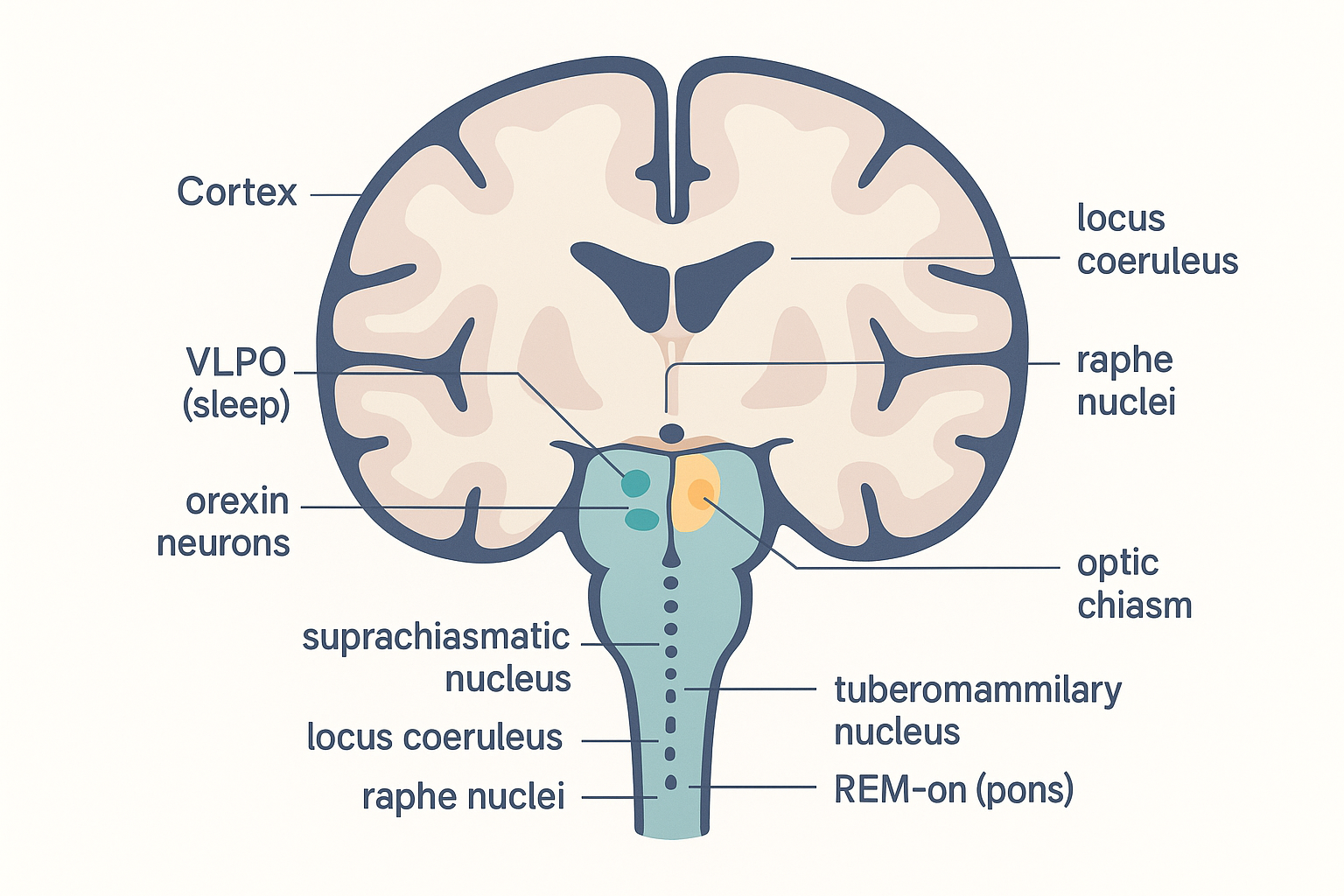 Where the switch lives. The sleep-promoting VLPO and the wake-stabilising orexin neurons sit in the hypothalamus; the ascending arousal chemistry (noradrenaline, serotonin, histamine, acetylcholine) rises from brainstem nuclei; and the suprachiasmatic clock times the whole system. Mutual inhibition between VLPO and the arousal centres makes a bistable flip-flop that snaps between wake and sleep.
What disrupts the architecture — and the honest practical view
Sleep architecture is not a single "amount" of sleep; it is a structure, and different insults damage different parts of it. Knowing which is which is the difference between fixing a problem and chasing a number.
Ageing. The single largest natural change. N3 (deep sleep) declines steeply with age — by middle age it may be a fraction of its young-adult level, and in older adults can be nearly absent — accompanied by reduced spindle density and more fragmented, lighter sleep. Because N3 carries memory consolidation and glymphatic clearance, this decline is suspected to be one mechanism linking ageing, poorer sleep, and cognitive decline. (REM declines more modestly.) Much of what people experience as "sleeping worse as I get older" is specifically the loss of deep sleep, and no supplement reliably restores youthful N3.
Alcohol. A textbook architecture-wrecker, and instructive because its two halves of the night differ. Alcohol is sedating, so it speeds sleep onset and can increase early N3 — which is why people believe it "helps them sleep". But it suppresses REM in the first half of the night and, as it is metabolised, produces a rebound: the second half becomes fragmented, REM-heavy, and full of awakenings. The net is less total REM, badly broken sleep, and the unrefreshing, anxious-dreaming small-hours waking familiar from drinking. Alcohol buys quick onset at the price of the night's architecture.
Caffeine. Works by blocking adenosine receptors (the adenosine page and caffeine page) — it masks sleep pressure rather than removing it. With a half-life of ~5–6 hours, an afternoon coffee leaves a meaningful dose in the blood at bedtime, where it reduces total sleep, suppresses N3, and lightens the night even in people who "fall asleep fine". Caffeine's damage is disproportionately to deep sleep and is often invisible to the sleeper.
Blue light and mistimed light. Evening light — especially the blue wavelengths from screens — suppresses melatonin and delays the circadian signal (Process C), pushing sleep onset later and shrinking the window in which the architecture can unfold (the pineal gland and circadian clock pages cover the mechanism). The damage here is to timing, which then truncates structure.
Sleep apnoea. Obstructive sleep apnoea — repeated airway collapse causing dozens or hundreds of brief arousals per hour — is perhaps the most destructive common disorder of architecture. Each apnoea drags the sleeper up out of deep sleep to resume breathing, so the night never settles into sustained N3 or long REM; it becomes a shredded sequence of N1/N2 and micro-arousals. The person sleeps "eight hours" and gets almost none of the restorative stages — which is why untreated apnoea is so strongly tied to cardiovascular disease, metabolic dysfunction, and cognitive impairment. It is the clearest case of quantity without architecture.
Sedative sleeping pills — a crucial nuance. Many hypnotics (benzodiazepines and "Z-drugs" such as zolpidem) act on GABA receptors to force sleep, but they do not reproduce natural architecture: classically they increase light N2 (and spindle-like activity) while suppressing deep N3 and REM. The 2025 Cell study added a sharp warning: zolpidem suppressed the noradrenaline oscillations that drive glymphatic clearance, meaning the drug may deliver time asleep while blunting the brain's nightly waste-rinse. The lesson generalises: "asleep" is not one thing, and a drug that switches off the cortex is not necessarily delivering the architecture that does sleep's work.
flowchart TD
    AGE["Ageing"] --> LOSE3["Less N3<br/>fewer spindles"]
    ALC["Alcohol"] --> REMSUP["Suppress early REM<br/>then fragmented rebound"]
    CAF["Caffeine (afternoon)"] --> LIGHT["Less N3, lighter night<br/>(masks adenosine)"]
    BLUE["Evening blue light"] --> DELAY["Delay circadian signal<br/>truncate the night"]
    APN["Sleep apnoea"] --> FRAG["Repeated arousals<br/>shred N3 + REM"]
    PILL["Sedative hypnotics<br/>(benzos / Z-drugs)"] --> UNNAT["More N2, less N3 + REM<br/>blunt glymphatic pump"]
    LOSE3 --> COST["Degraded restorative architecture"]
    REMSUP --> COST
    LIGHT --> COST
    DELAY --> COST
    FRAG --> COST
    UNNAT --> COST
Can you "maximise deep sleep"? An honest calibration
The wearables era has made "deep sleep" a number people chase, so two honest points are owed.
Calibration — sleep trackers and stage accuracy
Consumer wrist and ring trackers do not measure sleep stages the way a PSG does — they have no EEG. They infer stages from heart rate, heart-rate variability, movement, and sometimes temperature and breathing, then apply a proprietary algorithm. Validation studies are consistent: these devices are reasonably good at sleep vs wake and total sleep time, but their stage estimates — especially "deep sleep" and REM — are unreliable, often disagreeing substantially with simultaneous PSG and differing between brands and firmware versions. Treat your tracker's nightly "deep sleep: 47 minutes" as a rough, relative, trend-level signal, useful for spotting your own week-to-week patterns and the effect of obvious factors (a late drink, a bad night) — not as a precise measurement to optimise to the minute. The number is partly an estimate of an estimate.
Calibration — the 'maximise deep sleep' framing
Deep N3 is genuinely valuable, but it cannot simply be added on demand, and chasing it directly is mostly the wrong target. N3 is homeostatically defended: its amount is set largely by how much sleep pressure (adenosine) you have built and by your age, not by willpower or a clever supplement. The reliable levers are indirect and unglamorous — protect sleep pressure (don't nap excessively or over-caffeinate), keep a regular schedule so the circadian and homeostatic processes align, avoid the architecture-wreckers above (alcohol, late caffeine, mistimed light, untreated apnoea), and allow enough total time for the full sequence of cycles to run. Compounds that genuinely deepen slow-wave sleep are few and modest; glycine (via mild body-cooling) and magnesium have some support, but the effect sizes are small. The bigger wins come from not breaking the architecture, and from letting the night run long enough that the back-loaded REM is not amputated by an early alarm. You do not build a good night by maximising one stage; you build it by giving the whole architecture the time, regularity, and undisturbed conditions to assemble itself.
Putting it all together
- Sleep is structured, not flat. Polysomnography (EEG + EOG + EMG) defines four states: N1 (transition), N2 (light sleep with spindles and K-complexes), N3 (deep slow-wave/delta sleep), and REM (paradoxical sleep — a near-awake EEG plus darting eyes plus muscle atonia). The deepest split is NREM vs REM: two distinct brain states from two distinct circuits, serving distinct functions.
- The night has a shape. Sleep runs 4–6 cycles of ~90 minutes, each descending through NREM into REM. N3 is front-loaded (the first third), REM is back-loaded (the last third) — a shape dictated by sleep pressure discharging early and the circadian clock favouring late-night REM. Cut the night short and you mostly lose REM.
- Each stage earns its keep. N3 does synaptic downscaling (SHY), declarative memory consolidation via slow-oscillation–spindle–ripple coupling (hippocampus → cortex), glymphatic waste clearance (amyloid-beta), and the night's main growth-hormone pulse. REM does emotional de-charging, procedural/creative integration, synaptic pruning and developmental wiring, and dreaming — under a cholinergic-on/aminergic-off chemistry, with atonia as a safety interlock (whose failure is RBD). N2 spindles gate the senses, protect sleep, and consolidate motor skills.
- The brain switches with flip-flops. Mutual inhibition between the sleep-promoting VLPO (GABA) and the ascending arousal system (noradrenaline, serotonin, histamine, acetylcholine) makes a bistable wake/sleep switch, stabilised by orexin (lost in narcolepsy). A second pontine flip-flop toggles REM on/off. When they flip is set by the two-process model: homeostatic adenosine pressure (Process S) and the circadian clock (Process C).
- Different insults break different parts. Ageing and caffeine erode N3; alcohol suppresses then fragments REM; blue light delays the timing; apnoea shreds the whole structure with arousals; sedative hypnotics add light sleep while blunting N3, REM, and even the glymphatic rinse. Trackers estimate stages crudely, and deep sleep cannot be brute-forced — the win is protecting the conditions and giving the architecture enough undisturbed time to build itself.
The unifying idea: sleep is not the absence of activity but a different, exquisitely organised mode of it. The brain does not switch off at night — it switches jobs, cycling between a synchronised, slow, restorative NREM that downscales, files, cleans, and repairs, and an activated, paralysed, dreaming REM that integrates and emotionally re-balances. The ninety-minute architecture, with deep sleep up front and dreaming at dawn, is the schedule on which that work is done. Read your night as a structure, not a number, and most of what people get wrong about sleep — the alcohol nightcap, the chased "deep sleep" metric, the late alarm that amputates the dreaming — resolves itself.
Related Compounds & Deep Dives
Slow-wave (deep) sleep support
- Glycine — inhibitory transmitter; lowers core body temperature and has modest evidence for improving slow-wave sleep quality and next-day alertness.
- Magnesium (and magnesium L-threonate) — supports the GABAergic/NMDA balance underlying sleep onset and depth; see the magnesium deep dive.
Sleep onset, calm, and the GABA/alpha side
- L-theanine — raises relaxed-wakefulness alpha and eases the transition into sleep without sedation (see brain waves).
- Apigenin — flavonoid with benzodiazepine-site (GABA-A) activity; mild sedative, EEG-slowing direction.
- Silexan — standardised lavender oil; anxiolytic, used to ease the anxious arousal that delays sleep onset.
Timing the night (circadian / darkness signal)
- Melatonin — the darkness hormone that opens the sleep gate; sets when, not how deep (see the melatonin sibling page and the pineal gland).
- Circadian rhythm — light timing and the clock that gates REM toward the early morning.
Arousal chemistry (the wake side of the switch)
- Caffeine — adenosine antagonist; masks sleep pressure and disproportionately suppresses N3 (see adenosine & sleep pressure).
- Modafinil / armodafinil — promote wakefulness partly via the orexin/histamine arousal system that stabilises the flip-flop switch.
- Acetylcholine / choline — cholinergic tone drives the REM-on, dreaming, cortically activated state.
Behavioural levers
- Exercise / running — increase sleep pressure and tend to deepen N3; daytime timing matters.
- Meditation — reduces pre-sleep arousal and can ease sleep onset.
Related foundations
- Brain Waves — the delta, theta, spindle, and K-complex rhythms that define the stages, and the slow-oscillation–spindle–ripple coupling behind memory consolidation.
- The Lymphatic System — the glymphatic clearance that runs during deep slow-wave sleep, flushing amyloid-beta and tau.
- Neuroscience of Cognition — the dopamine, noradrenaline, and acetylcholine systems that form the ascending arousal system and the REM-on/REM-off switch.
- Autonomic Nervous System — the brainstem arousal nuclei and the autonomic shifts across NREM and REM.
- Hormones & the Endocrine System — the growth-hormone pulse of early deep sleep, and cortisol's circadian rise toward waking.
- Cellular Energy — the ATP breakdown that yields adenosine, the molecule of sleep pressure.
- Sleep: the Circadian Clock, Adenosine & Sleep Pressure, Melatonin — the sibling Sleep pages on when you sleep and why you get sleepy.