The Circadian Clock
The ~24-hour timekeeper wired into nearly every cell you own — how a loop of genes switching each other on and off becomes a clock, how the brain's master pacemaker keeps the whole body on the same schedule, and why a single bright morning is the most powerful drug you have for fixing your sleep.
The first real experiment on biological time was done on a plant. In 1729 the French astronomer Jean-Jacques d'Ortous de Mairan noticed that the leaves of a Mimosa pudica opened by day and folded by night, and asked the obvious engineer's question: was the plant simply responding to the sun, or did the rhythm come from inside? He put the plant in a cupboard in constant darkness — and the leaves kept opening and closing on roughly their usual schedule, with no light to cue them. The rhythm was endogenous: it was generated from within, not imposed from outside. For nearly two and a half centuries that observation sat as a curiosity. In the 1950s and 60s the chronobiologists Jürgen Aschoff and Colin Pittendrigh turned it into a science, showing that organisms (including humans, isolated in bunkers away from all time cues) keep a self-sustaining rhythm whose period is close to — but not exactly — 24 hours, and worked out the formal rules by which light resets it. The genetic gears were found in 1971, when Ron Konopka and Seymour Benzer isolated fruit flies whose clocks ran fast, ran slow, or not at all, and traced all three defects to a single gene they named period. Across the 1980s and 90s Jeffrey Hall, Michael Rosbash, and Michael Young prised that gene apart molecule by molecule and revealed the feedback loop that is the clock — work that won them the 2017 Nobel Prize in Physiology or Medicine. Today the frontier has moved outward: away from the single master clock in the brain and toward the realisation that almost every tissue carries its own clock — leading to "circadian medicine" (timing drugs to the clock), chrono-nutrition (when you eat as a signal in its own right), and the study of how shift work and light-at-night damage health through these peripheral clocks. This page is about that machine: what a circadian rhythm is, how its state is physically stored and updated inside a cell, and how the whole system is organised and kept in step with the turning world.
Why this page exists
The companion pineal gland page answered one half of the timing problem: how the body turns "it is night" into a molecule — melatonin — by wiring the eye, through the brain's master clock, down the spinal cord and back up a sympathetic nerve onto the gland. But that page deliberately treated the master clock as a black box that simply "keeps ~24-hour time." This page opens the box. It is the owner of the clock itself: the abstract rhythm, the molecular oscillator that generates it, the hierarchy of clocks that distributes it through the body, and the rules by which the outside world sets it.
The reader who has met melatonin, caffeine, or jet lag in passing usually carries a fuzzy mental model: "there's some internal rhythm, light affects it, melatonin is the night signal." That is true but useless for actually controlling your own biology. The questions that matter are sharper, and they are the ones an engineer asks of any control system. Where is the rhythm physically stored — what is the memory? How does it update itself every cycle without drifting away? What is the sensor, what is the set-point, and what is the actuator? Why does light in the morning fix jet lag while the same light at night makes it worse? Why does a clock in your liver care what time you eat? Answer those and the whole of sleep timing, jet lag, shift-work damage, chronotype ("morning larks" versus "night owls"), and the entire logic of light hygiene fall out of one coherent system. We build it in the order the system itself is organised: first the high-level behavioural frame (the two-process model), then what a circadian rhythm formally is, then the molecular oscillator that stores the state, then the body-wide hierarchy of clocks, then how the world sets them, and finally the failure modes and the levers that fix them.
The two-process model: the organising frame
Before the machinery, the frame. Why do you get sleepy at all, and why at the times you do? The dominant model — proposed by the Swiss sleep researcher Alexander Borbély in 1982 and still the backbone of sleep science — says your sleep–wake state is the product of two independent processes pulling at the same time.
- Process S — the homeostatic sleep drive ("sleep pressure"). This is a debt that accumulates the longer you are awake and is paid down while you sleep. It behaves like a charging and discharging capacitor: rising during waking, falling during sleep. Its physical substrate is, in large part, the build-up of adenosine — a by-product of the cell's energy currency being spent — in the brain; this is exactly what caffeine blocks, and it is the subject of its own page (cross-link below). For now, treat Process S as a slowly rising hunger for sleep that does not care what time it is — it only cares how long you have been awake.
- Process C — the circadian process. This is the ~24-hour rhythm generated by the clock this page describes, and crucially it is independent of whether you have slept or not. It does not track sleep debt; it tracks time of day. Process C sets a moving alerting signal (and, in the model's formal version, a pair of moving thresholds) that rises and falls on its own schedule regardless of how tired you are.
Sleep happens not from either process alone but from their interaction. Here is the elegant part. Through the day, sleep pressure (S) climbs steadily — yet you do not get progressively, helplessly sleepier from morning to night, because the circadian alerting signal (C) is also climbing through the day, actively opposing the rising pressure. The clock deliberately produces its strongest wake-promoting push in the evening — the so-called "wake maintenance zone" a few hours before habitual bedtime — precisely to counteract the now-large sleep debt and keep you consolidated and awake until a sensible hour. Then, at night, the circadian alerting signal drops away, the brake is released, the large accumulated pressure is suddenly unopposed, and sleep comes on and stays consolidated. By morning, pressure has been discharged by sleep and the circadian signal is rising again — so you wake and stay awake. The two curves, offset by design, produce a single long block of wakefulness and a single consolidated block of sleep rather than the scattered naps you would get from sleep pressure alone.
flowchart TD
    AWAKE["Time awake"] --> S["Process S<br/>sleep pressure rises<br/>(adenosine builds)"]
    CLOCK["Circadian clock"] --> C["Process C<br/>alerting signal<br/>(time-of-day, sleep-independent)"]
    C -->|"evening: strong wake push<br/>opposes rising pressure"| GATE["Sleep gate:<br/>S minus C"]
    S --> GATE
    C -->|"night: alerting drops,<br/>pressure now unopposed"| GATE
    GATE -->|"S high AND C low"| SLEEP["Consolidated sleep<br/>(S discharges)"]
    GATE -->|"S low AND C rising"| WAKE["Consolidated wakefulness"]
This frame matters because it cleanly separates two things people constantly confuse. "I am tired" (high Process S) is not the same as "it is my biological night" (low Process C). You can be exhausted at 3 p.m. (high S) yet unable to sleep because your clock is screaming daytime (high C) — and you can be wide awake at 4 a.m. on no sleep debt during jet lag because your clock still insists it is daytime in the city you left. Almost every sleep problem is a problem of one process, the other, or their misalignment. The rest of this page is about Process C — the clock — because the homeostatic Process S has its own dedicated page.
What a circadian rhythm actually is
A circadian rhythm (from Latin circa diem, "about a day") is a biological oscillation with four defining properties, and each one is load-bearing. Get these four definitions straight and the rest of the page is precise rather than hand-wavy.
- It is endogenous and self-sustaining. The rhythm is generated inside the organism and persists even when every external time cue is removed. This is the property de Mairan's plant demonstrated. The test is strict: put the organism in constant conditions — constant darkness or dim light, constant temperature, no clocks, no social cues — and a true circadian rhythm keeps oscillating. A rhythm that vanishes the moment you remove the light–dark cycle was merely a response to the environment, not a clock. The circadian rhythm is the clock running with its hands off.
- Its period is "about" a day, not exactly a day. When it runs in constant conditions with nothing to set it, the rhythm reveals its own natural period, called tau (τ) — the time for one full cycle. The deep point is that tau is not exactly 24 hours. In humans, careful "forced desynchrony" experiments (people kept on artificial day lengths in time-isolation) pin the average human τ at about 24.2 hours — slightly longer than a real day. A rhythm running freely with its own period, untethered from the 24-hour world, is said to be free-running. A free-running human clock of τ ≈ 24.2 h would, left alone, drift about 12 minutes later every day — which is exactly why, as we will see, the system needs a daily correction and why our natural tendency is to drift later rather than earlier.
- Period, phase, and amplitude are the three knobs. Any oscillation is described by three numbers. Period is how long one cycle takes (τ). Phase is where in the cycle you are at a given clock time — the timing of a reference point such as the melatonin rise or the core-body-temperature minimum relative to the outside clock; "phase" is what shifts when you get jet-lagged or when a lark and an owl wake at different hours. Amplitude is the strength of the swing — the height of the peak above the trough; a robust young clock has high amplitude, an ageing or sick or chronically light-polluted clock has a flattened, low-amplitude rhythm. When we talk about "shifting the clock" we mean moving its phase; when we talk about a clock weakening with age or shift work we mean losing amplitude.
- It is entrainable. Left alone the clock free-runs at τ ≈ 24.2 h, which is useless — a clock that drifts is not a clock. So the rhythm can be entrained: locked onto the exact 24-hour cycle of the outside world by external time cues. A time cue capable of entraining the clock is called a zeitgeber (German for "time-giver"). The dominant zeitgeber is light; weaker ones include feeding, exercise, temperature, and melatonin itself. Entrainment is not the same as a stopwatch being reset to a master time; it is a continuous, small daily correction of an oscillator that would otherwise drift. Each day the zeitgeber nudges the free-running clock's phase by just enough to cancel out the difference between τ and 24 hours, holding it locked at a stable phase relationship with the day.
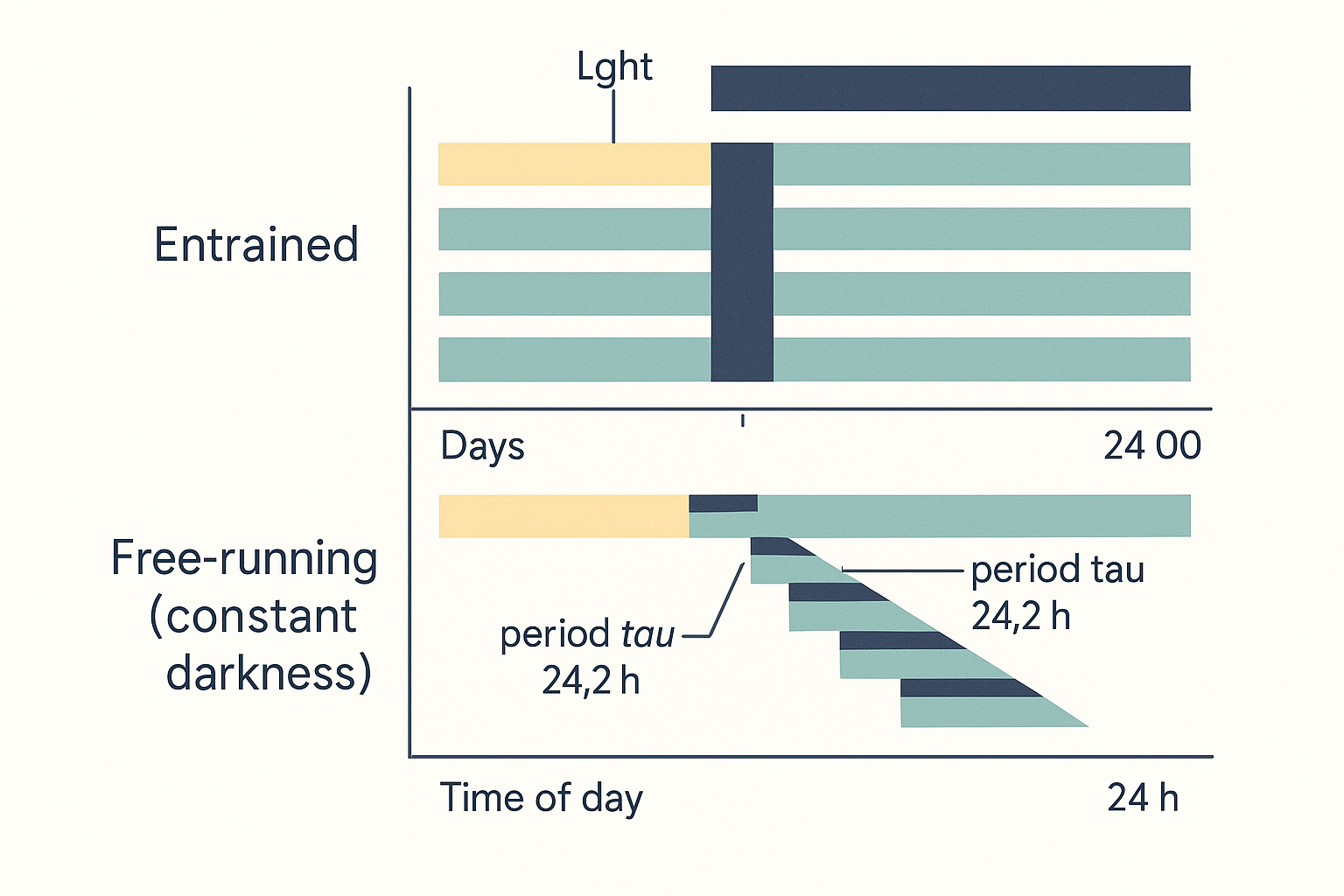 An actogram stacks successive days top to bottom. Entrained to the light–dark cycle (top), the rhythm locks to a fixed clock time — a vertical band. Removed from all time cues (bottom), the same clock free-runs at its own period (τ ≈ 24.2 h in humans), so each day starts a little later and the band slopes away. Entrainment is the daily correction that keeps the top panel vertical.
The molecular clock: how the state is stored and updated
Now the core question, the one an engineer most wants answered: where is the time physically stored, and how does the clock update itself every cycle? The answer is one of the most beautiful mechanisms in biology. The clock is not a structure or a current or a chemical level held steady — it is a loop of genes switching each other on and off, deliberately built with delays so that one full turn of the loop takes about 24 hours. This loop runs inside individual cells; it is cell-autonomous. The stored "state" of the clock is the current concentrations of a handful of proteins, rising and falling around the loop — that pattern of concentrations is the memory, and the loop's own dynamics are the update rule. This architecture is called a transcription–translation feedback loop (TTFL).
First, two pieces of vocabulary, because everything below depends on them. Transcription is the cell copying a gene's DNA into a messenger RNA (mRNA) — the first step of "reading out" a gene. Translation is the cell building the actual protein from that mRNA. A transcription factor is a protein that controls whether other genes get transcribed — it binds DNA at a control region and switches a gene on (an activator) or off (a repressor). The whole clock is just transcription factors regulating each other in a ring.
The core loop, step by step
Trace one full ~24-hour turn:
- The activators switch the clock genes on. Two proteins, CLOCK and BMAL1, pair up into a single complex (CLOCK:BMAL1). This complex is a transcription activator. It binds a specific short DNA sequence — the E-box (sequence CACGTG) — sitting in the control regions of the clock's target genes, and switches them on. Its key targets are the genes named Period (there are three, PER1/2/3) and Cryptochrome (CRY1/2). So early in the cycle: CLOCK:BMAL1 is on the DNA, and Per and Cry are being transcribed hard.
- The repressor proteins are built and accumulate. The Per and Cry mRNAs are translated into PER and CRY proteins out in the cytoplasm (the cell's main body, outside the nucleus). These proteins accumulate slowly over hours. This slow build-up is the first deliberate delay in the loop — the cell does not flip instantly; it fills a reservoir.
- A phosphorylation timer controls when they are ready. This is the step that actually sets the ~24-hour period, and it is the one most pages skip. As PER accumulates, it is tagged by an enzyme — casein kinase 1 delta and epsilon (CK1δ/ε) — which attaches phosphate groups to it (phosphorylation, a chemical post-it note that changes a protein's behaviour). Phosphorylation does two competing things to PER: some sites mark it for destruction, and others govern when it is allowed to enter the nucleus. The balance of these tags acts as a molecular egg-timer: it stalls the PER/CRY complex in the cytoplasm for hours before it is finally licensed to act. The speed of this kinase is, quite literally, the speed of the clock — which is why mutations here change the period of the whole organism (more on this below).
- The repressors enter the nucleus and shut their own genes off. Eventually, properly phosphorylated PER joins with CRY (and CK1δ/ε rides along), and the complex translocates into the nucleus. There it finds CLOCK:BMAL1 still sitting on the E-boxes and shuts it off — in two stages that recent work has resolved. First, the arriving complex delivers CK1δ to the DNA-bound CLOCK:BMAL1 and phosphorylates CLOCK, which physically displaces the activator from the E-box (so it can no longer drive transcription). Then, as PER is degraded, the remaining CRY1 stays behind and blocks BMAL1's activating surface, holding the gene silent. Either way the outcome is the same: the proteins shut off the very genes that made them. This is negative feedback — the defining feature.
- The repressors are degraded, and the loop restarts. With their own genes switched off, no new PER and CRY are being made — and the existing pool is steadily degraded (those destruction phosphate-tags from step 3 finally cash in, marking the proteins for the cell's disposal machinery). As PER and CRY concentrations fall, their grip on CLOCK:BMAL1 weakens. CLOCK is dephosphorylated, the activator complex re-binds the E-box, and transcription of Per and Cry starts again. The loop has completed one turn — and, because of the deliberate delays at every stage (slow accumulation, the phosphorylation egg-timer, slow degradation), that turn takes about 24 hours.
The crucial conceptual point: the clock's "state" is stored as the phase of this oscillation — the current level of PER/CRY proteins and how phosphorylated they are. There is no separate memory chip; the loop's own protein concentrations are the time, and the loop's chemistry is the update rule that advances that time. It is a clock built entirely out of the delay between a gene being switched on and its product coming back to switch it off.
flowchart TD
CB["CLOCK + BMAL1<br/>(activators) bind E-box"] -->|"switch ON"| GENES["Per & Cry genes<br/>transcribed"]
GENES -->|translation| PROT["PER + CRY proteins<br/>accumulate in cytoplasm"]
PROT -->|"CK1 phosphorylation:<br/>egg-timer + tagging"| DELAY["Delay: stalled hours<br/>before nuclear entry"]
DELAY -->|"enter nucleus"| INH["PER/CRY + CK1<br/>displace & block CLOCK/BMAL1"]
INH -->|"own genes shut OFF"| DEG["No new protein made;<br/>PER/CRY degraded"]
DEG -->|"repression lifts → restart"| CB
CB -->|"also switch ON"| REV["Rev-erb & Ror genes"]
REV --> RP["REV-ERB represses /<br/>ROR activates Bmal1"]
RP -.->|"second loop sets BMAL1 rhythm,<br/>adds stability"| CBThe secondary loop, and why the clock is robust
A single feedback loop can oscillate, but it would be fragile — easily knocked off rhythm. The real clock is reinforced by an interlocked second loop that controls the activator side. CLOCK:BMAL1 also switches on two more genes: Rev-erb (α and β) and Ror (α/β/γ). Their proteins then compete at a different DNA control element (the RORE, or ROR response element) in the promoter of the Bmal1 gene itself: REV-ERB represses Bmal1 while ROR activates it. The result is that BMAL1 — the activator — is itself made on a rhythm, in antiphase to PER/CRY. This second loop does not generate the rhythm on its own; it stabilises it, making the oscillator resistant to perturbation and sharpening the timing of the activator's daily return. It is also a major way the clock controls outputs: REV-ERB, in particular, rhythmically switches metabolic genes on and off, which is part of why metabolism is so tightly clock-gated. (REV-ERB's drug-targetability is one of the live frontiers of circadian medicine.)
This molecular loop is not a curiosity of brain cells. The same TTFL runs in liver cells, fat cells, heart muscle, gut lining, skin, immune cells — essentially everywhere. Genome-wide studies find that, across the whole body, on the order of 40% of all protein-coding genes are under circadian control in at least one tissue. The clock is not a niche timekeeper; it is a body-wide scheduling system that decides when huge swathes of your biochemistry run. That immediately raises the organisational problem this page turns to next: if every cell has its own clock, what stops them all drifting apart?
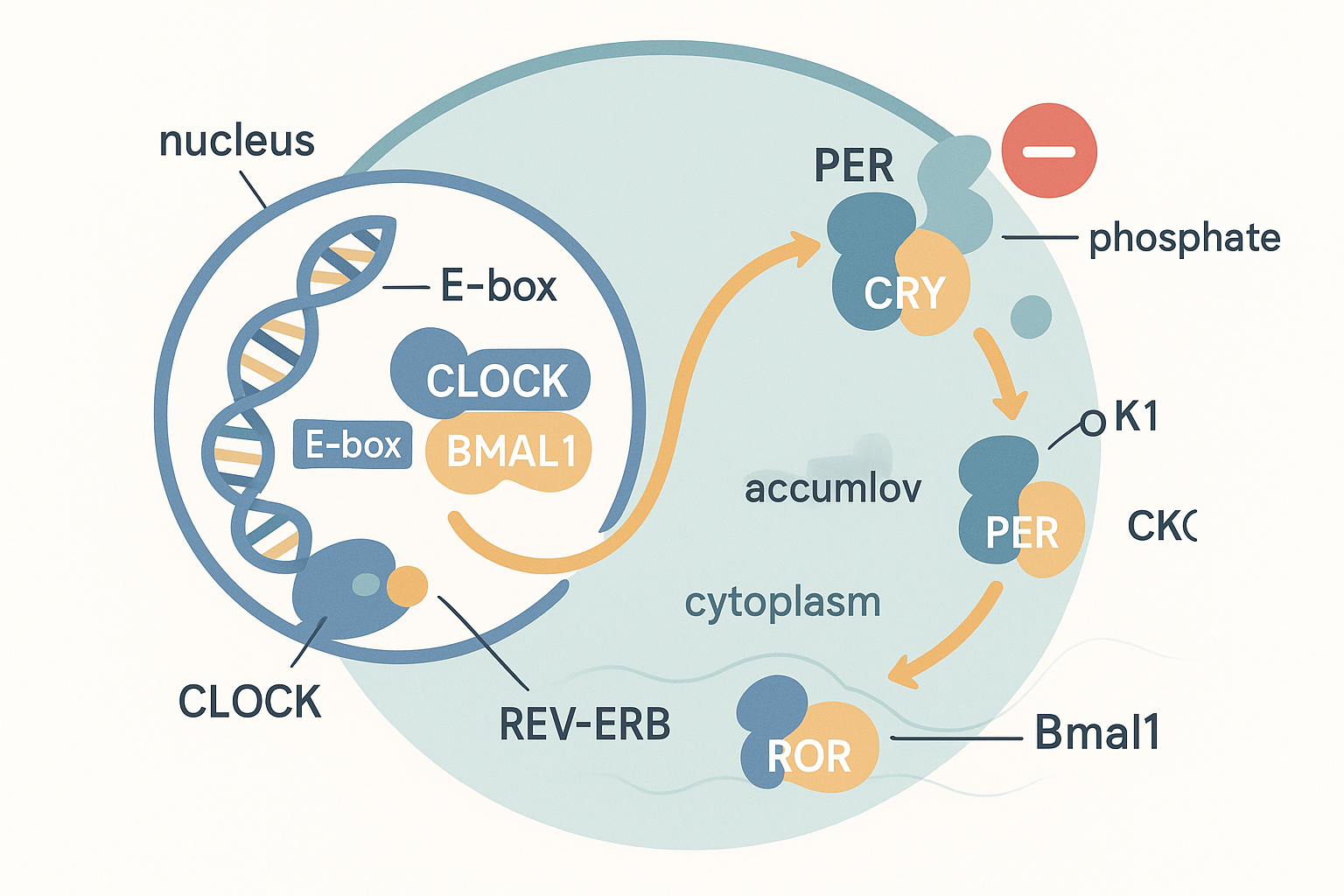 The clock lives in the geography of a single cell. CLOCK:BMAL1 on the nuclear DNA drives PER and CRY; the proteins build up in the cytoplasm, are phosphorylated by CK1 (the period-setting timer), then re-enter the nucleus to switch their own genes off before being degraded. The whole loop, with its built-in delays, turns once every ~24 hours. The state of the clock is simply where in this cycle the protein levels currently sit.
The system hierarchy: master clock and peripheral clocks
If billions of cells each run their own ~24-hour loop, and each loop free-runs at a slightly different rate, the body would rapidly become a bag of clocks all telling different times — circadian chaos. The body solves this with a hierarchy: one master clock that is itself kept accurate by the outside world, and a population of peripheral clocks in the tissues that the master clock keeps synchronised.
The master clock: the SCN
The master pacemaker is the suprachiasmatic nucleus (SCN) — a pair of tiny clusters totalling roughly 20,000 neurons in the hypothalamus, sitting just above the optic chiasm (where the optic nerves cross — hence "supra-chiasmatic"). Three features make the SCN fit to be the master:
- It is robustly self-sustaining. Each SCN neuron runs the TTFL loop, but unlike isolated peripheral cells, SCN neurons are densely coupled to one another — they exchange signals (notably the neuropeptides VIP and AVP) that pull all their individual loops into tight synchrony. A coupled population of oscillators is far steadier and more precise than any single cell; this coupling is why the SCN can keep ticking accurately for weeks in constant darkness while an isolated liver clock would quickly damp out. The SCN is, in effect, a flywheel — heavy, stable, hard to knock off rhythm.
- It is the one clock with a direct line to the light sensor. As detailed below (and on the pineal gland page), the SCN receives light information straight from the retina. It is the body's point of contact between the external day and the internal clock.
- It broadcasts time to the rest of the body. The SCN does not sense liver glucose or muscle fatigue; its job is purely to keep accurate time and impose it on everything else.
Peripheral clocks, and how the SCN synchronises them
Nearly every organ — liver, pancreas, gut, heart, kidney, fat, muscle, skin — contains cells running the same TTFL. These are the peripheral clocks, and they are not merely passive read-outs; they actively schedule their organ's local biochemistry (the liver clock, for instance, anticipates mealtimes and pre-positions digestive and metabolic enzymes). But a peripheral clock left to itself drifts. The SCN keeps them aligned through four main channels — and the variety is the point, because it is what lets different zeitgebers and different behaviours pull on the system:
- Neural signals (the autonomic nervous system). The SCN drives rhythmic output through the sympathetic and parasympathetic nerves (see the autonomic nervous system page) to organs directly — the same wiring that, routed to the pineal, produces the nightly melatonin pulse.
- Cortisol. The SCN imposes a daily rhythm on the adrenal gland's output of cortisol, which peaks sharply in the early morning (the cortisol awakening response). Cortisol is a powerful synchronising signal — almost every peripheral cell has glucocorticoid receptors — so this morning hormone pulse acts as a body-wide "it is now morning, start the day-time programme" broadcast.
- Body temperature. The SCN drives a daily core-body-temperature rhythm (lowest in the late night, around two hours before habitual waking; highest in the early evening). The swing is only about a degree, but peripheral clocks are sensitive to temperature cycles, so this gentle daily warming and cooling is itself an entraining signal — an internal zeitgeber the master clock uses to keep the tissues in step.
- Feeding/fasting cycles. Because the SCN controls the rest–activity cycle, it controls when you eat — and feeding is a potent synchroniser of peripheral clocks, especially the liver. This is the channel that makes meal timing ("chrono-nutrition") matter, and the one that can be hijacked, as the next section explains.
The deep idea is that the SCN sits at the top, reads the light, and uses these hormonal, neural, thermal, and behavioural relays to keep the orchestra of peripheral clocks playing in time. Melatonin — the pineal gland's output — is one more of these broadcast signals: the SCN's chemical announcement of biological night, read by MT1/MT2 receptors throughout the body and feeding back onto the SCN itself.
flowchart TD
LIGHT["Light (the day)"] --> SCN["SCN master clock<br/>(20,000 coupled neurons,<br/>self-sustaining flywheel)"]
SCN -->|autonomic nerves| AUT["Direct neural drive<br/>(incl. pineal → melatonin)"]
SCN -->|adrenal| CORT["Cortisol pulse<br/>(morning 'start day' signal)"]
SCN -->|hypothalamus| TEMP["Core body temperature<br/>rhythm (~1 C swing)"]
SCN -->|rest-activity| FEED["Feeding / fasting timing"]
AUT --> PERIPH["Peripheral clocks<br/>liver, gut, heart, fat,<br/>muscle, pancreas, skin"]
CORT --> PERIPH
TEMP --> PERIPH
FEED --> PERIPH
PERIPH -->|"each schedules its<br/>own organ's biochemistry"| OUT["~40% of genes<br/>clock-controlled"]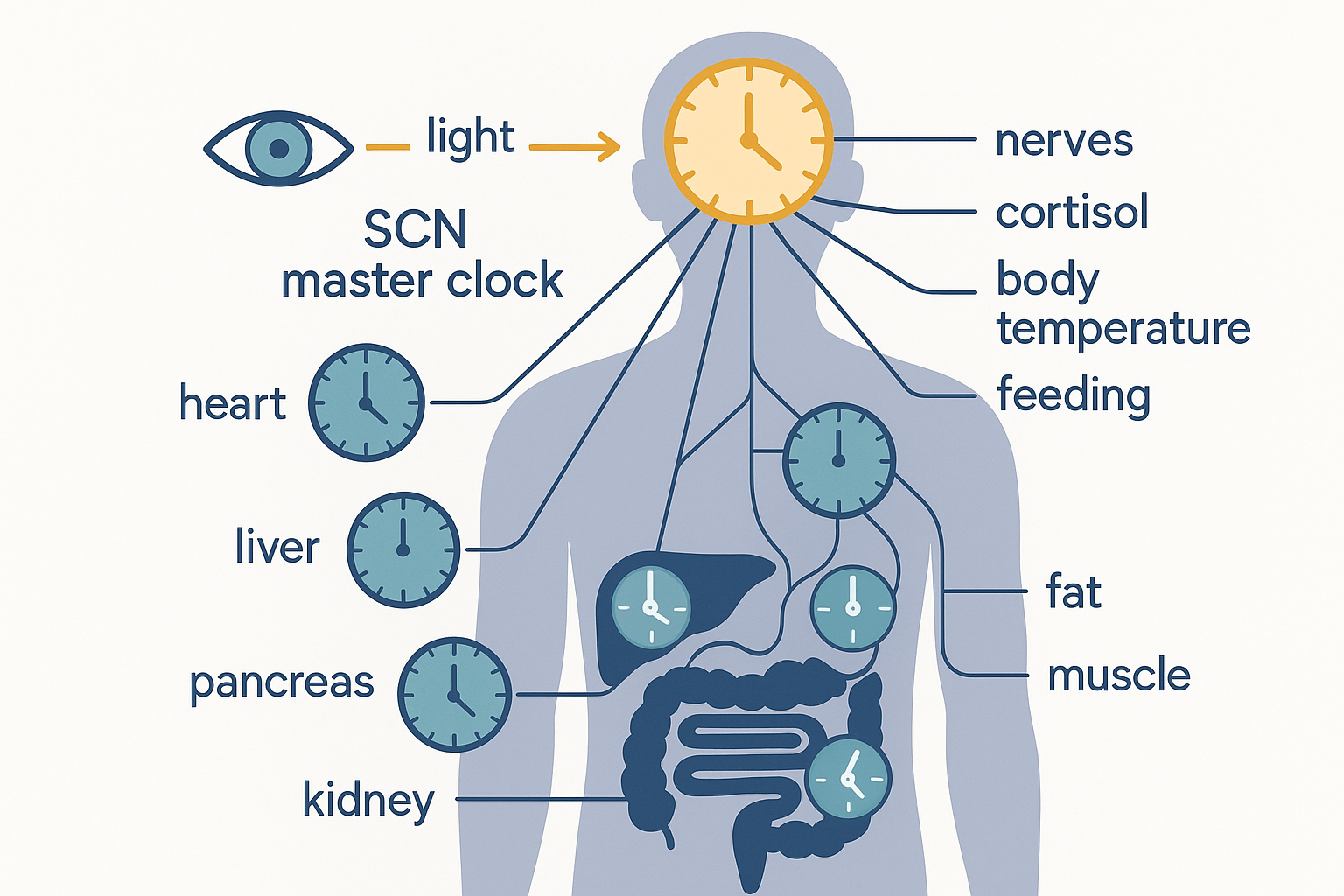 The clock is a hierarchy laid out across the whole body. The SCN in the brain — the only clock wired to the eye — keeps accurate time and synchronises the peripheral clocks in nearly every organ through four channels: autonomic nerves, the morning cortisol pulse, the core-body-temperature rhythm, and feeding times. Each peripheral clock then schedules its own organ's chemistry. Misalign the channels (e.g. eating at biological night) and the organ clocks pull apart from the master.
Entrainment: how the world sets the clock
We now have a free-running oscillator (τ ≈ 24.2 h) and a hierarchy that distributes its time. The last piece is the daily correction that holds the whole thing locked to the real 24-hour day — entrainment — and its single most important rule, the phase-response curve.
Light: the dominant zeitgeber
Light is the master zeitgeber, and the wiring is exactly the front end of the melatonin circuit on the pineal gland page, so only the essentials here. A special class of retinal cells — intrinsically photosensitive retinal ganglion cells (ipRGCs), containing the blue-light-sensing pigment melanopsin — measure ambient light (they are brightness meters, not vision cells). They send that signal down a dedicated pathway, the retinohypothalamic tract (RHT), straight to the SCN. Inside the SCN, a light pulse triggers a fast molecular event: it induces the Per genes. And this is the entire mechanism of resetting — a flash of light at the wrong time forces an extra burst of PER, which shoves the feedback loop forward or backward in its cycle. The clock is reset by light reaching in and directly perturbing the protein loop.
The phase-response curve: the most important rule on this page
Here is the rule that explains everything practical about light and jet lag, and it is profoundly counter-intuitive until you see it: the same light pulse shifts the clock in opposite directions depending on when in the cycle it arrives. Plot the size and direction of the shift against the time of the pulse and you get the phase-response curve (PRC) for light. Its shape is consistent across all studied animals, including humans:
- Light in the early biological night — the evening, before your core-body-temperature minimum — causes a PHASE DELAY. It pushes the clock later: you will want to sleep and wake later. Intuition: evening light is the day refusing to end, so the body reads "the day is long, dusk is late," and slides its whole schedule later.
- Light in the late biological night and early morning — after your core-temperature minimum, i.e. around and after habitual wake time — causes a PHASE ADVANCE. It pulls the clock earlier: you will want to sleep and wake earlier. Intuition: early light is dawn arriving, so the body reads "morning is here, and it came early," and pulls its schedule earlier.
- Light during the middle of the day has almost no phase-shifting effect — the "dead zone." Daylight at noon does not move the clock's phase much; what midday light does do is build the clock's amplitude (robustness), which is a separate and valuable benefit.
The pivot point is the core-body-temperature minimum (CBTmin), which falls roughly two hours before your habitual wake time. Light before CBTmin delays; light after CBTmin advances. This one fact is the engine of jet-lag management, of why scrolling a bright phone at midnight is so destructive (late-evening blue light is a maximal delay signal, dragging your clock later night after night), and of why morning light is the single most powerful tool for getting up earlier (post-CBTmin light is a maximal advance signal). It also explains the system's resting behaviour: because human τ runs slightly long (~24.2 h), we naturally drift later, and the daily dose of morning light delivers exactly the phase-advance needed to cancel that drift — which is why the body is built to be corrected by the dawn.
flowchart TD
CBT["Core body temperature<br/>minimum (~2h before wake)"]
EVE["Light in EARLY night<br/>(evening, before CBTmin)"] -->|phase DELAY| LATER["Clock shifts LATER<br/>(sleep/wake later)"]
MORN["Light in LATE night / morning<br/>(after CBTmin)"] -->|phase ADVANCE| EARLIER["Clock shifts EARLIER<br/>(sleep/wake earlier)"]
NOON["Light at MIDDAY"] -->|dead zone| AMP["Little phase shift;<br/>builds amplitude/robustness"]
CBT -.->|"pivot: before = delay,<br/>after = advance"| EVE
CBT -.-> MORN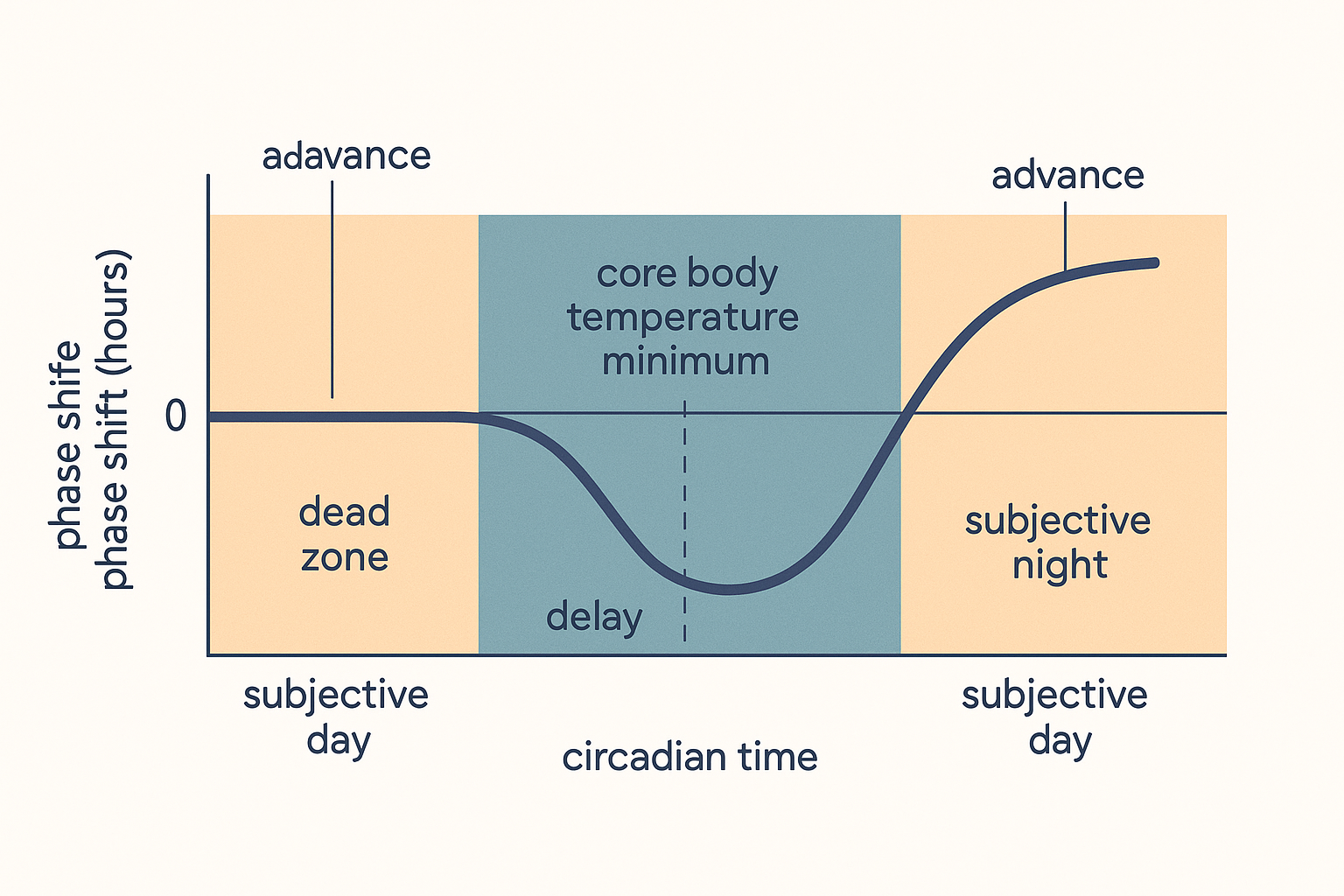 The light phase-response curve. A light pulse's effect depends entirely on when it lands. In the evening/early night (before the core-temperature minimum) light delays the clock, pushing sleep later; in the late night/early morning (after the minimum) it advances the clock, pulling sleep earlier; in the middle of the day it barely shifts phase at all. Read this curve and the rules of jet lag, light hygiene, and "get morning light to wake earlier" all follow directly.
Melatonin has its own phase-response curve that is roughly the mirror image of light's: melatonin taken in the evening advances the clock, and in the morning delays it. This is why timed melatonin is a clock-shifting tool, not merely a sedative — the mechanism and dosing are covered on the melatonin pages (cross-linked below).
Non-photic zeitgebers: food, exercise, temperature, melatonin
Light dominates the SCN, but it is not the only time-giver, and the others act largely on the peripheral clocks — which is precisely why they can throw the system out of internal alignment.
- Food — the food-entrainable oscillator. Feeding is the most important non-photic zeitgeber, and it works on a remarkable principle: it can entrain the liver and other peripheral clocks independently of the SCN. Restrict an animal's food to a fixed window and its peripheral clocks (and a behavioural "anticipation" of the meal) shift to that schedule even if the SCN, set by light, says otherwise. This implies a food-entrainable oscillator (FEO) — a clock that runs on meal timing rather than light, anatomically separate from the SCN (its exact location is still debated; the dorsomedial hypothalamus is implicated but unresolved). The practical upshot is large: eating at your biological night (the classic shift-worker or late-night-snacker pattern) drags your liver and gut clocks toward "daytime" while your light-locked SCN stays at "night," tearing the master and peripheral clocks apart. Much of the metabolic harm of shift work and late eating is this internal desynchrony, not light alone.
- Exercise. Physical activity at a consistent time is a modest zeitgeber, capable of nudging phase (and, like food, of acting on peripheral and behavioural clocks). Morning exercise tends to advance, late-night exercise can delay — a smaller lever than light but a real one.
- Temperature. Beyond the internal core-temperature rhythm, external temperature cycles can entrain peripheral clocks; the evening drop in environmental and core temperature is part of the normal sleep-onset signal.
- Melatonin. As above, the body's own night signal feeds back onto the SCN, and exogenous melatonin acts as a chronobiotic via its mirror-image PRC.
When all these zeitgebers agree — bright light and activity and food by day, darkness and fasting and rising melatonin by night — they reinforce one another and the whole hierarchy locks into crisp alignment. When they disagree — daylight but midnight meals, or darkness but a glowing screen — they pull different clocks to different phases, and the system fragments. That fragmentation is the failure mode.
When the clock breaks — and how to shift it
Every common circadian problem is now explicable as one of three things: the clock pointing at the wrong phase relative to your life, the clock having low amplitude (a weak, washed-out rhythm), or the master and peripheral clocks being internally misaligned with each other. The fixes follow directly from the entrainment rules above.
- Jet lag is the cleanest case: you fly across time zones, your SCN is still locked to the departure city, and the new local day is out of phase with your clock. Because the clock can only correct by about an hour or so per day, realignment takes roughly one day per time zone crossed. Direction matters and the PRC explains why: flying east (you need to advance, go to bed earlier) is harder, because advancing fights our natural long-τ tendency to drift later — and the morning light you would use is, just after arrival, still landing before your body's CBTmin, where it would delay you. The protocol is pure PRC: after eastward travel, seek morning light and avoid late light (and consider evening melatonin) to advance; after westward travel, seek evening light to delay. Timed correctly, light is the medicine; timed wrongly, it makes jet lag worse.
- Shift work is jet lag that never resolves, plus the food problem. The night worker's SCN is held at "night" by the daytime light they see on the commute home and on days off, while their behaviour — working, eating, exercising at night — tries to entrain their peripheral clocks to the opposite phase. The result is chronic internal desynchrony between the SCN and the peripheral clocks, which is the leading mechanistic explanation for the elevated metabolic, cardiovascular, and cancer risks associated with long-term shift work. The clock was never built to have its light input and its feeding input disagree for years.
- Social jet lag is the milder, near-universal version, named by the chronobiologist Till Roenneberg. On workdays an alarm clock forces you onto a schedule earlier than your biology wants; on free days you sleep on your real (later) circadian schedule. The gap between your workday and free-day sleep midpoints is a recurring, self-inflicted "time-zone shift" of an hour or two every week — associated with poorer health, mood, and metabolic markers.
- Delayed and advanced sleep phase. Some people's clocks are stably set late — delayed sleep phase disorder (DSPD), the extreme "night owl" who cannot fall asleep until the small hours and struggles to wake for a normal day — and some stably early — advanced sleep phase disorder (ASPD), the extreme "lark" who is sleepy in the early evening and wakes before dawn. These are genuine phase disorders, not laziness or insomnia, and the heritable forms are direct evidence for the molecular clock: familial advanced sleep phase syndrome (FASPS) was traced to mutations in PER2 and in CK1δ — the very phosphorylation timer from the molecular section — that make the clock run fast. A single-letter change in the egg-timer enzyme shifts a whole family's bedtime by hours. The clock genes are not abstractions; you can watch them set people's lives.
- Chronotype is the normal spread of this — where your clock naturally sits along the early–late axis. It is substantially genetic (variants in PER, CRY, and others), shifts predictably with age (children are early, adolescents drift markedly late — a biological fact, not teenage indolence — and older adults drift early again), and is modifiable at the margins by light exposure. Knowing your chronotype is just knowing your clock's preferred phase, and fighting it (an extreme owl forced onto a lark's schedule) produces chronic social jet lag.
The levers that fix a misaligned clock are the zeitgebers, applied with the PRC in mind, and the honest calibration is that the two big ones are behavioural and free:
- Bright light by day, especially morning light — the strongest phase-setting and amplitude-building signal there is. Morning outdoor light (orders of magnitude brighter than indoor lighting) advances and strengthens the clock; it is the single highest-leverage intervention.
- Darkness at night, especially avoiding evening blue light — because evening light is a maximal delay signal and directly suppresses melatonin (the pineal gland mechanism). Dimming and warming light in the last hours before bed removes the brake on your own night signal.
- Consistent meal timing, weighted earlier; consistent sleep timing — to keep the peripheral (especially liver) clocks aligned with the SCN, rather than letting late eating pull them apart.
- Timed melatonin as a chronobiotic — small doses, timed by its PRC (evening to advance, e.g. for eastward travel or DSPD), not large doses used as a sedative. Detail and dosing on the melatonin pages.
The honest bottom line: the circadian system is powerful but slow and stubborn — it corrects only about an hour a day, and it cannot be bullied. You work with it by feeding the right zeitgeber at the right phase, or you fight it and lose. Almost everything sold as a "sleep hack" either is, or fails to be, a correct application of the phase-response curve.
Putting it all together
- A circadian rhythm is an endogenous, self-sustaining ~24-hour oscillation that persists in constant conditions (free-running at human period τ ≈ 24.2 h), described by its period, phase, and amplitude, and lockable to the real day by entrainment to external zeitgebers (chiefly light).
- Sleep timing is the product of two processes (Borbély): Process S, a homeostatic sleep pressure that rises with time awake (adenosine), and Process C, the circadian alerting signal that is independent of sleep. The clock deliberately opposes rising pressure with an evening wake push, then withdraws it at night so sleep consolidates. Tiredness (high S) and biological night (low C) are different things; most sleep problems are their misalignment.
- The clock's state is stored in a molecular feedback loop (the TTFL). Activators CLOCK:BMAL1 switch on Per and Cry; the PER/CRY proteins accumulate in the cytoplasm, are timed and tagged by the kinase CK1δ/ε, re-enter the nucleus to shut off their own genes, and are then degraded so the loop restarts — one turn taking ~24 hours. The current protein levels are the stored time; the loop's chemistry is the update rule. A second, interlocked REV-ERB/ROR → Bmal1 loop stabilises it. The same loop runs in nearly every cell and clock-controls ~40% of genes.
- The system is a hierarchy. The SCN — ~20,000 light-wired, mutually coupled neurons — is the robust master clock; peripheral clocks in liver, gut, heart, fat, muscle, etc. run the same loop locally. The SCN keeps them synchronised through autonomic nerves, the morning cortisol pulse, the core-temperature rhythm, and feeding times (and melatonin as a broadcast night signal).
- Light entrains via the ipRGC → retinohypothalamic tract → SCN path (the front end of the melatonin circuit), resetting the clock by inducing Per. The phase-response curve is the master rule: light before the core-temperature minimum (evening) delays the clock; light after it (morning) advances it; midday light barely shifts phase but builds amplitude. Melatonin's PRC is the mirror image. Non-photic zeitgebers — food (the food-entrainable oscillator, acting on the liver independently of the SCN), exercise, temperature — mainly set the peripheral clocks, which is why mistimed eating causes internal desynchrony.
- The failure modes are wrong phase, low amplitude, or internal misalignment: jet lag (≈1 day correction per time zone; east is harder), shift work (chronic SCN-vs-periphery desynchrony, the route to its metabolic harm), social jet lag, and the genuine phase disorders DSPD/ASPD — whose familial forms trace to PER2/CK1δ mutations, hard proof the molecular clock sets real bedtimes. Chronotype is the normal genetic/age spread of clock phase.
- The fixes are the zeitgebers applied with the PRC in mind: bright morning light, darkness and no blue light at night, consistent earlier-weighted meals and sleep, and timed (not sedative-dose) melatonin. The clock is powerful but slow (~1 h/day) — work with it, not against it.
The unifying idea: the circadian clock is a distributed, self-updating timing network whose memory is the phase of a gene-expression loop. A loop of proteins switching their own genes off, built with deliberate delays so one turn takes a day, runs in every cell; a coupled population of those loops in the SCN forms a stable master clock; the master keeps the peripheral clocks in step through hormonal, neural, thermal, and behavioural broadcasts; and the eye's light signal corrects the whole system daily against the real sun. Understand the loop and the hierarchy and the phase-response curve, and sleep timing, jet lag, shift-work disease, chronotype, and the entire rationale of light hygiene stop being a list of tips and become predictions of one machine.
Related Compounds & Deep Dives
The night signal and its pathway
- Melatonin — the SCN's hormonal night broadcast and a chronobiotic; its mirror-image phase-response curve makes timed melatonin a clock-shifting tool, not just a sedative.
- Circadian rhythm — the practical compound/protocol view of the timing system this page builds from first principles.
Light as the master zeitgeber
- Sunlight — bright daytime (especially morning) light is the strongest entraining and amplitude-building signal for the SCN.
- Light therapy / Red light therapy — timed bright-light exposure as a direct lever on clock phase via the phase-response curve.
Pineal-targeting peptides
- Pinealon & Epithalon deep dive — the Khavinson pineal bioregulators claimed to restore the ageing pineal's rhythm and melatonin output.
- Epitalon — pineal-derived tetrapeptide pitched at restoring endogenous melatonin rhythm.
- Pinealon — related pineal tripeptide pitched at neuroprotection.
Supporting inputs
- Magnesium — sleep-supporting mineral and cofactor (see the Magnesium deep dive).
- Caffeine — works on the other process (S): an adenosine-receptor antagonist that blocks sleep pressure, with no direct action on the clock.
Related foundations
- The Pineal Gland — the sibling page: how the SCN's time signal is wired through the eye, spinal cord, and a sympathetic nerve to make melatonin; owns melatonin synthesis (not duplicated here).
- Autonomic Nervous System — the neural channel through which the SCN drives peripheral organs and the pineal.
- Hormones & the Endocrine System — cortisol and melatonin as the hormonal broadcasts the SCN uses to synchronise the body; receptor logic for MT1/MT2.
- Systemic Metabolism — why clock-controlled metabolism (REV-ERB, the liver clock) and meal timing interact, and how internal desynchrony drives metabolic harm.
- Neuroscience of Cognition — adenosine, the substrate of Process S, and the alerting systems the circadian signal modulates.