Adenosine & Sleep Pressure
Why staying awake is metabolically self-limiting — how the very act of using your brain produces the molecule that makes you sleepy, how that molecule throttles the arousal system, and why a cup of coffee is the cleanest proof of the whole mechanism.
A short history first, because this is one of the rare cases where a tidy theory and a tidy molecule were found separately and then turned out to be the same story. In 1982 the Swiss sleep scientist Alexander Borbély proposed the two-process model of sleep regulation: the timing and depth of sleep, he argued, are governed by two independent processes running at once — Process C, a roughly 24-hour clock-driven rhythm (the circadian process), and Process S, a homeostatic drive that simply rises the longer you stay awake and falls while you sleep, like a tank filling and draining. Borbély's model was abstract — Process S was a curve on a graph, a "sleep pressure" with no known physical substance behind it.
The substance arrived over the following decade. Building on earlier observations (the pharmacologist Miodrag Radulovacki had shown in the late 1970s and 1980s that adenosine and its analogues make animals sleepy), Tarja Porkka-Heiskanen and colleagues published a landmark 1997 Science paper showing that in the basal forebrain — a wake-promoting region — extracellular adenosine climbs steadily during prolonged wakefulness and falls during recovery sleep, behaving exactly like Borbély's abstract Process S made molecular. Adenosine was the "sleep pressure" you could measure. Since then the picture has filled in: the discovery that the A2A adenosine receptor (not the more abundant A1) is the key sleep-promoting switch and the surprising link to the lipid-signalling molecule prostaglandin D2; the realisation that caffeine — the most widely used psychoactive substance on earth — works precisely by blocking these receptors; and, more recently, the glymphatic discovery (Maiken Nedergaard, 2013) that sleep is when the brain physically flushes out metabolic waste, tying the chemistry of tiredness to a literal cleaning cycle. Current research is pursuing A2A-targeted compounds both to promote sleep and, conversely, to promote wakefulness (the selective A2A antagonist istradefylline is already licensed in Parkinson's disease).
Why this page exists
The companion Circadian Clock page owns Process C — the body's 24-hour timing system, the suprachiasmatic clock, melatonin, light. This page owns the other half: Process S, the homeostatic sleep drive, and the molecule that embodies it.
The reason this deserves a page of its own is that Process S answers a question the clock cannot. The circadian clock explains when you tend to feel sleepy (late evening) and alert (mid-morning), but it runs on the same schedule whether you slept ten hours or none. It cannot explain why a sleepless night leaves you wrecked, why a long afternoon of hard thinking is more tiring than a long afternoon of idleness, or why a nap "takes the edge off." Those are all Process S — a pressure that tracks not the time of day but how much waking your brain has actually done. And that pressure has a name, a chemical formula, and a beautifully direct relationship to the energy system described on the Cellular Energy page. Adenosine is, quite literally, the spent remnant of the cell's energy currency. Sleep pressure is the accumulated evidence that your brain has been spending energy.
By the end of this page you should be able to see the whole loop as an engineer would: a power-consuming system that generates its own "low fuel" warning light as an unavoidable by-product of running, a receiver that reads that warning and shuts the system down for maintenance, and a single famous drug — caffeine — that works not by adding power but by unscrewing the warning light.
Part 1 — Process S: sleep as a pressure that builds and drains
Start with the behaviour, before the chemistry. Strip away the clock and the rest of physiology and the homeostatic sleep drive obeys two simple rules:
- It rises monotonically while you are awake. Every waking hour adds to it. The longer you have been up, the higher it climbs — and it climbs faster under heavier mental and physical load, which is the first clue that it is tracking activity, not merely the passage of time.
- It falls while you sleep, and it falls steeply at first — most of the discharge happens in the early hours of sleep, in the deepest stages — then more gradually as the night goes on.
Plot that and you get a sawtooth: a long rising ramp across the waking day, then a sharp drop overnight, repeating. This is Process S. Borbély's insight was that this homeostatic sawtooth does not act alone; it is read against the circadian rhythm (Process C), and it is the interaction of the two that decides whether you are awake or asleep, and how well you sleep.
How S and C combine to gate sleep
Picture Process C as a smooth wave — an alerting signal the circadian clock broadcasts that is high through the day and low at night (covered in full on the Circadian Clock page). Process S is the rising sawtooth of accumulated sleep pressure. The brain, in effect, compares the two:
- During a normal day, sleep pressure (S) rises steadily — but so does the circadian alerting signal (C), and for much of the day C rises fast enough to offset the build-up of S. This is why you do not feel progressively more exhausted minute by minute through the morning: the clock is actively pushing back, holding you alert even as pressure accumulates underneath. (The circadian alerting drive characteristically peaks in the early evening — the so-called "second wind" or wake-maintenance zone — which is precisely the clock counter-acting a sleep pressure that by then is already very high.)
- In the evening, the circadian alerting signal falls away. Now there is nothing to oppose the large sleep pressure that has built up all day. The gap between high S and falling C widens — and when it crosses a threshold, you feel sleepy and fall asleep.
- Overnight, sleep discharges Process S. By morning, S is low. The circadian signal begins to climb again. With little pressure left and a rising alerting drive, you wake.
This two-against-each-other design has real explanatory power. It is why pulling an all-nighter is survivable: by the early hours you feel dreadful (S is enormous, C is at its trough), but if you push through to mid-morning you often feel paradoxically better — not because your sleep debt has been paid (it has only grown) but because the circadian signal has swung back up and is masking the still-high pressure. It is also why jet lag and shift work are so punishing: they force S and C out of their normal alignment, so you carry high sleep pressure at a time when the clock is screaming "be alert," or try to sleep when the clock is broadcasting "be awake."
flowchart TD
    AWAKE["Time awake → brain activity"] -->|builds| S["Process S<br/>(sleep pressure ↑)<br/>= adenosine accumulates"]
    CLOCK["Circadian clock"] -->|broadcasts| C["Process C<br/>(alerting signal)<br/>high by day, low at night"]
    S --> GATE{"S high AND C low?"}
    C --> GATE
    GATE -->|yes| SLEEP["Fall asleep →<br/>S discharges"]
    GATE -->|no| WAKE["Stay awake →<br/>S keeps rising"]
    SLEEP -->|S falls overnight| AWAKE
Everything from here down is the physical answer to one question Borbély left open: what is Process S? What substance rises with time awake and falls with sleep? The answer is adenosine — and to understand why adenosine, of all molecules, you have to go back to the energy currency itself.
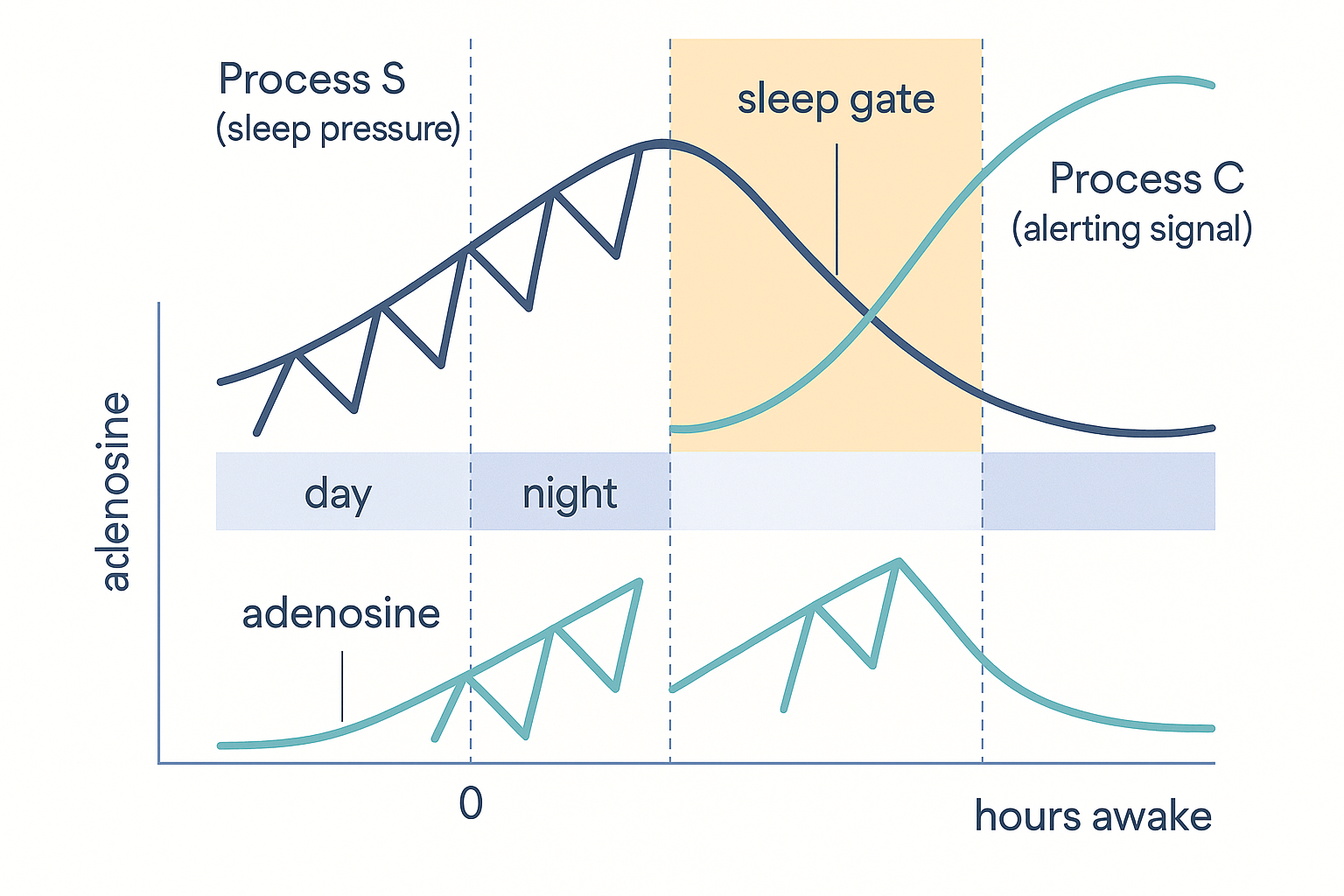 The two-process model made molecular: Process S (homeostatic sleep pressure) is a sawtooth that rises across the waking day and discharges during sleep, read against the circadian alerting wave of Process C. The lower panel shows that Process S is, physically, the rise and fall of extracellular adenosine.
Part 2 — Adenosine is the spent form of the energy currency
To see why adenosine is the perfect "you have been awake too long" signal, you need one fact from the Cellular Energy page, stated precisely.
The cell's energy currency is ATP — adenosine triphosphate. Read that name as a recipe. Adenosine is the backbone: a molecule made of the base adenine joined to the sugar ribose. Bolt three phosphate groups in a row onto that backbone and you have ATP. The energy of the cell is stored in the bonds holding those phosphates on. When the cell does work, it snaps the outermost phosphate off — ATP becomes ADP (adenosine diphosphate, two phosphates) — releasing energy. Snap another off and you get AMP (adenosine monophosphate, one phosphate). Strip the last phosphate and you are left with the bare backbone again: adenosine itself.
So adenosine is not some unrelated tiredness chemical the brain manufactures on a timer. Adenosine is what is left when the energy currency has been completely spent. It is the discharged battery with all three phosphates gone — the molecular ash of energy use.
This is the conceptual heart of the page, so dwell on it. During wakefulness, neurons fire constantly. Firing is enormously expensive: re-establishing the electrical charge after every nerve impulse means running the sodium-potassium pump (Na⁺/K⁺-ATPase) hard, and that pump alone consumes a large fraction of the brain's energy budget (the brain is ~2% of body weight but burns ~20% of the body's glucose — see Cellular Energy). All that pumping spends ATP, dropping it through ADP and AMP toward adenosine. The more the brain works, the more ATP is spent, the more adenosine appears. Adenosine concentration is therefore a direct, real-time readout of cumulative energy expenditure — a metabolic odometer. It is high precisely when, and where, the brain has been busy.
This is why Process S is not a clock. A clock would rise at the same rate regardless of what you did. Adenosine rises faster when you work harder and slower when you idle, because it is bookkeeping energy, not time. Sleep pressure is, at bottom, accumulated metabolic debt — and adenosine is the currency that debt is denominated in.
A crucial corollary: clearing adenosine back to ATP is not free. To rebuild the charged currency you must salvage the adenosine backbone and re-attach phosphates, and attaching phosphates costs energy — energy the mitochondria supply only when the system is rested and not also spending. This is the deep reason sleep is required to discharge the signal: you cannot pay down the debt while continuing to incur it. The cleaning has to happen offline.
A note on what adenosine is not. Adenosine is not a classical neurotransmitter packaged in vesicles and fired across a synapse on command (contrast dopamine on the Neuroscience of Cognition page). It is a neuromodulator — it accumulates diffusely in the fluid around cells and sets the background tone of whole regions, turning their excitability up or (mostly) down. It is less a message and more an ambient pressure, which is exactly the right physical form for a signal meant to represent "the overall state of the tank."
Part 3 — Where the extracellular adenosine actually comes from
Process S lives in the fluid outside the cells (the extracellular space), because that is where adenosine can reach receptors on neighbouring neurons. So the real question is: how does adenosine — the spent backbone — end up outside the cell in rising amounts during wakefulness? There are several routes, and they matter because they explain why the signal is metabolic and why it is regional.
Route 1 — Intracellular breakdown, then export
Inside a hard-working neuron, ATP falls toward AMP and adenosine as described. When intracellular adenosine rises, it is carried out across the membrane down its concentration gradient by dedicated doorways called equilibrative nucleoside transporters (ENTs) — proteins that let adenosine flow whichever way the gradient points. During wakefulness the gradient points outward (more adenosine inside than out), so adenosine leaks into the extracellular space. This is the most direct route: intracellular energy debt becomes extracellular signal.
Route 2 — Released ATP, chopped up outside the cell
Neurons and glia also release ATP itself into the extracellular space — as a co-transmitter alongside other signals, and through various channels. ATP outside the cell does not last; it is rapidly dismantled by a two-enzyme relay sitting on the outer cell surface (an ecto-enzyme is simply an enzyme whose working face points outward, into the extracellular space):
- CD39 (an ecto-nucleotidase, formal name NTPDase1) chops the phosphates off extracellular ATP and ADP, taking them down to AMP.
- CD73 (ecto-5′-nucleotidase) then removes the last phosphate from AMP, producing adenosine.
So released ATP is converted, right where it lands, into the very adenosine that signals sleepiness. This CD39 → CD73 relay is the dominant manufacturing line for extracellular adenosine in many brain regions, and it is a genuine control point: the amount of CD73 a region expresses helps set how readily activity is converted into sleep pressure there.
Route 3 — Astrocytes and the glycogen reservoir
The brain's most numerous support cells, the astrocytes (star-shaped glial cells that wrap around synapses and blood vessels), are central to this story and are a large part of why Porkka-Heiskanen's basal-forebrain finding made sense.
Astrocytes hold the brain's only meaningful glycogen store — glycogen being the branched storage form of glucose (the same molecule the Liver keeps as its glucose buffer). During wakefulness, sustained neural activity draws down astrocytic glycogen to help fuel the neurons. Astrocytes also actively release ATP (via a regulated mechanism involving vesicle-like release), which is then converted to adenosine by the CD39/CD73 relay outside. Experiments that block astrocytic release specifically blunt the build-up of sleep pressure — animals that cannot perform this gliotransmission accumulate less adenosine and show a weakened homeostatic response to sleep deprivation. This is strong evidence that a large share of Process S is astrocyte-derived: the support cells are metering the brain's energy use and broadcasting the result as adenosine.
flowchart TD
ACT["Wakeful neural activity<br/>(firing, ion pumping)"] --> SPEND["ATP spent → adenosine inside cell"]
SPEND -->|"ENT transporters<br/>(flow out down gradient)"| EXT["Extracellular adenosine<br/>= Process S signal"]
ACT --> REL["ATP released<br/>(neurons + astrocytes)"]
REL -->|"CD39: ATP/ADP → AMP"| AMP2["AMP"]
AMP2 -->|"CD73: AMP → adenosine"| EXT
ASTRO["Astrocytes<br/>(glycogen reservoir)"] --> REL
EXT --> RECEPT["Acts on adenosine receptors<br/>(Part 4)"]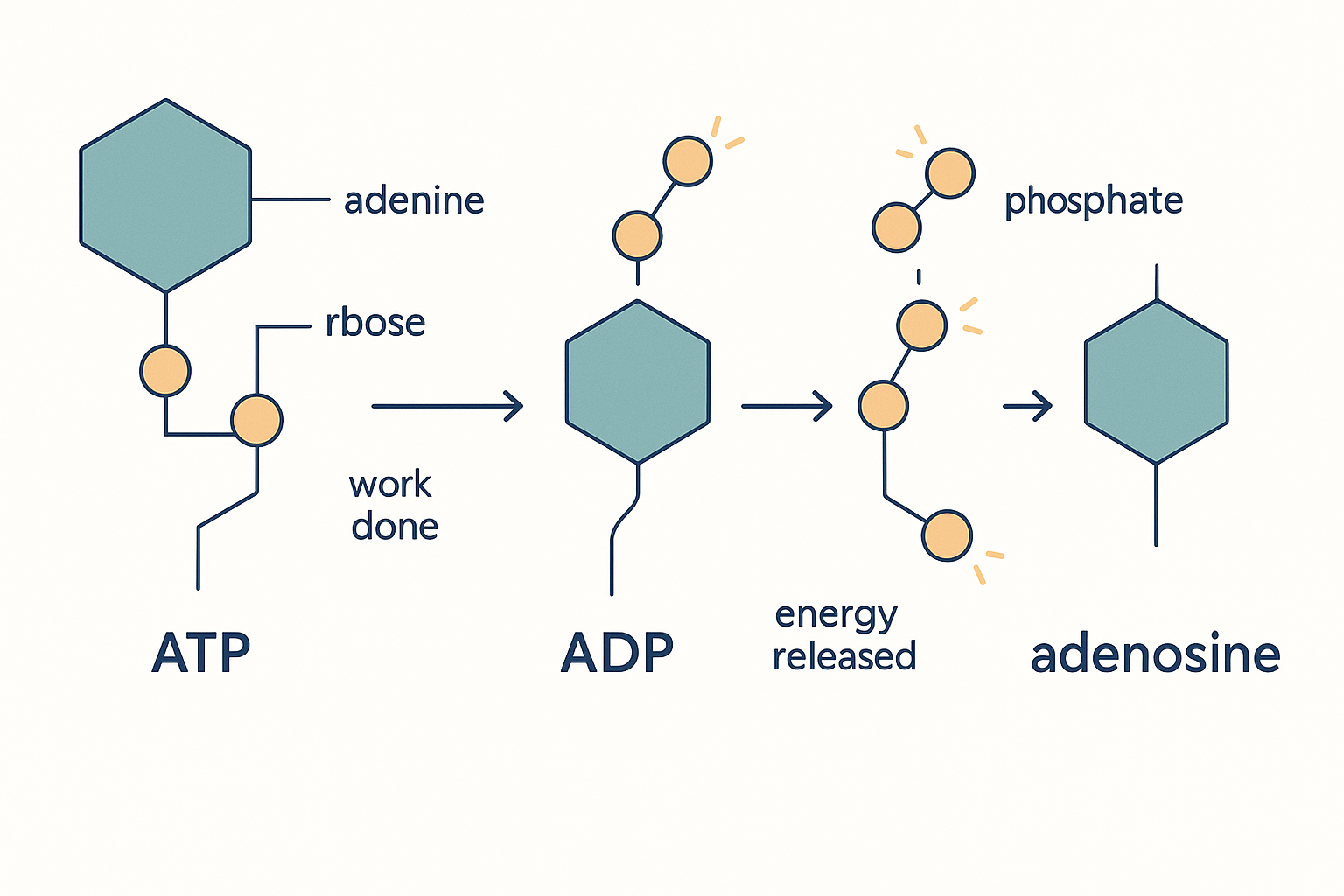 Adenosine is the fully discharged form of the cell's energy currency: strip all three phosphates from ATP and only the adenosine backbone remains. Because firing neurons spend ATP, adenosine accumulation is a direct molecular readout of how much energy the brain has used.
The picture that emerges is coherent: adenosine accumulates wherever and whenever neural energy is spent, by intracellular breakdown leaking out, by released ATP being chopped down outside, and by astrocytes actively converting their glycogen-fuelled activity into an adenosine signal. It rises across the waking day, concentrated in the regions that have been working. That is Process S, made of molecules. Now we turn to how that rising pool actually causes sleepiness — which is entirely a story about receptors.
Part 4 — The receptors: how adenosine flips the brain from wake to sleep
Adenosine does nothing until it binds a receptor — a protein on a cell's surface shaped to recognise it and trigger a response inside. (This is the universal rule for signalling molecules; see the Hormones page.) There are four adenosine receptor subtypes, named A1, A2A, A2B, and A3. They are all G-protein-coupled receptors — meaning that when adenosine binds, the receptor activates an internal relay protein (a "G-protein") that changes the cell's behaviour. The decisive fact is that different subtypes are wired to opposite relays, so adenosine can both quieten one set of neurons and activate another, all from the same rising pool. Two subtypes do the heavy lifting for sleep.
A1 — the inhibitory brake (turns wake-promoting neurons down)
The A1 receptor is the most widespread adenosine receptor in the brain. It couples to an inhibitory relay (a Gi protein — the "i" is for inhibitory). When adenosine binds A1, the neuron is hyperpolarised — pushed further from the threshold at which it would fire — partly by opening potassium channels that let positive charge leak out, and partly by damping the release of excitatory transmitters. The net effect: A1 activation makes neurons less likely to fire.
This matters most because A1 receptors sit on the brain's wake-promoting populations. As adenosine rises through the day, A1 progressively silences the very circuits that keep you alert:
- the cholinergic neurons of the basal forebrain (which release acetylcholine to drive cortical arousal — the region where Porkka-Heiskanen measured the adenosine rise);
- the orexin/hypocretin neurons of the lateral hypothalamus (the master wakefulness-stabilising system — the same one modafinil engages from the cognition page; loss of these neurons causes narcolepsy);
- and other arousal hubs including the histaminergic and noradrenergic systems.
So one half of adenosine's action is simply taking the foot off the accelerator — using A1 to inhibit the cells whose job is to hold you awake.
A2A — the active sleep switch (turns the sleep-promoting centre on)
The A2A receptor is far less abundant overall but is the genuine surprise of modern sleep neuroscience, because it couples to a stimulatory relay (a Gs protein) — the opposite of A1 — and it is positioned exactly where it counts. A2A receptors are concentrated in the striatum (a basal-ganglia region) and, critically for sleep, in and around the ventrolateral preoptic area (VLPO) of the hypothalamus.
The VLPO is the brain's sleep-promoting centre: a cluster of inhibitory GABAergic neurons (GABA being the brain's main calming transmitter — see the GABA & Excitation/Inhibition Balance page) whose job, when active, is to shut down the arousal system. The VLPO sends inhibitory projections onto the histaminergic neurons of the tuberomammillary nucleus (TMN), onto the orexin neurons, and onto the other wake centres. When the VLPO fires, the arousal centres go quiet, and you sleep.
Adenosine, via the stimulatory A2A receptor, activates the VLPO. So the second half of adenosine's action is the mirror image of the first: not just lifting the foot off the accelerator (A1 inhibiting wake centres) but pressing the brake pedal (A2A switching on the sleep centre, which then clamps the wake centres shut). The two work together — disinhibition of sleep and direct inhibition of wakefulness — which is why rising adenosine reliably tips the whole system over from wake into sleep.
This A2A pathway is also where the unexpected prostaglandin D2 connection enters. Prostaglandin D2 (PGD2) is a lipid-derived signalling molecule and is one of the most potent endogenous sleep-promoting substances known. It is produced in the membranes (the leptomeninges) surrounding the brain near the sleep-regulating regions, where it acts on its own DP1 receptors and, in doing so, drives up the local extracellular adenosine concentration — which then acts through A2A to promote sleep. PGD2, in effect, recruits and amplifies the adenosine-A2A switch. Animals lacking the A2A receptor lose much of the sleep-inducing power of PGD2, confirming that A2A is the linchpin through which both routine sleep pressure and this lipid somnogen funnel.
flowchart TD
    ADO["Rising extracellular adenosine"] --> A1["A1 receptor<br/>(inhibitory / Gi)"]
    ADO --> A2A["A2A receptor<br/>(stimulatory / Gs)"]
    PGD2["Prostaglandin D2"] -->|"raises local adenosine"| ADO
    A1 -->|"hyperpolarise → silence"| WAKE["Wake-promoting neurons:<br/>basal forebrain (ACh),<br/>orexin, histamine, noradrenaline"]
    A2A -->|"activate"| VLPO["VLPO sleep centre<br/>(GABA neurons)"]
    VLPO -->|"inhibit"| WAKE
    WAKE -->|"arousal falls"| SLEEP["NREM sleep"]
    VLPO --> SLEEP
A2B and A3 — the minor players
For completeness: the A2B receptor is also stimulatory (Gs) but low-affinity — it only responds when adenosine reaches high concentrations, so it acts as a kind of "extreme debt" sensor, and it is more prominent outside the brain (vasculature, inflammation). The A3 receptor is inhibitory (Gi) and is involved mainly in peripheral and protective/anti-inflammatory roles. Neither dominates the normal sleep-pressure mechanism, which is overwhelmingly an A1 (inhibit wake) plus A2A (activate sleep) affair. Remembering just those two — A1 brakes, A2A switches — captures the essential machinery.
Part 5 — Caffeine: the experiment that proves the mechanism
If adenosine is the sleepiness signal, then a drug that blocks adenosine receptors should make you feel less sleepy without adding any energy at all — and there should be one such drug so widely used that its effects are common knowledge. There is. It is caffeine, and it is the cleanest natural experiment in all of sleep science.
What caffeine actually does
Caffeine is a competitive antagonist at adenosine receptors — chiefly A1 and A2A. Unpack that term carefully, because every word is load-bearing:
- Antagonist: it binds the receptor but does not activate it. It occupies the pocket and triggers nothing.
- Competitive: it binds the same site adenosine would, so the two molecules compete for the receptor. Whoever is present in greater concentration tends to win. This is why caffeine's effect is dose-dependent and why it can be overwhelmed by very high adenosine (a sufficiently exhausted brain pushes through caffeine).
Structurally this is no accident: caffeine is a methylxanthine, and its ring system is similar enough to adenine — the base at the heart of adenosine — that it slots into the adenosine pocket like a key cut to the wrong tumbler: it fits the lock but will not turn it. So while caffeine is in the pocket, adenosine cannot bind, and its signal is not transmitted.
The consequence is the single most important idea about caffeine, and the reason it appears on this page rather than only on the cognition page:
Caffeine does not add energy, reduce your true sleep debt, or remove the adenosine. It blocks the reading of a signal that is still there. The metabolic debt continues to accumulate underneath; you simply stop being told about it.
Because A1 normally silences the wake-promoting neurons and A2A normally switches on the VLPO sleep centre, blocking both does two things at once: it lifts the inhibition off the arousal systems (basal forebrain, orexin, histamine — letting them fire freely again) and it prevents the VLPO from being switched on. The arousal system, freed from adenosine's brake, runs unopposed. This is why caffeine indirectly raises dopamine and noradrenaline signalling (as described on the Neuroscience of Cognition page) — not by touching those systems directly, but by removing the adenosine inhibition that was holding them down.
flowchart LR
ADO["Adenosine<br/>(still accumulating)"] -. "blocked from binding" .-x REC["A1 / A2A receptor<br/>pocket"]
CAF["Caffeine<br/>(competitive antagonist)"] -->|"occupies the pocket<br/>but does not activate"| REC
REC -->|"signal not transmitted"| RESULT["Wake neurons un-braked +<br/>VLPO not switched on<br/>→ feel alert"]
NOTE["Metabolic debt keeps rising<br/>underneath, unread"] -.-> ADO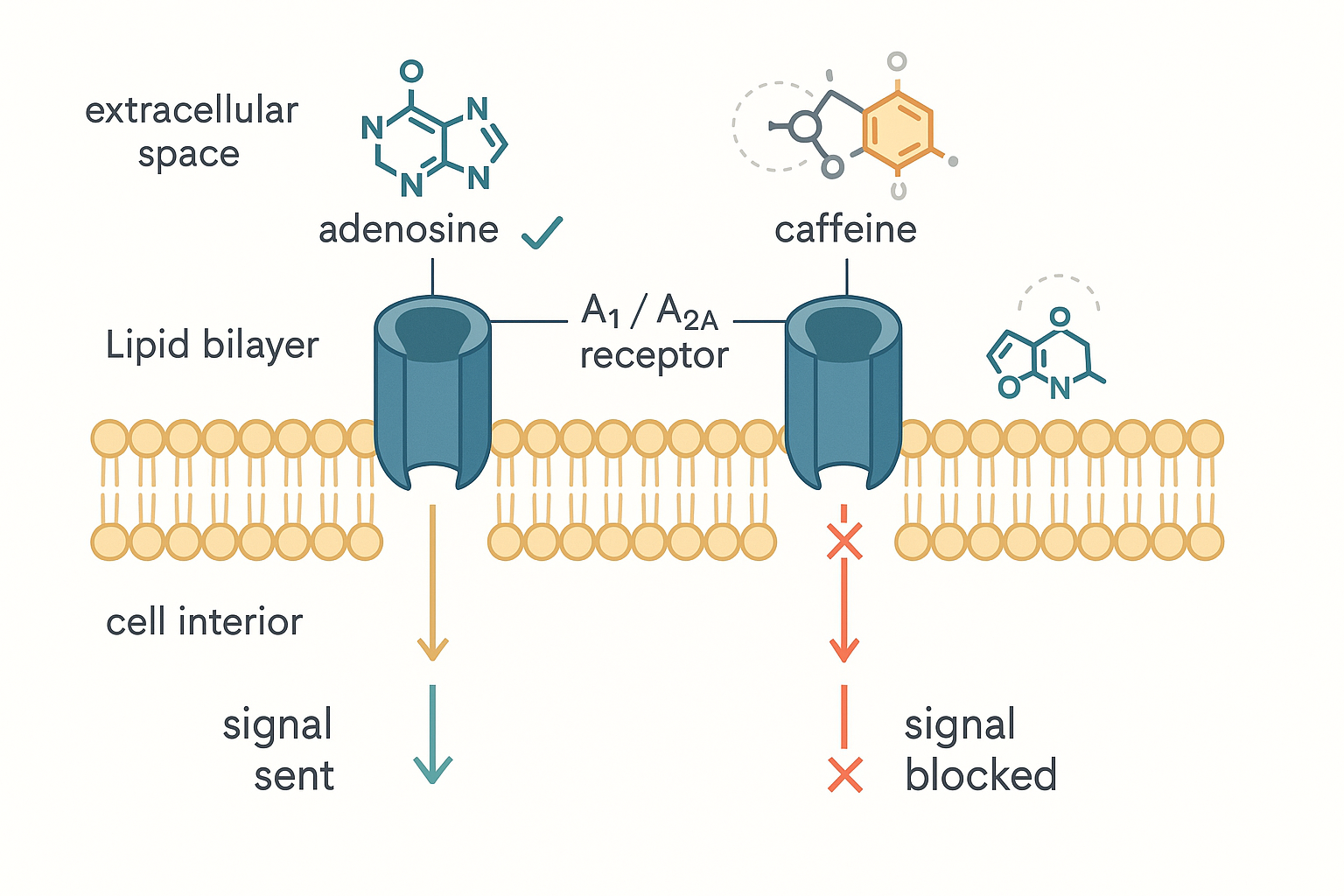 Adenosine and caffeine compete for the same receptor pocket. Adenosine binds and triggers the inward signal; caffeine, structurally similar enough to fit, occupies the pocket but cannot trigger anything — so it silences the tiredness signal without removing the underlying adenosine.
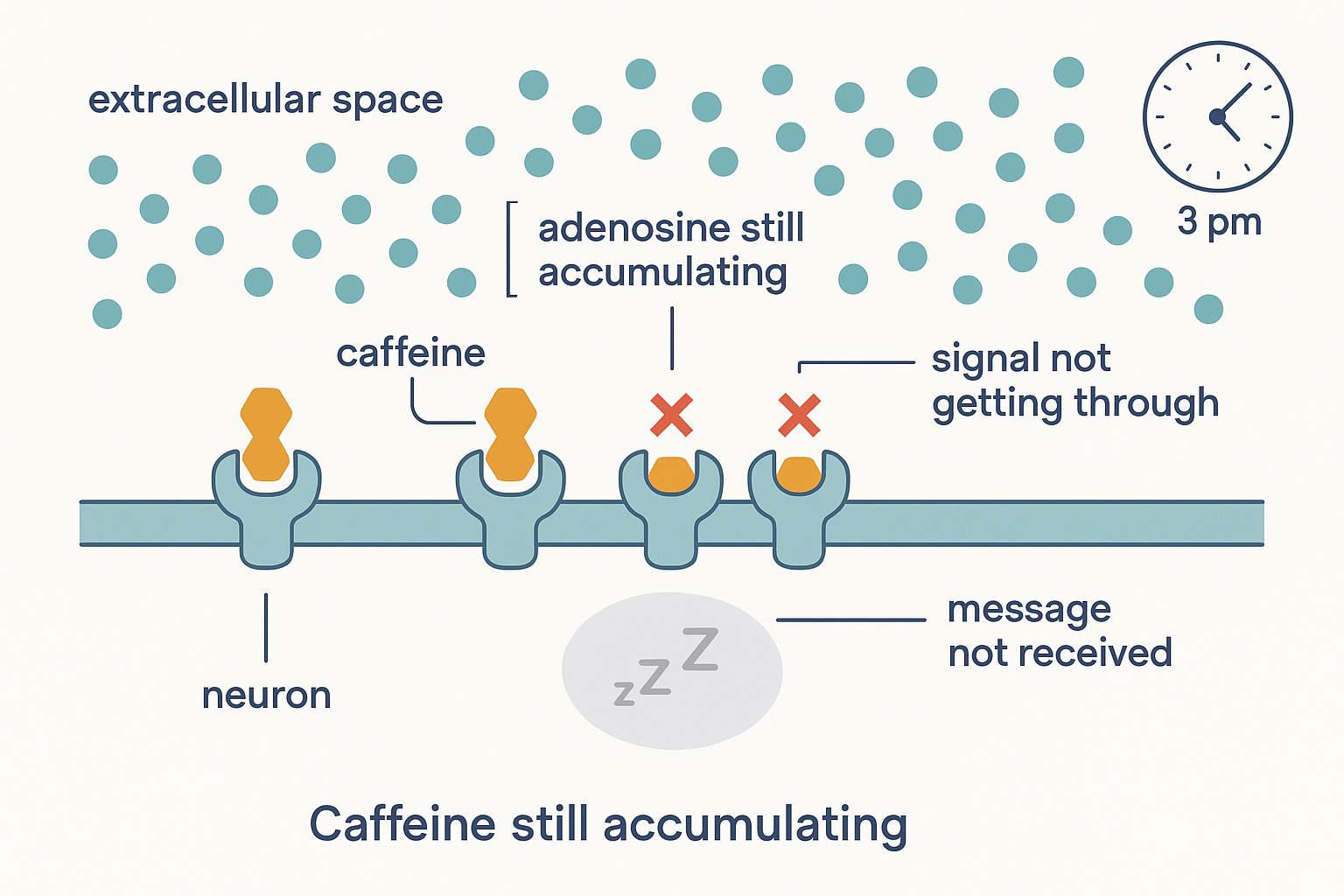 The scene-level view of caffeine's trick: the extracellular space fills with more and more adenosine through the day, but with every receptor occupied by caffeine the rising signal cannot be read. The debt accumulates; the brain is simply not told.
The honest pharmacology — half-life, the crash, tolerance, and timing
Caffeine is a near-perfect proof of mechanism, but using it well means understanding its pharmacokinetics, and being honest about its limits.
Half-life (~5 hours) and the afternoon trap. Caffeine is absorbed quickly (peak blood levels within ~30–60 minutes) and broken down in the liver, almost entirely by the enzyme CYP1A2 (a cytochrome P450 enzyme — Phase I detoxification on the liver page). Its half-life is roughly 4–6 hours in a typical adult, meaning that 5–6 hours after a dose, half of it is still in your system. A strong coffee at 3 pm leaves a meaningful fraction circulating at bedtime — still occupying adenosine receptors, still blunting the sleep-pressure signal exactly when you want it read. This is the single most important practical point: caffeine consumed in the afternoon measurably degrades that night's sleep (it reduces deep slow-wave sleep — see Sleep Architecture) even in people who "fall asleep fine," because feeling able to sleep and sleeping deeply are different things.
CYP1A2 variation. That half-life is not fixed across people. The CYP1A2 gene is genetically variable: "fast metabolisers" clear caffeine briskly and tolerate late or large doses better, while "slow metabolisers" carry it far longer, are more prone to its sleep disruption and cardiovascular jitters, and may get a disproportionate hit from a single afternoon cup. Several common factors also slow CYP1A2 — pregnancy and oral contraceptives markedly extend caffeine's half-life — while smoking induces (speeds up) the enzyme, which is part of why heavy smokers often drink more coffee. This genuine person-to-person variation is why universal rules ("no caffeine after 2 pm") are only rough guides.
The "crash" and adenosine rebound. Caffeine does not remove adenosine — it dams the signal behind the occupied receptors. As caffeine is metabolised and clears the pockets, all the adenosine that accumulated meanwhile (plus any receptor up-regulation, below) suddenly gets read at once. The result is the caffeine crash: a slump as the now-unblocked, still-elevated adenosine signal hits arousal systems that had been running unopposed. The crash is the debt collector arriving after the diversion ends.
Tolerance and receptor up-regulation. Block a receptor regularly and the brain compensates by making more of it. With habitual caffeine use, adenosine receptors up-regulate (their numbers rise), so a given dose of caffeine now blocks a smaller fraction of a larger receptor pool — the effect fades and you need more for the same lift. This is tolerance. Its mirror image is withdrawal: stop abruptly and you are left with an enlarged receptor population and normal adenosine, so the tiredness signal is now read louder than baseline — producing the classic caffeine-withdrawal headache, fog, and fatigue until the receptors down-regulate again over days. None of this is a moral failing of the drug; it is the predictable homeostatic response to chronically blocking a receptor.
The strategic implications follow directly from the mechanism rather than from folklore:
- Caffeine borrows alertness; it does not create it. Because the underlying adenosine debt keeps mounting unread, caffeine defers the bill rather than paying it. Sleep is the only thing that actually discharges Process S.
- Timing beats dose. Front-loading caffeine earlier in the day exploits the ~5-hour half-life so that little remains to corrupt the night's sleep-pressure reading.
- The "caffeine nap" makes mechanistic sense. Caffeine takes ~20–30 minutes to act; a short nap in that window lets sleep physically clear some adenosine while the caffeine is arriving to block the receptors as you wake — the two effects stack.
- L-theanine smooths, it does not replace. Pairing caffeine with the amino acid L-theanine (the classic from green tea) blunts the over-aroused, jittery edge of pure adenosine-blockade — pulling you back from the far side of the prefrontal "inverted-U" described on the cognition page — without restoring the adenosine signal. It changes the quality of the alertness, not the underlying debt.
The deeper point is that caffeine's very effectiveness is the proof of the model. A molecule whose only action is to sit in the adenosine pocket and do nothing reliably abolishes the feeling of sleepiness. There is no cleaner demonstration that the feeling of sleep pressure is adenosine binding its receptors.
Part 6 — Clearance: how sleep discharges the debt
Process S falls during sleep. What is physically happening?
Activity falls, so production falls. Sleep — especially deep non-REM slow-wave sleep — is a state of greatly reduced cortical firing in the relevant circuits. With the energy-spending activity throttled back, the production of new adenosine slows sharply. The relentless daytime ramp is switched off.
Salvage and recharge catch up. With less new adenosine arriving, the cell's housekeeping enzymes get ahead of the backlog. Extracellular and intracellular adenosine is taken back up and salvaged — re-phosphorylated back up through AMP, ADP, to ATP (by the enzyme adenosine kinase and the rest of the salvage pathway), or otherwise metabolised and cleared. The discharged batteries are recharged. Because this re-phosphorylation costs energy that the rested brain can now spare, it proceeds efficiently only when the system is offline — which is the molecular reason the debt can only be paid during sleep, not merely by resting while awake.
The depth of sleep tracks the size of the debt. This is the elegant closing of the loop and the bridge to the Sleep Architecture page. The intensity of deep slow-wave sleep — measured as the amount of slow (delta) electrical activity in the EEG, and discussed in full on the Brain Waves page — is proportional to the preceding sleep pressure. Stay awake longer, build more adenosine, and your subsequent sleep is deeper, with more intense slow-wave activity early in the night, which then dissipates across the night as the pressure discharges. This is why the first sleep cycles are the deepest and why slow-wave activity is highest in the early hours after a long day: deep sleep is the active draining of Process S, and its depth is a dial set by how much adenosine had accumulated. Naps "take the edge off" precisely because even a short bout of deep sleep clears a slice of adenosine, lowering the pressure — which, incidentally, is why a late-afternoon nap can sabotage that night's sleep onset (it has already discharged some of the pressure you needed to fall asleep).
The glymphatic flush. A complementary discovery deepens the "sleep as maintenance" picture. During sleep the brain runs its glymphatic system — a network (described on the Lymphatic System page) in which cerebrospinal fluid is driven through the brain tissue to wash out metabolic waste; the spaces between cells widen during sleep and the flow increases markedly. So sleep is not only when adenosine production stops and salvage catches up, but also when the brain is physically rinsed of the by-products of a day's metabolism. The chemistry of tiredness and the literal cleaning cycle are two faces of the same offline-maintenance state.
flowchart TD
    HIGH["High adenosine at sleep onset<br/>(big Process S debt)"] --> DEEP["Drives intense<br/>slow-wave (deep) sleep"]
    DEEP --> LOWACT["Cortical activity low →<br/>adenosine production slows"]
    LOWACT --> SALV["Salvage + re-phosphorylation<br/>(adenosine → AMP → ADP → ATP)"]
    DEEP --> GLY["Glymphatic flush<br/>clears metabolic waste"]
    SALV --> CLEARED["Adenosine falls →<br/>Process S discharged"]
    GLY --> CLEARED
    CLEARED --> WAKE["Wake refreshed,<br/>low sleep pressure"]
    DEEP -. "depth dissipates<br/>across the night" .-> CLEARED
Adenosine beyond the brain — a brief note
Although this page is about sleep, adenosine is a body-wide "low-energy / stress" signal, and the same logic recurs. In the heart, A1 receptors slow the heart rate — which is why adenosine is given intravenously as an emergency drug to stop certain rapid arrhythmias (it briefly arrests electrical conduction through the heart; its half-life in blood is only seconds). In the blood vessels, adenosine is a vasodilator — when a tissue runs short of oxygen and ATP falls, the adenosine produced relaxes the local arteries and increases blood flow, a neat local matching of supply to demand. (This vasodilation is also why caffeine, by blocking adenosine, constricts cerebral vessels — the basis of its use in some headache remedies, and of the rebound vasodilatory headache of withdrawal.) The unifying theme across all of these: adenosine is the universal signal of spent energy, and the body everywhere reads it as an instruction to slow down, conserve, and restore. Sleep is simply that instruction applied to the brain as a whole.
Putting it all together
Step back and the homeostatic sleep system is a single, self-contained feedback loop:
- Process S is the homeostatic sleep drive — a pressure that rises with time awake and discharges during sleep — and it is read against the circadian Process C (its own page); sleep happens when high S meets low C.
- That pressure is, physically, adenosine — the bare backbone left when the energy currency ATP is fully spent down through ADP and AMP. Sleep pressure is therefore not a timer but a metabolic odometer: the more energy the brain spends, the more adenosine accumulates.
- Extracellular adenosine is built from intracellular breakdown leaking out through ENT transporters, from released ATP chopped down by the CD39 → CD73 ecto-enzyme relay, and from astrocytes converting their glycogen-fuelled activity into an adenosine signal — which is why it rises wherever the brain has been working.
- It flips the brain to sleep through two receptors: A1 (inhibitory) silences the wake-promoting neurons (basal forebrain acetylcholine, orexin, histamine), and A2A (stimulatory) switches on the VLPO sleep centre, which then clamps the arousal system shut — with prostaglandin D2 amplifying the A2A route.
- Caffeine proves the whole scheme: a competitive antagonist that occupies the A1/A2A pockets, blocking the reading of an adenosine signal that is still accumulating underneath — adding no energy, paying down no debt, with the crash, the tolerance, and the receptor up-regulation all following directly from "block a receptor and the brain makes more of it."
- Sleep discharges the debt: production falls, salvage re-phosphorylates adenosine back to ATP, the glymphatic system flushes waste, and — the elegant closing detail — the depth of slow-wave sleep is set by how much adenosine had accumulated, so a longer day buys a deeper night.
The unifying idea is almost philosophical in its tidiness: being awake is metabolically self-limiting. The act of running the brain produces, as an unavoidable by-product, the exact molecule that forces the brain to stop and recover. You cannot think your way out of needing sleep, because thinking is what generates the pressure to sleep. Caffeine does not break this loop — it only hides the gauge. The debt is always, eventually, collected; the only currency that settles it is sleep itself.
Related Compounds & Deep Dives
The adenosine antagonists and their companions
- Caffeine — the competitive A1/A2A adenosine-receptor antagonist; the proof-of-mechanism for this entire page. Blocks the tiredness signal without adding energy.
- Coffee — the dominant delivery vehicle for caffeine, with its own additional compounds.
- L-theanine — paired with caffeine to smooth the over-aroused edge of adenosine blockade without restoring the adenosine signal; pulls back from the wrong side of the prefrontal inverted-U.
Sleep-supporting compounds (acting on adjacent systems)
- Magnesium — required to make functional ATP (Mg-ATP) in the first place, and a calming influence on the NMDA/excitation system that opposes the wakeful firing which generates adenosine.
- Glycine — an inhibitory transmitter taken to support sleep onset and depth, complementary to the adenosine/VLPO mechanism.
- Melatonin — the circadian (Process C) hormone, not the homeostatic signal; it sets timing rather than pressure, and works best understood alongside this page.
Wakefulness compounds (the other side of the switch)
- Modafinil — promotes wakefulness via the orexin/histamine arousal system that adenosine's A1 receptor normally silences; the pharmacological opposite of letting Process S win (see the deep dive).
Related foundations
- Cellular Energy: From Fuel to ATP — where ATP comes from; adenosine is its fully spent form, so this page is the upstream prerequisite.
- Circadian Clock — Process C, the timing half of the two-process model that Process S is read against.
- Sleep Architecture — how the discharged sleep pressure becomes the stages and depth of a night's sleep; slow-wave intensity tracks the adenosine debt.
- The Pineal Gland — melatonin and the circadian signal that gates when adenosine's pressure is allowed to take over.
- Neuroscience of Cognition — the dopamine/noradrenaline arousal systems that caffeine indirectly disinhibits by removing the adenosine brake.
- GABA & Excitation/Inhibition Balance — the GABAergic VLPO neurons that A2A activates to shut down arousal.
- Brain Waves — slow-wave (delta) activity as the EEG measure of how much sleep pressure is being discharged.