Oxidative Stress & Antioxidants
The price of breathing. Aerobic life runs on oxygen — the most powerful electron-thief biology could harness — and that same chemistry slowly corrodes the very tissue it powers. This page builds the universal picture from the atom up: what oxidation actually is, why a molecule of oxygen is both indispensable and dangerous, what reactive species damage and how, where they come from (with heavy emphasis on the dietary source people actually ask about — rancid and fried fats), the layered antioxidant defence network that holds the line, and the single most important calibration in the whole field: that the goal is not zero oxidation but the right amount, which is exactly why decades of antioxidant megadose trials disappointed.
The idea that oxygen — the gas we cannot live without — is also a slow poison took two centuries to assemble. In the 1770s–80s, the French chemist Antoine Lavoisier identified the reactive component of air that metals and burning candles consumed, and named it oxygène ("acid-former"); he also coined oxidation for the family of reactions in which a substance combines with it. For 150 years "oxidation" simply meant "reaction with oxygen," and rusting iron or a candle flame were its emblems.
The biological turn came in the twentieth century. In 1954, Rebeca Gerschman proposed that the toxicity of high-pressure oxygen and the damage from ionising radiation share a common cause — oxygen free radicals — the first clear statement that the body generates reactive oxygen as a hazard in its own right. Two years later, in 1956, Denham Harman — a chemist who had spent the war watching oxygen turn petroleum oils rancid — generalised this into the free-radical theory of ageing: that the same reactive by-products which spoil fats accumulate damage in living tissue across a lifetime. The theory had no proven mechanism until 1969, when Joe McCord and Irwin Fridovich discovered superoxide dismutase (SOD) — an enzyme whose only job is to destroy a specific oxygen radical. A dedicated, highly-evolved enzyme to dispose of superoxide was the smoking gun: the body makes this radical constantly, on purpose, and spends energy defending against it. The science of redox biology was born.
Then came the era that humbled the field. Through the 1990s and 2000s, huge clinical trials handed out high-dose antioxidants — beta-carotene, vitamin E, vitamin C — expecting to slow cancer, heart disease, and ageing. Several showed no benefit, and some showed harm (more on the ATBC, CARET, and SELECT trials below). The simplistic "antioxidants are good, take more" picture collapsed. What replaced it is subtler and is where the frontier sits today: reactive oxygen as a signalling molecule the body cannot do without, hormesis (a small dose of a stressor is beneficial, a large dose harmful), the discovery of Nrf2 as a master switch that lets cells build their own defences, and mitochondria-targeted antioxidants (such as MitoQ) designed to act precisely where the damage starts rather than flooding the whole body. This page builds that mature picture from first principles.
Why this page exists
Oxidation is the most over-simplified idea in popular health. "Oxidation bad, antioxidants good, eat the brightly-coloured berry, buy the supplement with the big ORAC number" — almost every part of that folk model is wrong or, past a point, backwards. Yet underneath the slogans sits genuinely fundamental chemistry that touches nearly everything else on this site: how mitochondria make energy, why polyunsaturated fats are risky, what fried food actually does, how inflammation and ageing proceed, and why a long list of supplements (vitamin E, vitamin C, glutathione, NAC, CoQ10, melatonin, the polyphenols) exist at all.
This is the general, parent page for that chemistry. Other pages on the site take a slice of it and go deep:
- Redox Balance in the Brain applies all of this to the organ where the stakes are highest — the neuron — and develops the redox couples (NAD⁺/NADH, NADPH, GSH/GSSG), the species cascade, and glutathione cycling in fine detail. This page recaps the universal chemistry briefly and goes broader — whole-body and dietary — pointing to brain-redox for the neuro-specific mechanics.
- The Vitamin E deep dive and the Fat & Fat Metabolism page develop lipid peroxidation — the membrane-rusting chain reaction — and the chain-breaking antioxidants that stop it. This page sets the context and does not re-derive that mechanism in depth.
- Cellular Energy explains the electron transport chain, the largest internal source of reactive oxygen, and Inflammation is oxidative stress's self-reinforcing twin.
- Its sibling, Glycation, AGEs & Ageing, owns the sugar-driven damage pathway. The two damage routes interlock — combined, they are called glycoxidation — but to keep boundaries clean, this page owns oxidation (oxygen-driven damage) and dietary oxidised fats, and points to the glycation page for everything AGE-related.
We build from the absolute foundation — what an electron transfer is — up to a calibrated, honest framework for what (if anything) to actually do about oxidative stress.
Part 1 — What oxidation actually is
Before any biology, one piece of chemistry must be solid, because the entire page rests on it.
Oxidation is electrons changing hands
Chemistry, at bottom, is the behaviour of electrons — the tiny negatively-charged particles that surround atoms. A vast number of chemical reactions are, very simply, electrons moving from one atom or molecule to another. We name the two halves of that move:
- Oxidation is the loss of electrons by a molecule.
- Reduction is the gain of electrons by a molecule.
The memory aid chemists teach is "OIL RIG" — Oxidation Is Loss, Reduction Is Gain. (A second aid, "LEO the lion says GER" — Lose Electrons = Oxidation, Gain Electrons = Reduction — says the same thing.)
The name is a historical accident worth knowing, because it causes endless confusion. Oxidation is named after oxygen only because oxygen is the substance most famous for ripping electrons off other things — rust is iron that oxygen has oxidised, a cut apple browns because oxygen oxidises it, a fat goes rancid when oxygen oxidises it. But oxygen need not be present for a reaction to count as oxidation. The defining event is the electron transfer itself. A molecule can be oxidised by chlorine, by another metal, or by losing hydrogen atoms — no oxygen required. Keep this separation in mind: "oxidation" the general electron-loss concept is broader than "reaction with oxygen," even though they share a name.
The two halves are always paired
Here is the rule that makes the whole system a balance rather than a one-way street: an electron a molecule loses must go somewhere. It cannot vanish; it lands on another molecule. So every oxidation is paired with a simultaneous reduction — hence the contraction "redox." The molecule that grabs the electrons (and is thereby reduced) is doing the oxidising to its partner, so it is the oxidising agent, or oxidant. The molecule that gives up electrons (and is thereby oxidised) is doing the reducing, so it is the reducing agent — and in biological language, a reducing agent willing to donate electrons to neutralise a dangerous oxidant is exactly what we call an antioxidant.
This is the single most clarifying translation on the page. Whenever you read "antioxidant," substitute in your head: "a molecule willing to give away electrons." That is, mechanistically, all an antioxidant is — a sacrificial electron donor.
A free radical has an unpaired electron
Electrons inside molecules normally sit in pairs; that pairing is what makes most molecules stable and unreactive. A free radical is an atom or molecule with an unpaired electron — a single, lonely, unmatched electron that makes the molecule frantic to either seize a partner electron from a neighbour or shed its own. That frantic instability is what "reactive" means: a radical will tear an electron off whatever it touches.
And this is the feature that makes radicals uniquely dangerous, far more than a single chemical insult: when a radical steals an electron from a stable molecule, that victim now becomes a radical itself — it has an unpaired electron and goes hunting for the next molecule. One radical can therefore start a chain reaction, a propagating cascade of theft running through a tissue, each molecule wounding the next. We meet this exact cascade — lipid peroxidation — shortly. Much of antioxidant biology is about breaking the chain: satisfying a radical's hunger with a donated electron while the donor remains stable enough not to continue the cascade.
"Reactive species" is broader than "radical"
The popular term is "free radicals," but the precise umbrella is reactive species, and it is wider in two directions:
- Not all reactive species are radicals. Hydrogen peroxide (H₂O₂), for instance, has no unpaired electron — it is not a radical — yet it is a reactive, biologically important oxidant. Its lack of a radical's frantic instability is precisely what lets it serve as a controllable signal (Part 6).
- Not all reactive species contain oxygen. Biology produces reactive oxygen species (ROS) — superoxide, hydrogen peroxide, the hydroxyl radical — but also reactive nitrogen species (RNS) such as nitric oxide and the vicious peroxynitrite formed when nitric oxide meets superoxide.
The brain-redox page catalogues these individual players in detail. For the general picture, hold three: superoxide (O₂·⁻), the primary spark that electron-leak produces; hydrogen peroxide (H₂O₂), the mild, stable, diffusible middle product that doubles as a signal; and the hydroxyl radical (·OH), the indiscriminate, instantly-destructive end product that no enzyme can defend against — formed when hydrogen peroxide meets loose iron.
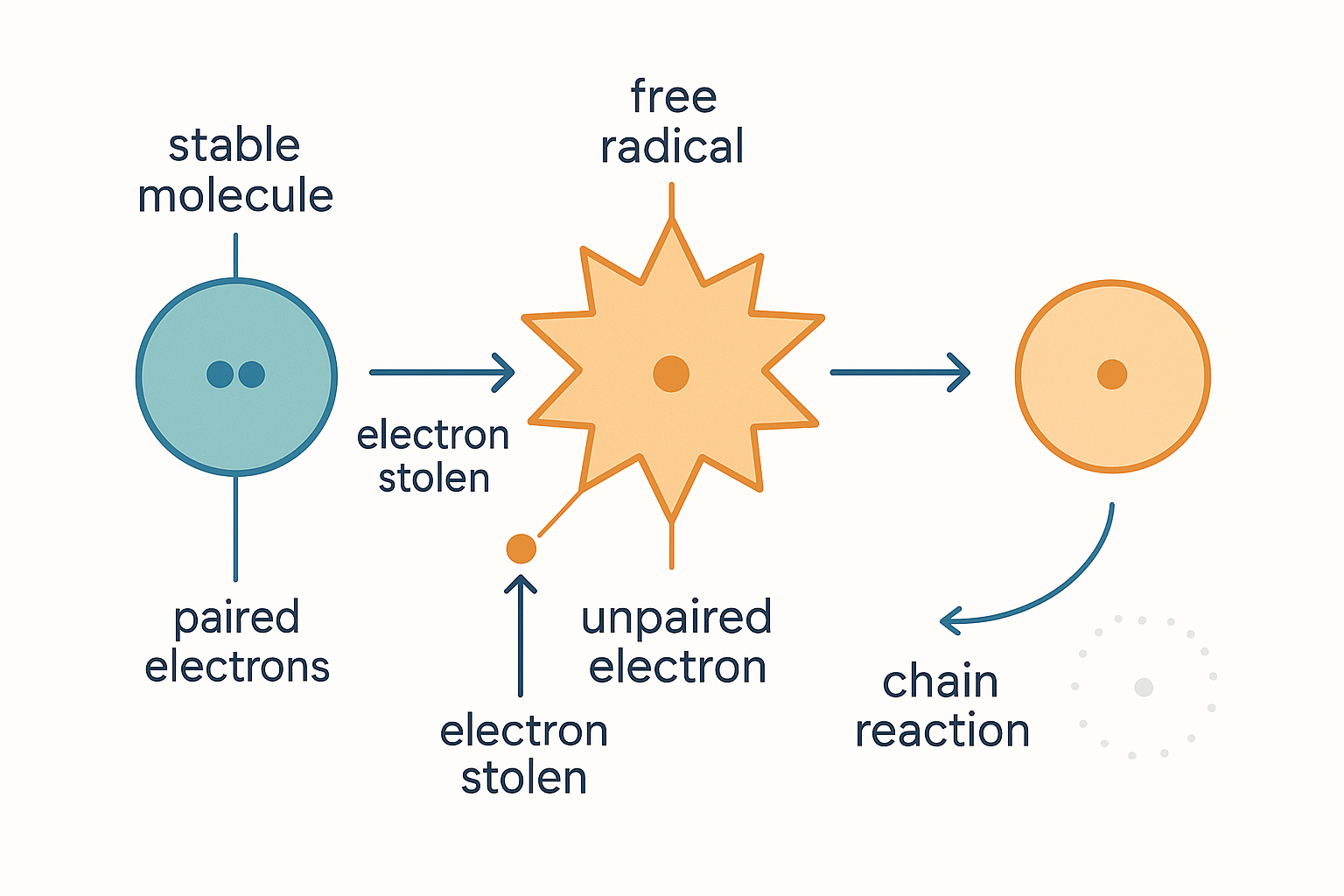 The molecular essence of oxidation: a free radical, destabilised by its single unpaired electron, rips an electron from a stable neighbour. The victim is now itself a radical — so one act of theft can ignite a self-propagating chain, each molecule wounding the next. An antioxidant ends the chain by donating an electron while staying stable itself.
Part 2 — The oxygen paradox
Now the central tension that gives the field its shape, and the reason oxidative stress is unavoidable rather than merely an accident.
Aerobic life depends on oxygen for one specific, brilliant reason. As the Cellular Energy page explains, cells extract energy by stripping high-energy electrons off food and walking them down the mitochondrial electron transport chain, pumping protons and making ATP at each step. But that staircase only works if something waits at the bottom to accept the spent electrons and clear the chain. Oxygen is the ideal final acceptor precisely because it is such a powerful electron-grabber: its strong pull keeps electrons flowing briskly down the whole chain. The pay-off is enormous — fully oxidising glucose with oxygen yields roughly 16 times more ATP than splitting it without oxygen (fermentation). Aerobic metabolism is the deal that made complex, energy-hungry life — animals, brains — possible at all.
But the very property that makes oxygen useful makes it dangerous. Molecular oxygen (O₂) is unusually reactive for a stable gas; chemically it behaves almost like a radical itself, carrying two unpaired electrons. It "wants" four electrons to be fully reduced to harmless water (O₂ + 4 electrons + 4 H⁺ → 2 H₂O). The electron transport chain delivers them carefully, one controlled handful at a time. But the process is not perfect: a small fraction of electrons leak out partway and land on oxygen one at a time, producing the partially-reduced forms — superoxide first, then hydrogen peroxide, then the hydroxyl radical — which are far more reactive than O₂ itself. The same molecule that safely accepts a full set of four electrons becomes a source of destruction when it picks up just one or two.
This is the oxygen paradox, sometimes called the Faustian bargain of aerobic life: we cannot make enough energy to be complex animals without oxygen, and we cannot use oxygen without continuously producing the reactive species that corrode us. Oxidative stress is therefore not a malfunction or a modern disease — it is the built-in tax on breathing. Every aerobic organism on Earth co-evolved an antioxidant defence system alongside its oxygen-using machinery, because the two are inseparable. The interesting questions are never "how do I eliminate oxidation" (impossible, and as we will see, undesirable) but "how is the balance held, where does it tip, and what tips it."
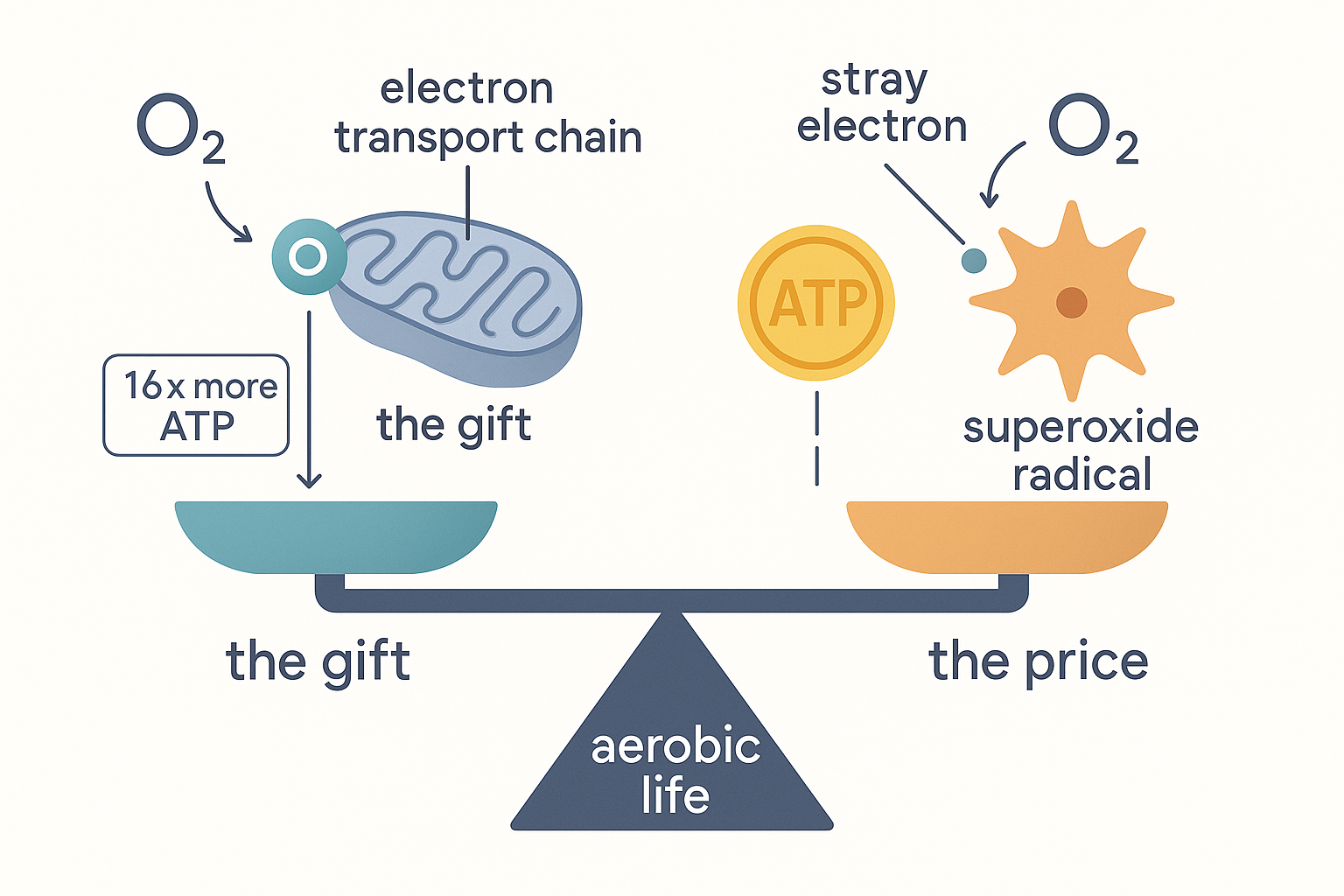 The oxygen paradox on a single balance: oxygen's hunger for electrons is what makes it the perfect final acceptor of the electron transport chain (enabling roughly 16 times more ATP than life without it) — and is also exactly why a few leaked electrons turn it into superoxide. The gift and the price are the same chemistry; aerobic life lives at the fulcrum.
Part 3 — Oxidative stress, and what gets damaged
The definition is a balance, not a substance
Oxidative stress is not "the presence of reactive species" — they are always present, by Part 2's argument, and as we will see the body deliberately makes them. It is defined as an imbalance in which the production of oxidising species outstrips the antioxidant capacity available to neutralise them, allowing damage to accumulate. It is a tilted see-saw, not a poison. This balance framing is the key to everything: stress can rise either because production climbs (more leak, more inflammation, more dietary oxidants) or because defence falls (depleted glutathione, missing selenium, exhausted vitamin E) — and the two are addressed differently.
When the balance tips, three classes of large biological molecule take the damage. They are worth knowing individually because each leaves a distinct, measurable scar that researchers use to quantify oxidative stress.
Lipids — peroxidation, rancidity, and toxic aldehydes
The fats in every cell membrane are a prime target, especially the polyunsaturated fatty acids (PUFAs) — fats with multiple carbon–carbon double bonds. As the Fat page and Vitamin E deep dive explain in full, the carbons sitting between two double bonds hold their hydrogens especially loosely, making them the weak points a radical attacks first. The result is lipid peroxidation — the membrane-rusting chain reaction: a radical steals a hydrogen, the fat becomes a radical, grabs oxygen, and attacks the next fat, and the damage propagates molecule-to-molecule through the membrane. This is the same chemistry that turns cooking oil rancid — "rancidity" and "lipid peroxidation in your tissues" are literally the same reaction, one in a bottle and one in a membrane.
Lipid peroxidation does two destructive things. It shreds the membrane (including mitochondrial membranes — damaging the very machinery that leaks the radicals, a vicious circle). And it spawns reactive aldehyde fragments — chiefly 4-HNE (4-hydroxynonenal) and MDA (malondialdehyde) — small, mobile, aggressive molecules that drift away and attack proteins and DNA, and are themselves inflammatory signals. 4-HNE and MDA are the standard laboratory markers of lipid oxidative damage. The more double bonds a fat carries, the more readily all of this happens — which is the mechanistic heart of the bioenergetic case against PUFA.
Proteins — carbonylation and thiol oxidation
Proteins — the enzymes, transporters, and structural scaffolding that do nearly all the cell's work — are damaged by oxidation in two main ways. Reactive species can introduce carbonyl groups onto certain amino-acid side chains, a generally irreversible modification called protein carbonylation that cripples the protein's function; carbonyl content is the most widely used marker of protein oxidative damage. Separately, the sulphur-containing thiol groups (–SH) on the amino acid cysteine are highly redox-sensitive: their oxidation can be a reversible signal (Part 6) or, when excessive, a damaging loss of function. Oxidised, carbonylated proteins misfold, lose activity, and clog the cell's disposal systems — a recurring feature of ageing tissue.
DNA — 8-OHdG and mutation
Reactive species, above all the hydroxyl radical, attack DNA — chemically altering its bases. The best-characterised lesion is 8-OHdG (8-hydroxy-2′-deoxyguanosine), an oxidised form of the base guanine that, if not repaired before the DNA is copied, causes a mutation (it mispairs during replication). 8-OHdG is the standard urinary and tissue marker of oxidative DNA damage. Mitochondrial DNA is especially vulnerable: it sits right next to the electron-leak that produces the radicals, has fewer protective proteins than nuclear DNA, and weaker repair — so mitochondria accumulate oxidative DNA damage faster, which feeds directly into the ageing theory of Part 7.
A note on glycoxidation — the link to the sugar pathway
Oxidation does not act alone. The parallel damage route — glycation, in which sugars stick to proteins and DNA to form advanced glycation end-products (AGEs) — interlocks with oxidation at many points: several glycation steps require oxidation to proceed, and oxidised lipids (the 4-HNE and MDA above) can themselves modify proteins in AGE-like ways. The combined process is called glycoxidation, and it is a major driver of the stiffened, browned, cross-linked molecules of aged tissue. This page deliberately keeps glycation brief — the full mechanism, the AGEs, and the ageing tie-in live on the Glycation, AGEs & Ageing page. Hold only this: oxidation and glycation are two reinforcing routes to the same molecular wear.
flowchart TD
subgraph SOURCES["WHERE OXIDANTS COME FROM"]
INT["INTERNAL<br/>· mitochondrial ETC leak<br/>· immune respiratory burst (NADPH oxidase)<br/>· inflammation<br/>· peroxisomes<br/>· Fenton: free iron / copper"]
EXT["EXTERNAL / DIETARY<br/>· oxidised / rancid PUFA oils<br/>· fried + reused-oil food<br/>· smoking · air pollution<br/>· UV + ionising radiation<br/>· alcohol · excess iron"]
end
INT --> POOL["Reactive species pool<br/>superoxide · H2O2 · hydroxyl · peroxynitrite"]
EXT --> POOL
POOL --> LIPID["LIPIDS<br/>peroxidation → 4-HNE · MDA"]
POOL --> PROT["PROTEINS<br/>carbonylation · thiol oxidation"]
POOL --> DNA["DNA<br/>8-OHdG → mutation"]
LIPID --> STRESS["OXIDATIVE STRESS<br/>(production > defence)"]
PROT --> STRESS
DNA --> STRESS
DEF["Antioxidant defence<br/>(enzymes · network · Nrf2)"] -. holds the balance .-> STRESSPart 4 — Where oxidants come from
To reason about oxidative stress you must know the sources, because which source dominates decides what to do about it. They split cleanly into oxidants the body makes internally and oxidants that arrive from outside — and the external, dietary ones are the part most people can actually act on.
Internal sources
1. Mitochondrial electron leak — the baseline. As established in Part 2 and the Cellular Energy page, a small percentage of electrons travelling down the electron transport chain (mainly at Complex I and Complex III) escape onto oxygen prematurely, making superoxide. This is the largest continuous, baseline source in most cells, and crucially it rises when the chain is "backed up" — when there is plenty of fuel but low ATP demand, electrons sit on the carriers longer and leak more. This is the mechanistic basis of the bioenergetic argument that a briskly-running, efficient metabolism leaks fewer radicals than a sluggish, congested one.
2. The immune respiratory burst — a deliberate weapon. Not all reactive oxygen is accidental. Immune cells (neutrophils, macrophages) carry an enzyme, NADPH oxidase (the NOX family), whose entire purpose is to manufacture superoxide on demand as a chemical weapon — a sudden "respiratory burst" of reactive oxygen used to kill engulfed bacteria. This is reactive oxygen deployed on purpose. It is also why infection and immune activity raise oxidative load, and why oxidative stress and immune function are intertwined.
3. Inflammation — the self-reinforcing loop. Reactive oxygen activates the master inflammatory switch NF-κB; the resulting inflammation recruits more immune cells, whose NOX enzymes produce more reactive oxygen; and lipid-peroxidation products (4-HNE, MDA) are themselves inflammatory triggers. Oxidative stress and inflammation are not two problems but one self-amplifying cycle — each is the other's accomplice.
4. Peroxisomes. These small organelles handle certain fatty-acid breakdown and other reactions that generate hydrogen peroxide directly as a by-product. They contain their own catalase to mop most of it up, but they are a genuine and often-overlooked internal source.
5. Transition-metal (Fenton) chemistry. This is the amplifier that turns a manageable oxidant into the worst one. Free, loosely-bound iron or copper catalyses the Fenton reaction, converting relatively mild hydrogen peroxide into the hydroxyl radical — the most destructive species in biology, which no enzyme can defend against. This is why the body works so hard to keep iron and copper safely bound to carrier and storage proteins (transferrin, ferritin, caeruloplasmin), and why iron overload is genuinely pro-oxidant — a recurring theme in the bioenergetic framework's caution about excess iron.
External and dietary sources — the part you can act on
This is the section readers most want, because it is the lever within reach. Oxidants do not only arise inside us; we eat, breathe, and absorb them.
Oxidised and rancid polyunsaturated fats — the big one. Recall that lipid peroxidation is the same chemistry whether it happens in a membrane or in a bottle. Polyunsaturated oils — sunflower, soybean, corn, and other "seed oils," plus fish oil — are chemically primed to oxidise because of their many double bonds, and they begin doing so before you ever eat them, driven by the same three accelerants that spoil any fat: heat, light, and oxygen (with trace metals as catalysts). This is precisely why old cooking oil "goes off," why a bottle left open or on a sunny shelf turns rancid, and — the crucial point — why fried and reheated food is a concentrated oxidant source. Deep-frying combines high heat, prolonged oxygen exposure, and (in commercial settings) oil reused for hours or days: each cycle drives more peroxidation, so reused frying oil is loaded with pre-formed lipid-oxidation products (LOPs) — the same 4-HNE and MDA and related aldehydes — before the food reaches your plate. You are then eating the oxidative damage ready-made, importing the reactive aldehydes directly rather than having to generate them. Heated cholesterol-containing foods similarly form oxysterols (oxidised cholesterol), another class of pre-formed dietary oxidant implicated in vascular damage.
This is the concrete, mechanistic answer to the common intuition that "old fats and fried food create oxidation": they literally are oxidised fat, carrying the chain-reaction's toxic end-products into the body, where those aldehydes go on to damage proteins and DNA and stoke inflammation. It is also why the bioenergetic framing prioritises avoiding such fats over swallowing antioxidants to clean up after them — preventing the import is more effective than mopping up. The more polyunsaturated and the more heat-and-air-abused a fat, the worse it is on this axis; stable saturated fats (which lack the vulnerable double bonds) barely peroxidise and tolerate cooking heat far better.
The other external sources round out the picture:
- Cigarette smoke is a direct, enormous source of free radicals and oxidants inhaled straight into the lungs — central to why the antioxidant trials in smokers (below) went so wrong.
- Air pollution (particulates, ozone, nitrogen oxides) delivers oxidants and pro-oxidant particles to the airways and bloodstream.
- Ultraviolet (UV) radiation from sunlight generates reactive oxygen in skin — the chemistry behind much of photo-ageing.
- Ionising radiation (X-rays, gamma rays) damages tissue substantially by splitting water into hydroxyl radicals — radiation's harm is, in large part, oxidative; this was one of Gerschman's original clues.
- Alcohol is metabolised in the liver to acetaldehyde and, via the CYP2E1 enzyme, generates reactive oxygen while depleting glutathione — a major reason heavy drinking is oxidatively damaging to the liver.
- Excess iron (from overload, repeated transfusion, or some supplements) feeds the Fenton reaction above — dietary and stored iron is the external-meets-internal pro-oxidant.
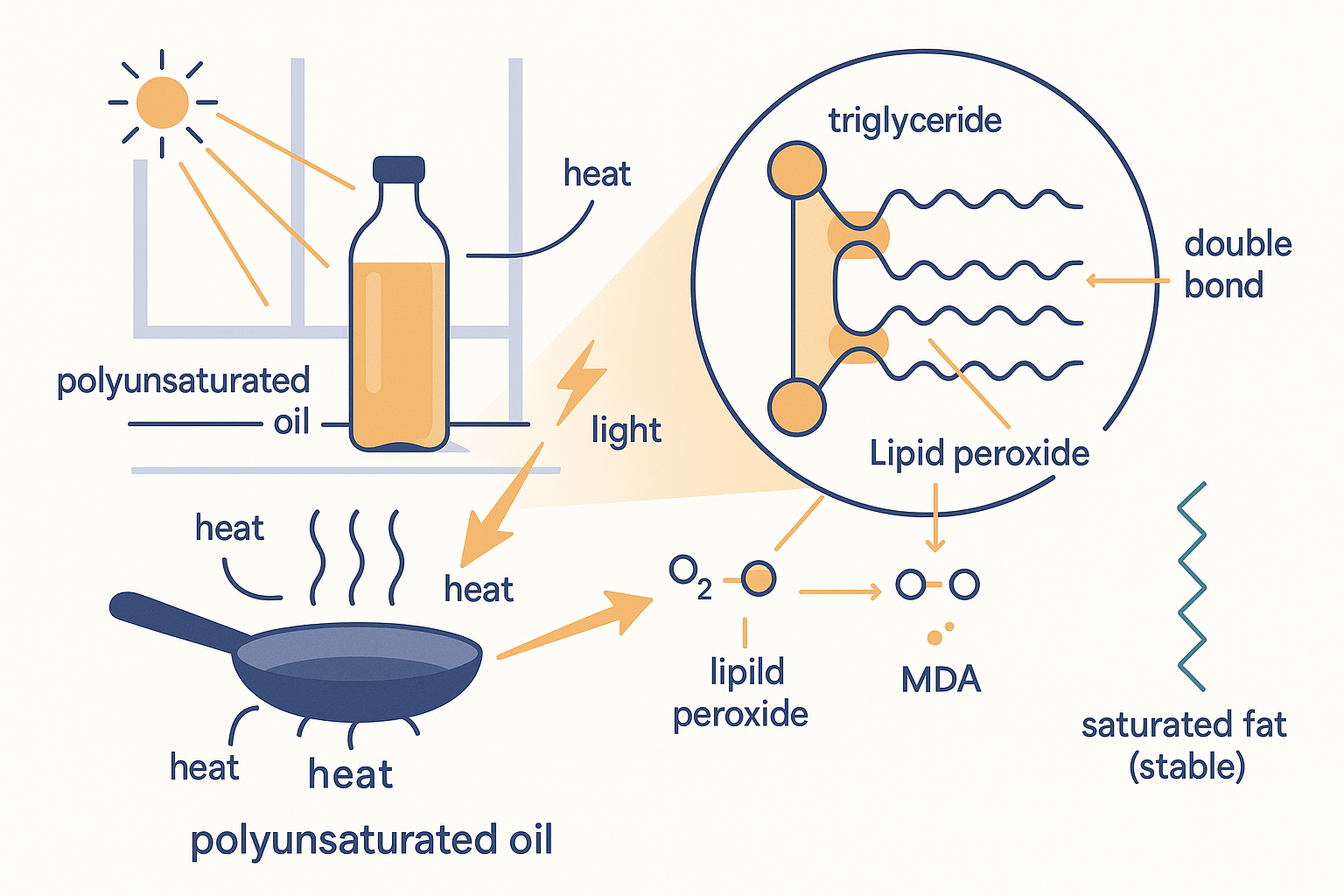 Why old and fried fats are an oxidant source you eat ready-made: heat, light and oxygen attack the double bonds of a polyunsaturated triglyceride, forming lipid peroxides that fragment into reactive aldehydes (4-HNE, MDA) — the chemistry of rancidity. Reused frying oil accumulates these before the food reaches the plate. A saturated fat, lacking double bonds, stays intact — which is why it tolerates heat far better.
Part 5 — The antioxidant defence system and the network
Against all of this the body runs not a single antioxidant but a layered, cooperative network — three tiers of defence in which the members regenerate one another and pass danger down a relay until it is neutralised as harmless water. Understanding that it is a network, not a list of independent scavengers, is the single most useful idea for evaluating supplements: you can saturate one link while the chain is bottlenecked elsewhere.
Tier 1 — The enzymes (catalytic, the front line)
These are protein enzymes that destroy reactive species catalytically — each enzyme molecule neutralises target molecules over and over, thousands of times per second, without being used up. They are arranged as an assembly line that walks superoxide all the way down to water:
- Superoxide dismutase (SOD) — the first enzyme in the line, and the one whose discovery founded the field. It converts two superoxide molecules into one hydrogen peroxide and one oxygen. There are versions in the mitochondria (a manganese form, MnSOD/SOD2, sitting right where superoxide leaks) and the cytosol (a copper–zinc form, SOD1). SOD does not eliminate the danger — it converts superoxide into hydrogen peroxide, which the next enzyme must handle.
- Catalase — converts hydrogen peroxide directly into water and oxygen, extremely fast. Abundant in the liver and in peroxisomes.
- Glutathione peroxidase (GPx) — disposes of hydrogen peroxide (and lipid peroxides) using glutathione as the electron source. Critically, GPx contains the trace element selenium at its active site — it is a selenoenzyme — which is the direct mechanistic reason selenium is an essential antioxidant nutrient: no selenium, no functional GPx.
- Peroxiredoxins (Prx) and the thioredoxin system — a second, parallel, extremely abundant peroxide-disposal network, now thought to handle much of the cell's everyday hydrogen peroxide and to act as the actual sensors that pass the H₂O₂ signal on to other proteins (Part 6).
Tier 2 — The small-molecule antioxidants (consumed, then recycled)
Where the enzymes are catalytic, these small molecules are largely sacrificial — they donate an electron and are spent — but the body recycles most of them. They divide into the body's own and the dietary kind.
Endogenous (made by the body):
- Glutathione (GSH) — the master intracellular antioxidant, present at very high (millimolar) concentrations, and the workhorse behind glutathione peroxidase. It is a small molecule built from three amino acids, the business end being the cysteine thiol; its synthesis is rate-limited by cysteine availability, which is the entire mechanistic basis of the supplement NAC (N-acetylcysteine) — a stabilised cysteine donor that raises the cell's capacity to make glutathione (and the clinical antidote to paracetamol overdose, which kills the liver precisely by exhausting glutathione). The brain-redox page develops the glutathione cycle in full.
- Uric acid — not a supplement but worth knowing: it is one of the largest-capacity antioxidants in human blood plasma, accounting for a substantial fraction of total plasma antioxidant power. Humans, unusually, lost the enzyme that breaks it down; one hypothesis is that we retained high uric acid partly for its antioxidant value — a trade-off against its role in gout.
- Bilirubin — the yellow-brown breakdown product of haem (the iron-carrying part of haemoglobin), long dismissed as mere waste, is in fact a potent antioxidant, especially against lipid peroxidation; modestly elevated bilirubin is associated with lower oxidative and cardiovascular risk.
- CoQ10 / ubiquinol — the same electron shuttle from the electron transport chain doubles as a fat-soluble membrane antioxidant and regenerates spent vitamin E.
- Alpha-lipoic acid — a small sulphur-containing molecule made in mitochondria, unusual for being both fat- and water-soluble, letting it act across compartments; it also helps regenerate other antioxidants (vitamin C, glutathione) — hence its "universal antioxidant" nickname.
- Melatonin — better known as the sleep hormone, but also a potent, membrane- and mitochondria-penetrant antioxidant whose breakdown products are themselves antioxidants (a protective cascade) — part of why it is studied well beyond sleep.
Dietary (must be eaten):
- Vitamin E — the principal lipid-phase antioxidant, embedded inside membranes among the vulnerable fats, where it is the main chain-breaker that stops lipid peroxidation. Its full mechanism — donate a hydrogen, become a harmless tocopheroxyl radical, get regenerated — is the subject of the Vitamin E deep dive; this page does not re-derive it.
- Vitamin C (ascorbate) — the principal aqueous-phase (water-soluble) antioxidant, working in the cytosol and blood plasma, and the molecule that regenerates spent vitamin E at the membrane surface.
- Carotenoids — the orange/red plant pigments (beta-carotene, lycopene, lutein), fat-soluble antioxidants that are especially good at quenching a particular excited form of oxygen (singlet oxygen) in membranes — and, as the trials below show, the cautionary tale of the whole field.
- Polyphenols and flavonoids — the vast family of plant compounds (in quercetin, curcumin, green tea, berries, coffee, cocoa). They have direct radical-scavenging ability, but — importantly — much of their real benefit appears to come not from scavenging but from the indirect, hormetic route of Tier 3.
The network — the non-obvious key idea
The single most important thing to grasp is that no antioxidant works alone; they hand danger down a relay, each regenerating the next, ending in the body's bottomless reducing currency. The canonical cascade:
- A radical attacks a membrane fat → vitamin E intercepts it (donating a hydrogen, breaking the chain) and becomes a spent radical.
- Vitamin C (and CoQ10) at the membrane surface donate an electron to regenerate vitamin E, passing the absorbed damage into the water phase — and are themselves spent.
- Glutathione regenerates vitamin C.
- Glutathione reductase regenerates glutathione, drawing electrons from NADPH — the cell's master reducing currency (generated largely through a glucose-handling route, the pentose phosphate pathway).
So the damage is passed, hot-potato style, from the oily interior of a membrane all the way to NADPH, which the cell can replenish indefinitely from glucose. This is the deepest reason mega-dosing one isolated antioxidant so often disappoints: flooding vitamin E does nothing if vitamin C, glutathione, selenium, or NADPH downstream is the bottleneck — and, worse, a spent antioxidant that cannot be regenerated becomes a mild pro-oxidant radical itself. The network, not any single molecule, is what protects you.
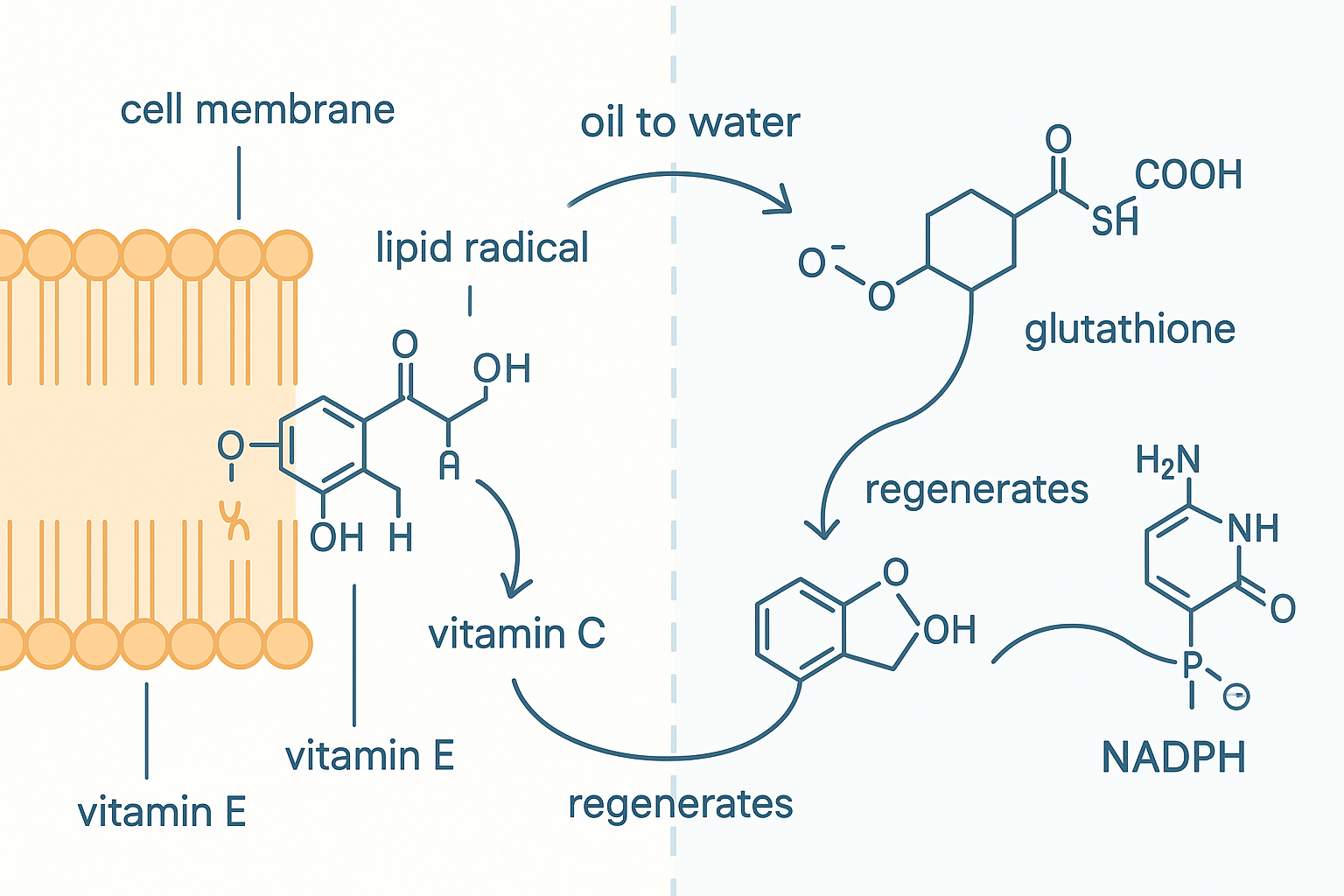 The antioxidant network as a physical relay, not a list: a radical caught by vitamin E inside the oily membrane is passed — hand to hand — to vitamin C at the water boundary, then to glutathione in the watery interior, and finally to NADPH, the cell's bottomless reducing currency replenished from glucose. Each molecule regenerates the one before it. This is why no single antioxidant works alone, and why mega-dosing one link fails when another is the bottleneck.
Tier 3 — The master switch: Nrf2 / ARE (build your own defences)
Every enzyme and synthesis pathway above is a protein, and proteins are made by switching on genes. The body does not run its defence at a fixed level — it scales it up when it senses oxidative threat, through a master transcription factor called Nrf2 (nuclear factor erythroid 2–related factor 2).
The mechanism is itself elegant redox sensing. Normally Nrf2 is held captive in the cytoplasm by a partner protein, Keap1, which constantly tags it for destruction — keeping the defence idling. But Keap1 is itself a sensor, studded with reactive cysteine thiols. When oxidants — or certain reactive plant chemicals — modify those thiols, Keap1 changes shape and releases Nrf2, which travels to the nucleus and switches on a whole battery of defence genes (those sharing a DNA tag called the Antioxidant Response Element, ARE): glutathione-synthesis enzymes, glutathione peroxidase and reductase, SOD, NADPH-generating enzymes, and more — all at once.
This reframes how the most robust "antioxidant" foods actually work. Sulforaphane (from broccoli sprouts), curcumin, quercetin, and many polyphenols are mild Keap1 irritants: they poke the sensor, release Nrf2, and provoke the cell to build its own, far larger, self-renewing defence. This is a hormetic mechanism — a small controlled stress that triggers an adaptive over-response — and it is mechanistically superior to swallowing a direct scavenger, because an enzyme system the cell builds for itself is catalytic, regenerating, and correctly localised, whereas a swallowed antioxidant is consumed once and may need regenerating itself. This distinction is the hinge of the calibration argument in Part 6, and it is why "eat the colourful plants" can be sound advice even though "take a big antioxidant pill" is not.
flowchart TD
    CALM["Calm cell"] --> KEAP["Keap1 holds Nrf2 captive<br/>+ tags it for destruction"]
    KEAP --> IDLE["Defence genes idling"]
    TRIG["Oxidant stress<br/>OR sulforaphane / curcumin /<br/>quercetin (mild irritants)"] -->|"modify Keap1's<br/>reactive thiols"| REL["Keap1 releases Nrf2"]
    REL --> NUC["Nrf2 enters nucleus,<br/>binds ARE"]
    NUC --> GENES["Turns ON the defence programme:<br/>glutathione synthesis · GPx · SOD ·<br/>NADPH supply · detox enzymes"]
    GENES --> OWN["Cell builds its OWN<br/>larger, self-renewing,<br/>catalytic defence"]
    OWN -.->|"superior to a single<br/>swallowed scavenger"| OWN
Part 6 — The crucial nuance: ROS as a signal, hormesis, and why megadoses disappoint
Here the popular understanding breaks down completely, and the sophisticated picture begins. It is the most important calibration on the page, and it is the one most at odds with "antioxidants = always good."
Reactive oxygen is also a signal, not only damage
A cell scrubbed completely free of reactive oxygen would not be healthy — it would be deaf to a whole channel of information and unable to adapt. At low, controlled concentrations, reactive species are essential signalling molecules. The key player is hydrogen peroxide, whose mildness, stability, and ability to diffuse across membranes — the very properties that make it not a frantic radical — make it an ideal messenger. A controlled puff of H₂O₂ (made deliberately by NADPH oxidase, or arising from mitochondrial activity) carries a message by reversibly oxidising specific cysteine thiols on target proteins, flipping them between "off" and "on" shapes — much like the more familiar on/off switching by phosphate groups, and reversible because the thioredoxin and glutathione systems can switch it back. This redox signalling regulates:
- Growth-factor and insulin signalling, which deliberately generate local H₂O₂ bursts as part of normal action.
- The Nrf2 response itself — oxidants are the trigger for building more defence (Part 5).
- Adaptation to exercise — the reactive-oxygen burst from exercising muscle mitochondria is a large part of the signal that tells cells to build more mitochondria and more of their own antioxidant enzymes.
This last point has a direct, proven, practical consequence (below): high-dose antioxidants taken around training can blunt the adaptations to that training — because you mop up the very signal that drives them.
The hormetic U-curve
This sets up the central conceptual tool: the relationship between reactive-oxygen level and biological function is not a downward slope ("more oxidation, always worse") but a U-shaped (inverted-U) curve.
- Too little reactive oxygen — the over-scavenged state — and signalling fails: blunted adaptation, sluggish Nrf2 defences, and even a paradoxical vulnerability because the cell never trains its defences. There is a real, if less famous, pathology called reductive stress — an excess of reducing power that is itself harmful.
- A moderate, dynamic level — the healthy window — and reactive oxygen does its signalling and adaptive job, comfortably handled by defences kept appropriately exercised. This is the optimum.
- Too much — true oxidative stress — and the damage of Parts 3–4 takes over.
The goal is therefore not to drive oxidation as low as possible but to sit in the middle of the U. This single reframing dissolves the antioxidant paradox: antioxidants help the person on the over-oxidised right-hand side of the curve, but they can harm the person already near the optimum by shoving them left into blunted signalling. (The brain-redox page develops this U-curve, with its own illustration, for the neuron specifically.)
The trials that humbled the field
This is not theory — it is what the large, expensive clinical trials actually found when they gave high-dose antioxidants to broad populations:
- ATBC (1994) — the Alpha-Tocopherol, Beta-Carotene trial gave beta-carotene and/or vitamin E (50 mg/day) to ~29,000 Finnish male smokers. The beta-carotene group had more lung cancer, not less — the opposite of the hypothesis.
- CARET (1996) — gave beta-carotene plus retinol to smokers and asbestos-exposed workers. It was stopped early because the supplemented group had roughly 28% more lung cancer and higher overall mortality. Two trials, same disturbing direction: in people whose lungs were already under heavy oxidant assault from smoke, adding a high-dose antioxidant made things worse.
- SELECT (2008–2011) — the Selenium and Vitamin E Cancer Prevention Trial randomised 35,533 men to vitamin E (400 IU/day), selenium, both, or placebo, expecting fewer prostate cancers. It found no benefit, and on longer follow-up the vitamin E group had a statistically significant ~17% increase in prostate cancer. A landmark negative result for high-dose vitamin E.
- Exercise-adaptation blunting — controlled studies have shown that high doses of vitamin C and vitamin E taken around training can blunt some of the beneficial adaptations to exercise (mitochondrial biogenesis, insulin-sensitivity gains) — the redox-signalling mechanism above, demonstrated in humans.
And in 2012, the USDA quietly withdrew its ORAC database — the table of "antioxidant capacity" scores that had been splashed across supplement and superfood marketing — stating that the values "have no relevance to the effects of specific bioactive compounds" in the body and were being routinely misused. The single most popular consumer metric of "antioxidant power" was officially repudiated as biologically meaningless.
The bottom line: lower the load before you raise the defence
Put the U-curve and the trials together and a clear, calibrated conclusion emerges, and it is the one the bioenergetic (Ray Peat–influenced) framing on this site emphasises: reducing the oxidant load generally beats mega-dosing antioxidants to mop up after it. The most effective interventions are the ones that lower production at source — not smoking, avoiding oxidised and heat-abused polyunsaturated fats (Part 4), keeping iron from overloading, supporting a brisk and efficient metabolism so mitochondria leak less, and resolving inflammation — rather than swallowing large doses of isolated scavengers to neutralise a flood you keep replenishing. Where defence is the target, the indirect, hormetic Nrf2 route (colourful plants, sulforaphane, polyphenols, and the mild stress of exercise and sauna) — which prompts the cell to build its own catalytic, self-renewing, correctly-localised defence — is mechanistically far sounder than dumping in a single sacrificial antioxidant at supra-physiological dose. Megadosing is the right move only for the person genuinely stuck on the over-oxidised side of the curve, and even then preferably within the network, not as an isolated link.
flowchart TD
PROB["Oxidative stress<br/>(production > defence)"] --> Q{Restore balance — how?}
Q --> LOWER["LOWER PRODUCTION<br/>(usually the better lever)"]
Q --> RAISE["RAISE DEFENCE"]
LOWER --> L1["stop smoking · avoid oxidised /<br/>fried PUFA · limit excess iron ·<br/>resolve inflammation ·<br/>keep metabolism brisk (less leak)"]
RAISE --> R1["INDIRECT / hormetic — preferred:<br/>Nrf2 activators (sulforaphane,<br/>polyphenols), exercise, sauna<br/>→ cell builds its own defence"]
RAISE --> R2["DIRECT scavenger MEGADOSE —<br/>caution: ATBC · CARET · SELECT<br/>showed no benefit / harm;<br/>can blunt adaptation; only helps<br/>the truly over-oxidised"]
R1 -.better than.-> R2Part 7 — The free-radical theory of ageing
Finally, the grand claim that organises much of this field: Denham Harman's free-radical theory of ageing (1956), later sharpened into the mitochondrial free-radical theory of ageing. Its logic is clean and intuitive: every aerobic cell leaks a small, continuous stream of reactive oxygen; that stream inflicts a small, continuous quota of damage on lipids, proteins, and — most consequentially — DNA, especially the vulnerable mitochondrial DNA sitting right beside the leak. Damaged mitochondria leak more, in a slow vicious circle; damage to irreplaceable, long-lived cells (neurons, heart muscle) accumulates because they cannot be swapped out. Over decades, the theory holds, this accumulating oxidative damage is much of what we experience as ageing and as the rising risk of degenerative disease. It is also why Harman, watching oils go rancid, saw the connection in the first place — and why the brain, the highest-oxygen, least-replaceable organ, is where the theory found its strongest foothold (see brain-redox).
The honest calibration: the theory explains a great deal and is supported by mountains of correlative evidence — oxidative markers (8-OHdG, protein carbonyls, lipid-peroxidation products) rise with age across tissues and species. But it is not the whole story, and the field has moved past the simple version:
- The straightforward prediction — "boost antioxidants, slow ageing, live longer" — largely failed in animal and human trials (the Part 6 results are exactly this failure). If accumulated oxidation were the sole pacemaker of ageing, antioxidants should have worked; they mostly did not.
- The signalling and hormesis findings (Part 6) show why: because reactive oxygen is also an adaptive signal, simply scavenging it can do as much harm as good, and some long-lived organisms tolerate or even rely on relatively high oxidant fluxes. Mild oxidative stress can extend lifespan in model organisms (a phenomenon called mitohormesis) — the opposite of the naive prediction.
- Ageing is now understood as multi-causal, a set of interlocking "hallmarks" of which oxidative damage is one — alongside glycation/glycoxidation (the cross-linking, browning, AGE pathway of the Glycation, AGEs & Ageing page), telomere shortening, impaired protein clearing, chronic low-grade inflammation ("inflammaging"), and cellular senescence. Oxidation interacts with all of them — it accelerates glycation, drives inflammation, and damages the repair machinery — but it is a contributor and accelerant, not the lone master clock Harman first imagined.
The mature position: oxidative damage is a real, central, and modifiable strand of ageing — worth taking seriously precisely by lowering the avoidable load — but ageing is a web, not a single thread, and "more antioxidants = longer life" is exactly the over-extrapolation the trials disproved.
Putting it all together
Step back and view the whole system:
-
Oxidation is electron bookkeeping. Oxidation is electron loss, reduction is electron gain (OIL RIG), and the two are always paired — so an "antioxidant" is simply a molecule willing to donate electrons. A free radical has an unpaired electron, which makes it reactive and lets it start self-propagating chain reactions; the broader category is reactive species (including non-radical H₂O₂ and reactive nitrogen species).
-
The oxygen paradox is the engine of the whole topic. Aerobic life needs oxygen as the electron transport chain's final acceptor (≈16× more ATP than without it) precisely because oxygen is a powerful electron-grabber — and that same property means leaked electrons turn it into superoxide. Oxidative stress is the unavoidable tax on breathing, which is why every aerobic organism co-evolved an antioxidant defence.
-
Oxidative stress is a balance, not a substance: production of reactive species exceeding the capacity to neutralise them. It damages lipids (peroxidation → 4-HNE, MDA — the same chemistry as rancid oil), proteins (carbonylation, thiol oxidation), and DNA (8-OHdG → mutation), each leaving a measurable scar. It interlocks with sugar-driven glycation as glycoxidation (see the glycation page).
-
Oxidants come from internal sources — mitochondrial electron leak (the baseline), the deliberate immune respiratory burst (NADPH oxidase), the inflammation loop, peroxisomes, and iron/copper Fenton chemistry — and from external/dietary sources, above all oxidised and rancid polyunsaturated fats (fried food and reused frying oil import pre-formed 4-HNE, MDA, and oxysterols ready-made), plus smoking, pollution, UV and ionising radiation, alcohol, and excess iron.
-
Defence is a three-tier network: catalytic enzymes (SOD → catalase / glutathione-peroxidase / peroxiredoxins) that walk superoxide down to water; small-molecule antioxidants — endogenous (glutathione the master, plus uric acid, bilirubin, CoQ10, lipoic acid, melatonin) and dietary (vitamin E in the lipid phase, vitamin C in the aqueous phase, carotenoids, polyphenols) — arranged in a regenerating relay (vitamin E → vitamin C → glutathione → NADPH) so that no antioxidant works alone; and the master gene programme Nrf2/ARE, which the cell switches on (in response to oxidants or mild plant-chemical and exercise stress) to build its own, larger, self-renewing defence.
-
The crucial nuance: reactive oxygen is also an essential signal (H₂O₂ tunes growth, insulin, Nrf2, and exercise adaptation), so function follows a hormetic U-curve — both too little (reductive stress, blunted adaptation) and too much (oxidative stress) are harmful, and the goal is the middle, not zero. This is exactly why the landmark megadose trials disappointed or harmed: ATBC and CARET (beta-carotene → more lung cancer in smokers), SELECT (vitamin E → ~17% more prostate cancer), high-dose vitamin C/E blunting exercise adaptations, and the USDA's withdrawal of the meaningless ORAC database. The calibrated conclusion: lower the oxidant load first (avoid oxidised PUFA, don't smoke, control iron, fix the metabolism), and where you raise defence, prefer the indirect Nrf2 route over isolated scavenger megadoses.
-
Ageing: Harman's free-radical theory captures a real, central strand of ageing (oxidative markers rise with age; mitochondrial DNA is the vulnerable target) — but the failed antioxidant trials and the discovery of redox signalling show it is not the whole story. Ageing is multi-causal (oxidation, glycation, inflammation, senescence, and more interwoven), and oxidative damage is a modifiable accelerant rather than the lone master clock.
The single unifying idea, echoing its sister pages: the body does not want to eliminate oxidation — it wants to govern it. Reactive oxygen is simultaneously the price of using oxygen, a genuine cause of damage and ageing, and an indispensable signal. Health is not the absence of oxidation but its precise regulation — enough to signal and adapt, never so much as to destroy — and the most reliable way to stay in that window is to stop importing and over-producing oxidants in the first place, not to chase them with megadoses after the fact.
Related Compounds & Deep Dives
The glutathione system (the master endogenous antioxidant)
- Glutathione — the central intracellular antioxidant; the GSH/GSSG ratio is the standard readout of redox health.
- NAC (N-acetylcysteine) — delivers cysteine, the rate-limiting raw material for glutathione synthesis; the clinical glutathione-replenisher.
- Selenium — the essential cofactor at the active site of glutathione peroxidase, the body's main peroxide-disposal enzyme.
The membrane antioxidant network (the regenerating relay)
- Vitamin E and the Vitamin E deep dive — the lipid-phase, chain-breaking antioxidant that stops lipid peroxidation; full mechanism and the alpha-vs-gamma debate.
- Vitamin C — the principal aqueous-phase antioxidant; regenerates spent vitamin E at the membrane surface.
- CoQ10 / ubiquinone and ubiquinol — the electron-transport-chain shuttle that doubles as a membrane antioxidant and regenerates vitamin E.
Endogenous and dietary scavengers
- Melatonin — beyond sleep, a membrane- and mitochondria-penetrant antioxidant with antioxidant breakdown products.
- L-carnosine — a dipeptide that quenches reactive carbonyls and aldehydes (4-HNE, MDA) and the glycoxidation products that bridge to the glycation page.
- Quercetin and Curcumin — polyphenols whose main benefit is the indirect, hormetic Nrf2 route (Part 5), not direct scavenging.
Mitochondrial / bioenergetic angle
- Methylene blue — an alternative mitochondrial electron carrier argued to reduce superoxide leak by keeping electron flow brisk rather than scavenging products (dose-sensitive and hormetic).
Related foundations
- Redox Balance in the Brain — this chemistry applied to the neuron: the redox couples, the species cascade, glutathione cycling, and the hormetic U-curve in depth.
- Fat & Fat Metabolism — PUFA, lipid peroxidation, and oxidised dietary fats — the dietary-oxidation source in full.
- Cellular Energy: From Fuel to ATP — the electron transport chain whose electron leak is the largest internal oxidant source.
- Inflammation — the self-reinforcing oxidative–inflammatory loop.
- Glycation, AGEs & Ageing — the sugar-driven damage pathway that interlocks with oxidation as glycoxidation.