GABA & the Excitation–Inhibition Balance
The brain runs on two opposing chemicals — one that says "fire" and one that says "stop" — held in a tuned balance. This is the page about the "stop" signal: how the brain makes it, the chloride channel it opens, the developmental quirk that makes it briefly do the opposite, and why a balance tipped too far either way produces anxiety, insomnia, or seizures. It is also why "GABA supplements" mostly do nothing, and what actually works.
When biochemists first went looking for what the brain was made of, they kept finding an amino acid that appeared almost nowhere else in the body. In 1950, working independently, Eugene Roberts and Sam Frankel in California, and Jorge Awapara in Texas, identified gamma-aminobutyric acid (GABA) as a major constituent of mammalian brain tissue — present at concentrations hundreds of times higher than in other organs (Roberts & Frankel, 1950). That was a puzzle, not an answer: nobody knew what it was for. The idea that GABA might be the brain's main inhibitory signal grew through the late 1950s from experiments on crayfish neurons, but it was not until 1967 that Kresimir Krnjević and Susan Schwartz produced clean proof, in the mammalian cortex, that GABA is the major inhibitory neurotransmitter (Krnjević & Schwartz, 1967). Research then exploded.
The next chapter was pharmacological. In the 1970s the benzodiazepines — Valium and its relatives, already in wide use as tranquillisers — were shown to work by binding the GABA receptor and amplifying GABA's own signal. Suddenly the most-prescribed calming drugs in the world had a molecular address. The story has kept opening outwards since: the discovery that the brain makes its own GABA-boosting steroids (neurosteroids such as allopregnanolone, now the basis of antidepressants like brexanolone and zuranolone), and the realisation that the excitation/inhibition balance is not just about anxiety but is a core organising principle of how circuits develop, learn, and sometimes go wrong in epilepsy and neurodevelopmental conditions.
This page builds that whole picture from first principles.
Why this page exists
The neuroscience of cognition page was about the brain's accelerators — dopamine, noradrenaline, the chemistry of drive and focus. But a brain that could only accelerate would be useless, or rather it would be a seizure. Every excitatory signal needs a counter-signal that says enough, and a system to keep the two in proportion. That counter-system is GABAergic inhibition, and the proportion is the excitation/inhibition (E/I) balance.
Almost everything people reach for to calm down, sleep, or take the edge off anxiety acts somewhere in this system — l-theanine, taurine, glycine, phenibut, magnesium, alcohol, benzodiazepines, progesterone and its neurosteroid metabolites. But they act at different points, and lumping them together as "GABA stuff" hides which lever each one pulls and why some are gentle while others (phenibut, alcohol, benzodiazepines) build tolerance and dependence. By the end of this page you should be able to look at any calming compound and say which step it touches: the raw material, the synthesising enzyme, the chloride channel and which site on it, the slow metabotropic receptor, or the reuptake and breakdown that clear GABA away.
We build the inhibitory system the way the brain does — from glutamate.
The two master transmitters: glutamate and GABA
The brain has dozens of signalling molecules, but two of them carry the overwhelming majority of all fast synaptic traffic, and they are a matched pair.
- Glutamate is the brain's master excitatory transmitter. When a neuron releases glutamate onto the next cell, it makes that cell more likely to fire. Roughly 80–90% of the brain's neurons are excitatory and use glutamate. (It is the same glutamate from the cognition page, whose NMDA receptor is the subject of the magnesium deep dive.)
- GABA is the brain's master inhibitory transmitter. When a neuron releases GABA onto the next cell, it makes that cell less likely to fire. The remaining 10–20% of neurons are inhibitory and use GABA.
A first vocabulary anchor, since the rest of the page leans on it. A neuron is a nerve cell; it carries an electrical signal along its length and passes a chemical signal — a neurotransmitter — across a tiny gap, the synapse, to the next cell. The cell that releases is presynaptic; the cell that receives is postsynaptic. Whether a transmitter excites or inhibits is not a property of the molecule floating in the gap — it is a property of the receptor it lands on. This is the single most important idea on the page: GABA inhibits because its receptors open channels that hyperpolarise the cell. We will define exactly what that means shortly.
The deepest fact about glutamate and GABA is that they are the same carbon skeleton. GABA is made from glutamate by removing a single chemical group. The brain's "stop" signal is, quite literally, one enzymatic step away from its "go" signal — which is why their production and recycling are physically interlocked, and why a vitamin deficiency or an enzyme failure can shift the whole balance at once.
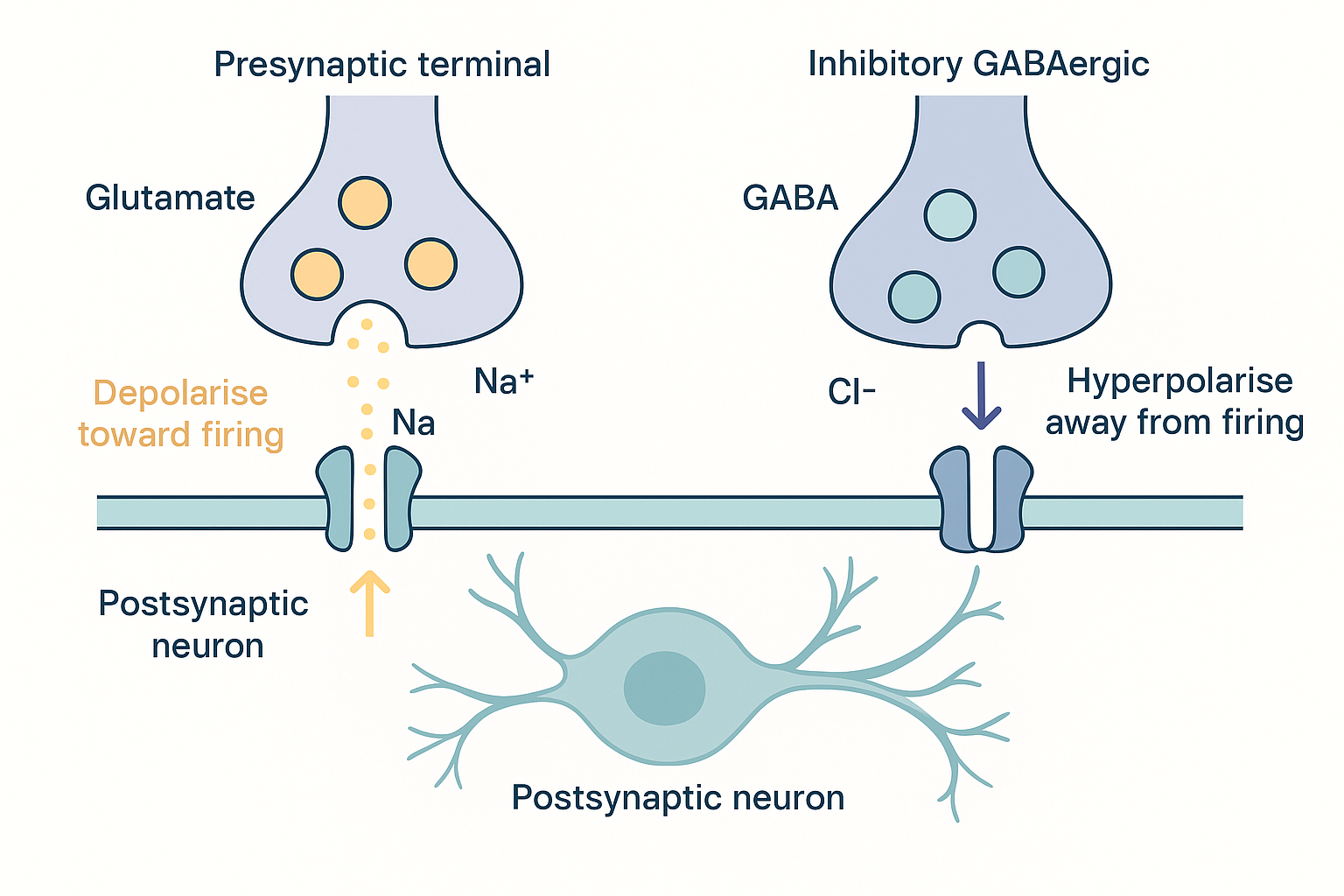 The matched pair at the cell surface: the same target neuron receives an excitatory glutamatergic synapse (left, sodium in, pushed toward firing) and an inhibitory GABAergic synapse (right, chloride in, pulled away from firing). Whether a signal excites or inhibits is decided by the receptor and the ion it gates, not by the transmitter floating in the gap.
The glutamate–glutamine cycle: where the raw material comes from
Glutamate and GABA are not endlessly synthesised from scratch; they are recycled, and the recycling runs through a third kind of cell. Neurons share the brain with astrocytes — star-shaped support cells that wrap around synapses, manage the local chemical environment, and, crucially, handle transmitter recycling. The loop they run is the glutamate–glutamine cycle, and it is the supply chain for the entire excitatory/inhibitory system.
Here is the cycle, step by step:
- An excitatory neuron releases glutamate into the synapse to send its signal.
- Letting glutamate linger would be both noisy and dangerous (more on the danger — excitotoxicity — later), so it must be cleared fast. Astrocytes pump glutamate out of the synapse using dedicated transporters (the EAATs, excitatory amino acid transporters).
- Inside the astrocyte, the enzyme glutamine synthetase converts glutamate to glutamine — an inert, non-signalling storage form. Glutamine cannot activate receptors, so it is safe to ship around.
- The astrocyte exports glutamine back to neurons.
- Neurons take up glutamine and, using the enzyme glutaminase, convert it back to glutamate — ready to be released again, or, in GABAergic neurons, converted onward into GABA.
This cycle is why glutamate is "recharged" rather than constantly rebuilt from food, and it places astrocytes at the centre of the E/I balance: by controlling how fast they clear glutamate and how much glutamine they return, they set the supply of both transmitters.
flowchart LR
    subgraph EXC["Excitatory neuron"]
      GLU1[Glutamate] -->|released| SYN[Synapse]
    end
    SYN -->|EAAT uptake| AST
    subgraph AST["Astrocyte (support cell)"]
      GLN1["Glutamine synthetase<br/>makes inert glutamine"]
    end
    AST -->|exports glutamine| NEU
    subgraph NEU["Neuron"]
      GLN2[Glutamine] -->|glutaminase| GLU2[Glutamate]
      GLU2 -->|GAD enzyme<br/>+ vitamin B6| GABA[GABA]
    end
    GABA -->|released by<br/>inhibitory neuron| SYN
Making GABA: the GAD enzyme and vitamin B6
The step that turns the master excitatory transmitter into the master inhibitory one is a single decarboxylation — the removal of a carboxyl (–COOH) group as carbon dioxide. The enzyme that does it is glutamic acid decarboxylase (GAD), and it is found only in GABAergic neurons (and a few other GABA-making cells). GAD is what defines a neuron as inhibitory: a cell becomes a GABA neuron by expressing GAD.
GAD does not work alone. Like every decarboxylase of this family, it depends absolutely on a cofactor: pyridoxal-5'-phosphate (P5P), the active form of vitamin B6. P5P sits in the enzyme's active site and is the chemical machinery that actually grips the glutamate molecule and pulls off the carboxyl group. Without P5P, GAD cannot run, and GABA synthesis falls.
This is not a trivia point — it is a clinical reality. Severe vitamin B6 deficiency causes seizures, and the mechanism is precisely this: starved of P5P, GAD slows, GABA levels drop, inhibition fails, and the brain tips toward runaway excitation. In newborns there is a rare inherited condition (pyridoxine-dependent epilepsy) in which the seizures stop almost immediately when B6 is given. The same logic runs in the other direction for P5P / vitamin B6 supplementation in the calming context: B6 is a permissive cofactor for making GABA, which is part of why it appears in sleep and anxiety stacks — though, as we will see, having enough B6 only matters when B6 is the thing you are short of.
There is a second elegant detail. GABA is not only made from glutamate — it is also broken down back into the energy economy, and the breakdown enzymes feed the brain's main energy cycle. After GABA has done its signalling job and been cleared, the enzyme GABA transaminase (GABA-T) converts it to succinic semialdehyde, which becomes succinate — an intermediate of the Krebs cycle (the central energy-extraction cycle from the cellular energy page). This short detour — glutamate → GABA → succinate → back into the Krebs cycle — is called the GABA shunt, and a meaningful fraction of the brain's glutamate flux runs through it. GABA is thus simultaneously a signal and a small energy substrate, and both GAD (making it) and GABA-T (destroying it) are also B6-dependent enzymes.
flowchart LR
    GLN[Glutamine] -->|glutaminase| GLU[Glutamate]
    GLU -->|"GAD enzyme<br/>needs vitamin B6 (P5P)"| GABA[GABA]
    GABA -->|released, then cleared| CLEAR[Out of synapse]
    CLEAR -->|"GABA-T<br/>(also needs B6)"| SSA[Succinic semialdehyde]
    SSA --> SUC[Succinate]
    SUC -->|"feeds Krebs cycle<br/>= the GABA shunt"| ENERGY[Brain energy]
    GLU -.->|"alternative fate:<br/>excitatory signalling"| EXC[Fires next neuron]
GABA-A receptors: the chloride channel that hyperpolarises
GABA has two distinct receptor systems, working on different timescales. The fast one — the one benzodiazepines, alcohol, and neurosteroids all act on — is the GABA-A receptor. Understanding it requires understanding what "inhibition" physically is.
A two-minute primer on membrane voltage. Every neuron holds a voltage across its membrane, like a tiny charged battery. At rest the inside is about −70 millivolts (mV) relative to the outside — this is the resting membrane potential. The neuron fires (sends a signal) when something pushes that voltage up past a threshold of roughly −55 mV; this upward move toward firing is depolarisation. Anything that pushes the voltage in the opposite direction — more negative inside, away from threshold — makes firing harder; that is hyperpolarisation. Excitation = depolarisation = toward firing. Inhibition = hyperpolarisation (or holding the voltage clamped) = away from firing. That is the whole of it.
The GABA-A receptor is an ionotropic receptor, meaning it is an ion channel: the receptor and the pore are the same protein. It is built from five protein subunits arranged in a ring around a central pore (a pentamer), and that pore is selective for chloride ions (Cl⁻) — negatively charged. When GABA binds, the channel opens and chloride flows. In a mature neuron, chloride is more concentrated outside the cell than inside, so opening the gate lets Cl⁻ flow inward. Each chloride ion carries a negative charge in with it, so the inside of the cell becomes more negative — hyperpolarisation. The neuron is pushed away from its firing threshold. That is how GABA inhibits: it opens a negative-ion channel that drags the membrane voltage downward, and even when it doesn't move the voltage much, the open channel acts as an electrical "short circuit" (called shunting inhibition) that bleeds away any incoming excitation.
flowchart TD
    GABA[GABA binds GABA-A receptor] --> OPEN[Cl- channel opens]
    OPEN --> IN["Cl- flows INTO cell<br/>(chloride higher outside)"]
    IN --> NEG[Inside becomes more negative<br/>= hyperpolarisation]
    NEG --> AWAY[Membrane pushed away<br/>from firing threshold]
    AWAY --> INHIB[Neuron LESS likely to fire<br/>= inhibition]
The modulatory sites: why one channel has so many drugs
The reason the GABA-A receptor matters so much pharmacologically is that it is not a simple on/off switch. The pentamer has, besides the spot where GABA itself binds, several separate modulatory sites — pockets where other molecules dock and change how the channel responds to GABA. Most of these are positive allosteric modulators: they do not open the channel themselves, they make GABA's own opening bigger or more frequent. This is a beautifully safe design and a dangerous one at the same time — safe because the drug only works where GABA is already being released (it amplifies the brain's own signal rather than overriding it), dangerous because several of these sites can be hit at once.
- The benzodiazepine site. Benzodiazepines (diazepam, alprazolam, and relatives) bind here and increase the frequency with which GABA opens the channel. They cannot open it without GABA, which is part of why benzodiazepines are relatively hard to fatally overdose on alone — there is a ceiling set by how much GABA is present. Their problem is tolerance and dependence, not acute lethality.
- The barbiturate site. Barbiturates increase the duration the channel stays open, and at higher doses can open it without GABA at all. Removing the GABA ceiling is exactly why barbiturates are far more dangerous in overdose than benzodiazepines — they can drive inhibition to the point of stopping breathing.
- The neurosteroid site. The brain makes its own steroids that powerfully potentiate GABA-A — most importantly allopregnanolone, made from progesterone. This is the molecular reason progesterone is calming and sleep-promoting, why some women experience anxiety and insomnia in the low-progesterone phase of the menstrual cycle, and why synthetic allopregnanolone analogues (brexanolone, zuranolone) are now used as fast-acting antidepressants (Cai et al., 2019).
- The ethanol site(s). Alcohol potentiates GABA-A (among several other actions), which accounts for a large part of its sedative, anxiolytic, disinhibiting, and motor-impairing effects — and, through GABA-A adaptation, much of the rebound hyperexcitability of withdrawal.
Because benzodiazepines, alcohol, barbiturates, and neurosteroids all push the same channel, their effects stack dangerously: combining alcohol with benzodiazepines (or with phenibut, which also reaches GABA-A) can drive inhibition far enough to suppress breathing. This is the single most important safety fact in the whole calming-compound landscape.
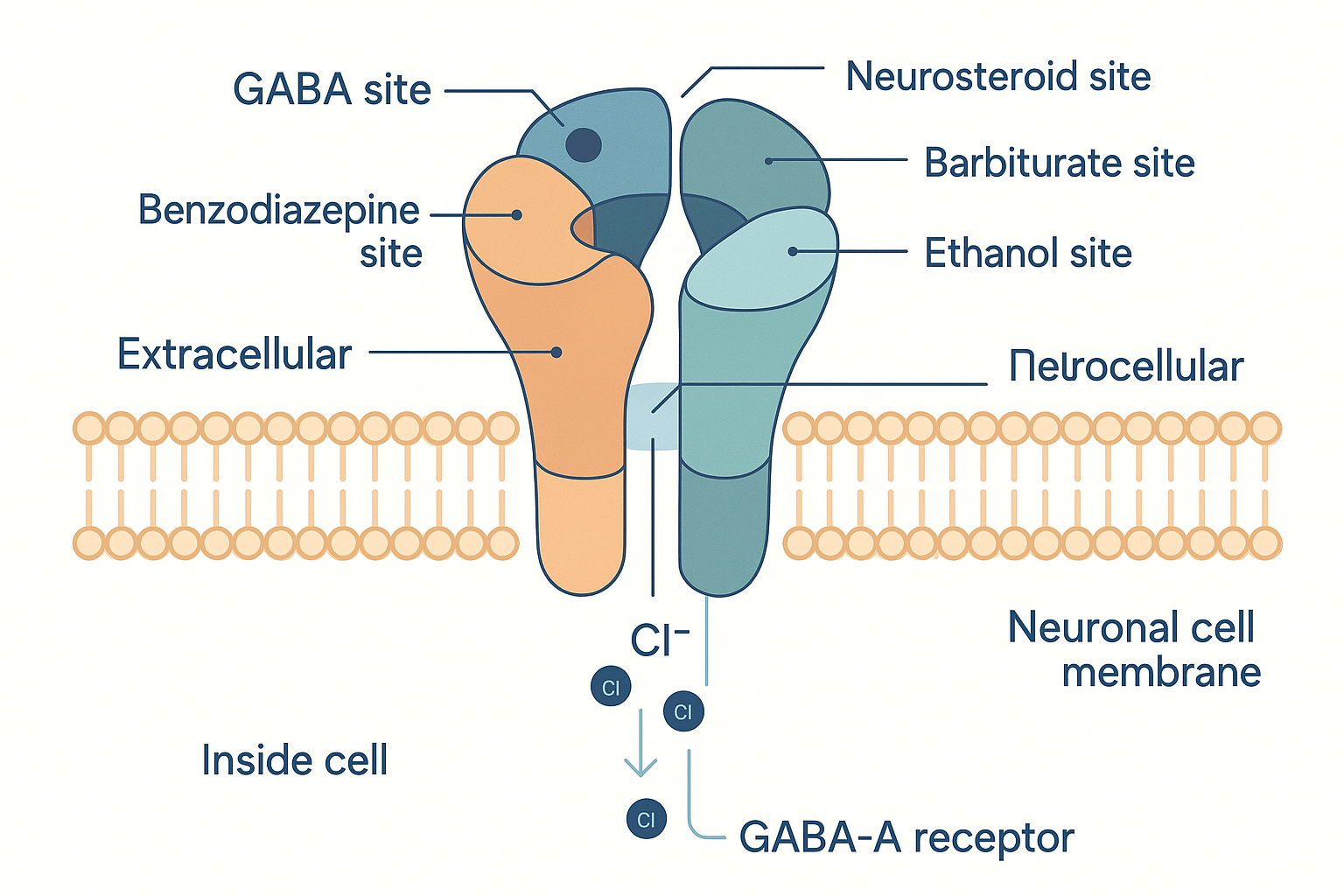 The GABA-A receptor as a physical chloride channel: five subunits ringing a central pore that passes Cl⁻ into the cell. GABA binds at its own site to open the gate; benzodiazepines, neurosteroids, barbiturates, and ethanol bind separate modulatory pockets and amplify that opening — which is why they all calm, and why combining them is dangerous.
Tonic versus phasic inhibition
GABA-A inhibition comes in two flavours, and the distinction matters for how drugs feel and what they treat.
- Phasic inhibition is the fast, brief, point-to-point kind: a burst of GABA released into a synapse, a sharp pulse of chloride current, over in milliseconds. This is "this specific input, right now, off."
- Tonic inhibition is a slow, persistent background hum. A low concentration of ambient GABA, leaking out of synapses and not yet cleared, continuously activates a special population of GABA-A receptors sitting outside the synapse (extrasynaptic receptors, often containing the delta subunit). These produce a steady, always-on inhibitory tone that sets the overall excitability of the neuron — a baseline volume control rather than a switch.
Neurosteroids and alcohol act strongly on the tonic, extrasynaptic system; classical benzodiazepines act mainly on the phasic, synaptic one. This is why their subjective characters differ — and why the tonic system, which sets the brain's whole gain, is an increasingly important drug target.
GABA-B receptors: the slow metabotropic brake
The second GABA receptor system is the GABA-B receptor, and it is a completely different kind of machine. Where GABA-A is an ion channel (fast, milliseconds), GABA-B is metabotropic — it does not pass ions itself. Instead it is coupled to a G-protein, an internal relay molecule, and when GABA binds, the G-protein detaches and goes off to act on other targets inside the cell. This makes GABA-B slow (hundreds of milliseconds to seconds) but long-lasting.
Its effects, via that G-protein, are twofold and both inhibitory:
- It opens potassium (K⁺) channels. Potassium leaving the cell makes the inside more negative — hyperpolarisation again, but by a different ion and a slower route.
- It closes calcium (Ca²⁺) channels at presynaptic terminals. Calcium entry is what triggers neurotransmitter release in the first place, so shutting these channels reduces how much transmitter the neuron releases. GABA-B receptors sitting on presynaptic terminals therefore act as a volume knob on transmitter release — including, when placed on GABA terminals themselves, as a feedback brake on GABA release.
Two compounds make GABA-B concrete:
- Baclofen is a selective GABA-B agonist used as a muscle relaxant (for spasticity) and, off-label, for alcohol craving. Its profile — muscle relaxation, sedation — is the GABA-B signature.
- Phenibut is essentially a baclofen relative (it is beta-phenyl-GABA) and is a GABA-B agonist at its core, with additional GABA-A action at higher doses. Because it carries a phenyl ring that lets it cross the blood–brain barrier (see below), phenibut actually reaches the brain where plain GABA cannot — which is why it works where GABA capsules don't, and also why it is the most dependence-forming compound in the everyday anxiolytic toolkit. GABA-B agonists produce real physical tolerance and a genuinely nasty withdrawal; phenibut should be treated with the same respect as a prescription sedative, not as a benign "amino acid". (Its full risk profile is on the phenibut page.)
Clearing GABA away: GAT and GABA-T
A signal that cannot be switched off is not a signal. Just as dopamine is cleared by the DAT reuptake pump in the cognition page, GABA is cleared from the synapse by GABA transporters (GATs) — proteins on neurons and astrocytes that pump GABA back out of the gap, terminating the signal and recycling the molecule. Blocking GAT (the epilepsy drug tiagabine does this) leaves GABA in the synapse longer and so strengthens inhibition.
The other fate, once GABA is back inside, is destruction by GABA transaminase (GABA-T) — the GABA-shunt enzyme met earlier, which converts GABA toward succinate and the Krebs cycle. Inhibiting GABA-T (the drug vigabatrin does this irreversibly) raises brain GABA by blocking its breakdown, another anticonvulsant strategy. The general principle, identical to the dopamine system: you can raise a transmitter's signal by making more of it, by blocking its reuptake, or by blocking its breakdown — and there are drugs at each of these three points for GABA.
The chloride switch: why GABA is excitatory in the developing brain
Here is the most counterintuitive fact in the whole subject, and one of the most beautiful. Everything above said GABA inhibits because chloride flows into the cell, making it more negative. But that depends entirely on chloride being more concentrated outside the neuron than inside. In the immature brain — the fetal and newborn brain — that is reversed, and GABA is therefore excitatory.
The reason is two chloride-pumping proteins with opposite jobs:
- NKCC1 is a transporter that pumps chloride into the neuron, raising internal chloride.
- KCC2 is a transporter that pumps chloride out of the neuron, lowering internal chloride.
In the immature neuron, NKCC1 is highly expressed and KCC2 is barely present. Internal chloride is therefore high. When GABA opens the GABA-A channel in such a cell, chloride flows outward (down its gradient, from high inside to lower outside), and an outflow of negative charge makes the inside more positive — depolarisation. In the immature brain, GABA excites. As the brain matures, KCC2 is switched on and NKCC1 is wound down; internal chloride falls below external; the chloride gradient flips; and GABA settles into its lifelong role as the inhibitory transmitter. This developmental hand-over is the chloride switch (Ben-Ari; reviewed in Watanabe & Fukuda, 2015).
This is not a curiosity. In the developing brain, GABA's early excitatory action is essential: working together with NMDA receptors, the calcium it lets in drives neurite growth, neuron migration, and synapse formation — GABA helps build the circuits it will later restrain. And when the switch fails or runs late, the consequences are serious: disrupted KCC2/NKCC1 balance — keeping internal chloride high into later life — is implicated in epilepsy, autism spectrum disorders, schizophrenia, and Down syndrome (Watanabe & Fukuda, 2015). It even has therapeutic echoes: the NKCC1 blocker bumetanide (a common diuretic) has been trialled to lower internal chloride and "restore" inhibitory GABA in some of these conditions, with mixed results. Inflammation, too, can drive KCC2 down in the adult brain and partially un-do the switch — one molecular route by which neuroinflammation tips the E/I balance toward excitation.
flowchart LR
subgraph IMM["Immature neuron"]
N1[NKCC1 pumps Cl- IN] --> HI[High internal Cl-]
HI --> OUT[GABA opens channel<br/>Cl- flows OUT]
OUT --> DEP[Depolarises<br/>= GABA EXCITES]
end
subgraph MAT["Mature neuron"]
K1[KCC2 pumps Cl- OUT] --> LO[Low internal Cl-]
LO --> INF[GABA opens channel<br/>Cl- flows IN]
INF --> HYP[Hyperpolarises<br/>= GABA INHIBITS]
end
IMM -->|"KCC2 switched on,<br/>NKCC1 wound down"| MAT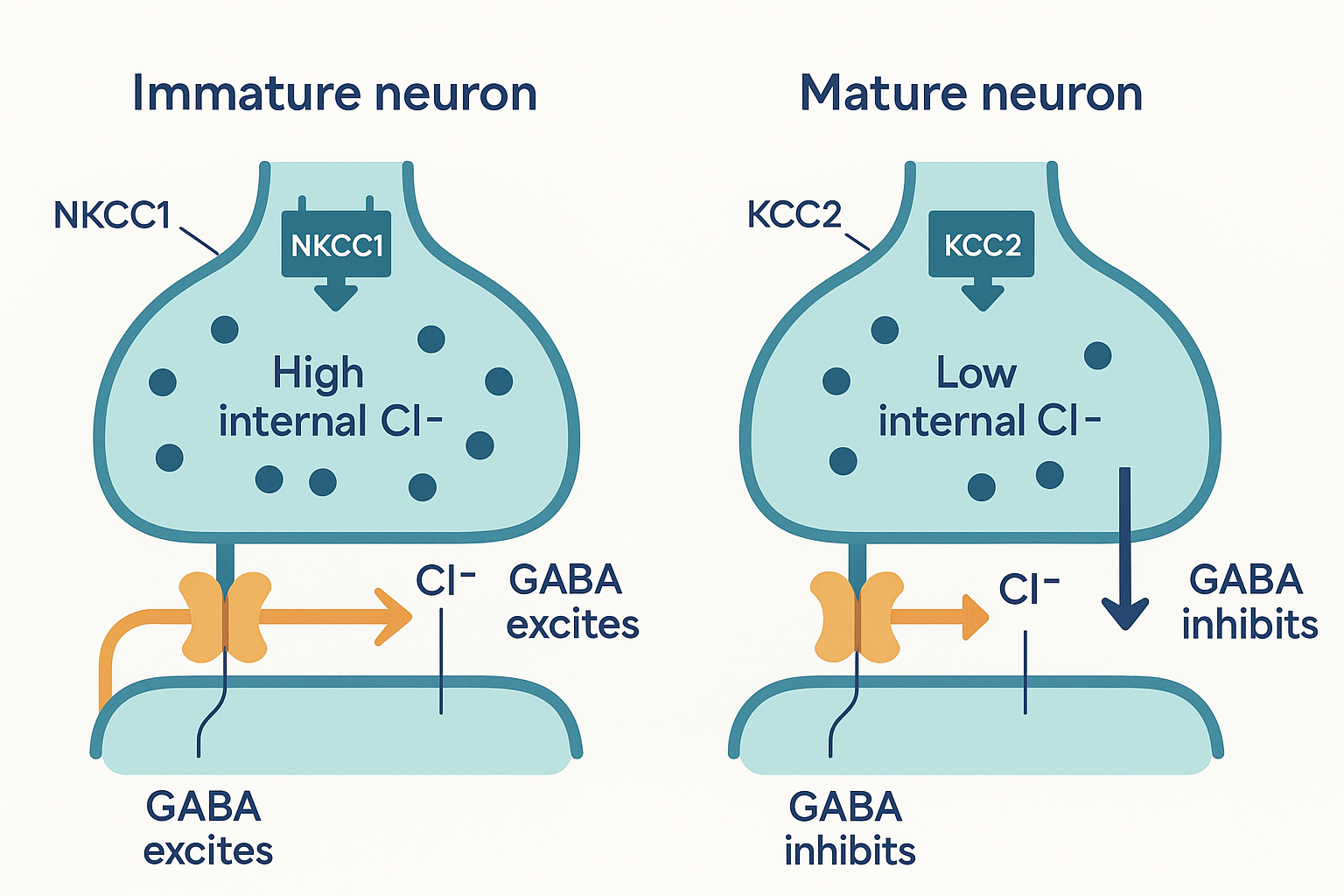 The chloride switch in space: the immature neuron (left) is dominated by NKCC1 pumps that load it with chloride, so opening a GABA channel lets chloride out and excites the cell; the mature neuron (right) expresses KCC2, which clears chloride out, so the same channel now lets chloride in and inhibits. The same receptor, opposite effects, decided entirely by which pump dominates.
The excitation/inhibition balance as an organising principle
Now the synthesis. The reason all of this machinery exists is to maintain a tuned ratio between excitation and inhibition — the E/I balance — across the brain, moment to moment and region by region. This is arguably the single most important operating principle of neural circuits, and it is worth seeing why the brain bothers.
A network of excitatory neurons wired to each other has a built-in instability: excitation begets excitation. Neuron A fires neuron B, which fires C, which feeds back to A — and without something to oppose it, activity runs away into a self-amplifying storm. That storm has a clinical name: a seizure. The only thing standing between normal cognition and a seizure is inhibition, continuously applied in exactly the right amount. Too little and the network runs hot toward seizure and anxiety; too much and it falls silent, sedated, unable to process. The brain therefore runs deliberately near a balance point, where excitation and inhibition rise and fall together in proportion, kept matched within each circuit.
Crucially, E/I balance is not just about quantity — it is about precision in time and space. Inhibition does not merely turn the volume down globally; it sculpts. It sharpens which neurons fire and which stay quiet, sets the timing windows in which signals count, and carves the rhythmic oscillations (the brain waves) that bind activity across regions. This sculpting is the job of a remarkable diversity of inhibitory interneurons — local GABA neurons that do not send long-range signals but shape the activity of the excitatory cells around them. Three families do most of the work, and they target different parts of the excitatory neuron, which is how the brain achieves different kinds of control:
- PV (parvalbumin) interneurons are the fast, powerful brake. They fire rapidly and synapse onto the cell body and axon of excitatory neurons — right at the output — so they can veto firing instantly and with authority. They are the pacemakers of fast gamma oscillations and the front line against runaway excitation. PV-cell dysfunction is heavily implicated in schizophrenia.
- SST (somatostatin) interneurons target the distant dendrites — the input branches — of excitatory neurons. They control which incoming signals a neuron is even allowed to hear, gating inputs rather than vetoing outputs.
- VIP (vasoactive intestinal peptide) interneurons mostly inhibit other interneurons (especially SST cells). By inhibiting an inhibitor, they release the brake — a disinhibition circuit that lets attention and context selectively turn excitation back up where it is needed.
So inhibition is not a blanket. It is a layered control system — a fast output veto (PV), an input gate (SST), and a context-driven release of the brake (VIP) — and the E/I "balance" is really the moment-to-moment output of this whole apparatus. The brain waves this produces, and how they are tuned, are taken up on the companion Brain Waves page.
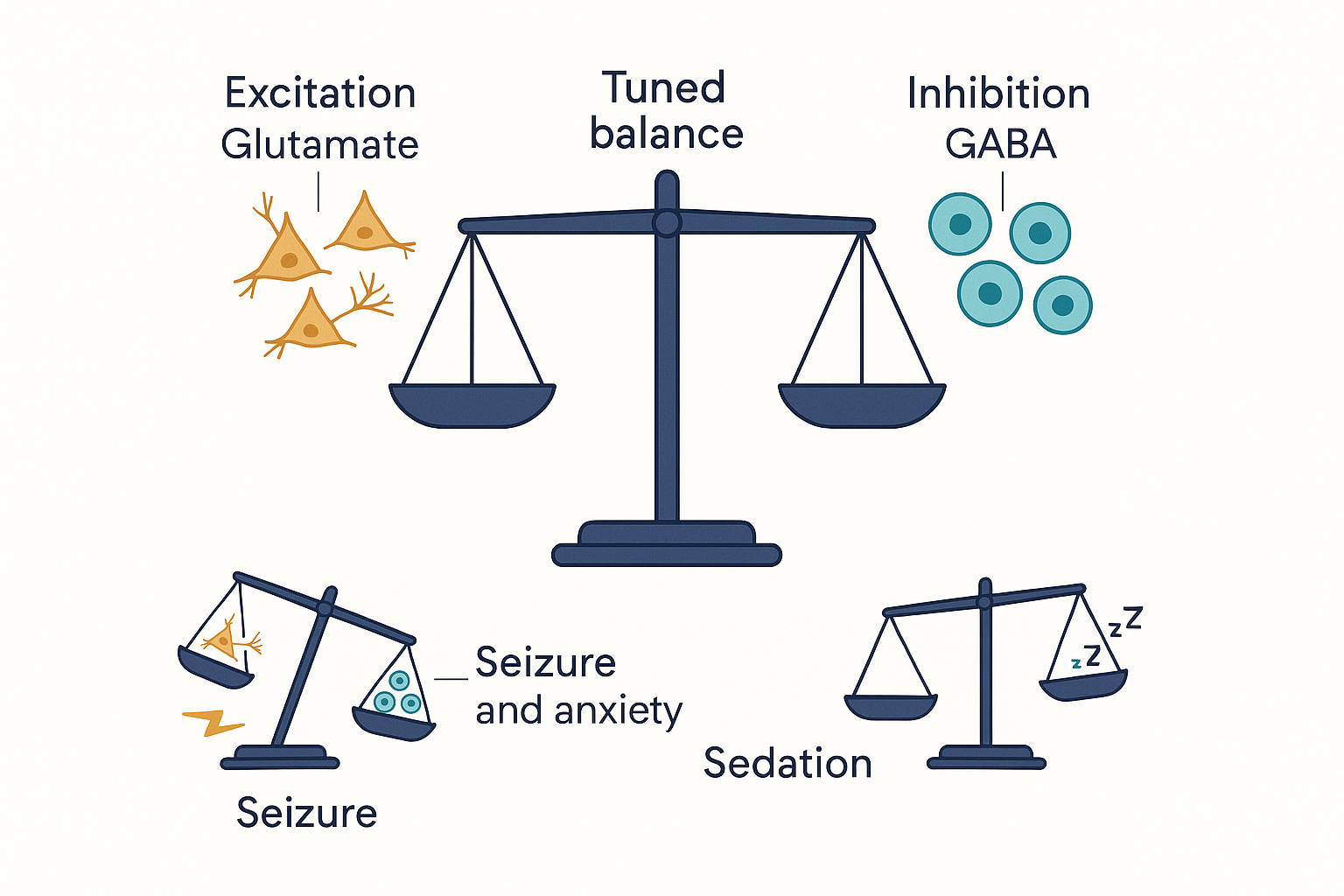 The excitation/inhibition balance as a literal scale: glutamatergic excitation on one pan, GABAergic inhibition on the other, held near level. Tip the beam toward excitation and the brain runs hot — anxiety, then seizure; tip it toward inhibition and it slows — calm, then sedation, then unconsciousness. Health is the tuned middle, not the maximum of either side.
When the balance tips: failure modes
Because the whole system is a balance, its pathologies fall naturally into "too much excitation" and "too much inhibition", and most calming and stimulating interventions are understood as nudges along this axis.
Anxiety — the balance leaning excitatory. A brain running with insufficient inhibitory tone is, subjectively, anxious: thoughts race, threat circuits (the amygdala) fire too readily, and the system cannot settle. This is the everyday end of the spectrum, and it is precisely why everything that boosts GABA-A — benzodiazepines, alcohol, neurosteroids, l-theanine's gentler nudge — is anxiolytic. It is also why GABA-ergic tone is tied to sleep: falling asleep requires inhibitory circuits in the hypothalamus and brainstem to quiet the arousal systems, and most sedative-hypnotics work by reinforcing GABA-A inhibition. (The sleep architecture this produces is the subject of the Sleep compound section.)
Seizures and epilepsy — the balance tipped hard excitatory. Push the imbalance far enough and you get the runaway storm described above. Many anticonvulsant drugs are, mechanistically, E/I-balance correctors that act on exactly the machinery on this page: benzodiazepines and barbiturates (potentiate GABA-A), tiagabine (blocks GAT, raising synaptic GABA), vigabatrin (blocks GABA-T, raising total GABA), and others that instead reduce glutamatergic excitation. The B6/GAD link closes the loop: too little inhibition from any cause — a failed GAD, a B6 deficiency, a lost interneuron population — manifests as seizure.
Excitotoxicity — when excitation becomes a poison. This is the most dangerous failure, and it is the bridge to the forthcoming Neurotoxicity page. Glutamate excites by, among other things, letting calcium into neurons through NMDA receptors. Calcium is a powerful internal signal — and in excess, a destructive one. If glutamate is released in massive amounts and not cleared (as happens in stroke, traumatic brain injury, or severe seizure), NMDA receptors are over-activated, calcium floods in past what the cell can buffer, and that calcium triggers enzymes that dismantle the neuron from the inside — a process called excitotoxicity that literally kills cells. Inhibition, and the astrocytic clearance of glutamate, are the brain's defences against it. (This is also where the magnesium story connects: the Mg²⁺ ion physically plugs the NMDA channel as a voltage-dependent gate, raising the bar for over-activation — see the magnesium deep dive.)
The autism E/I hypothesis — calibrate carefully. A prominent and genuinely interesting idea proposes that an elevated E/I ratio (too much excitation relative to inhibition, often framed as GABAergic deficit) contributes to autism spectrum conditions, with supporting threads from genetics (many autism-risk genes touch synapses and GABA signalling), from the chloride-switch failures above, and from neuroimaging (reviewed widely, e.g. Sohal & Rubenstein, and the gene-set work of Horder et al., 2018). The honest calibration: this is a real and productive research hypothesis, not an established mechanism or a unified explanation. "E/I balance" is measured in very different ways across studies (synaptic conductance ratios, population firing, MRI-derived GABA/glutamate signals) that do not always agree; the direction of imbalance may differ across brain regions and individuals; and autism is heterogeneous enough that no single neurochemical story will cover it. Treat the E/I framing as a useful lens that organises a lot of findings — and be sceptical of any product or protocol that claims to "fix the E/I balance" as if it were a single tunable dial.
flowchart TD
    BAL[E/I balance] --> EXC[Too much EXCITATION]
    BAL --> INH[Too much INHIBITION]
    EXC --> ANX[Anxiety, racing thoughts]
    EXC --> SEIZ[Seizure / epilepsy]
    EXC --> TOX["Excitotoxicity<br/>(Ca2+ floods, cells die)<br/>stroke, TBI"]
    INH --> SED[Sedation, poor processing]
    INH --> RESP["Respiratory depression<br/>(alcohol + benzo + phenibut)"]
    TOX -.->|bridge| NT[Neurotoxicity page]
Why you can't just "take GABA" — and what actually works
A reasonable person, told that GABA calms the brain, buys a bottle of GABA powder. It mostly does nothing. The reason is the blood–brain barrier (BBB) — the tight, selective wall of cells lining the brain's blood vessels that decides what may enter. GABA is a small, water-soluble, charged molecule with no dedicated uptake route across the barrier, so oral GABA penetrates the brain poorly. (There are caveats — some effect may occur via gut and vagal signalling, the gut-brain axis, and the barrier is leakier in a few regions — but as a strategy for raising brain GABA, swallowing GABA is weak and unreliable.) The brain makes its GABA locally, from glutamate, behind the barrier. To influence it from outside you must do one of three things: get a molecule across the barrier that then acts on the system, feed or unblock the local synthesis, or modulate the receptors. The DB compounds sort neatly into these strategies, and seeing which is which is the practical payoff of the page.
- L-theanine — the amino acid from tea. It crosses the BBB (it has a transporter), and its calming-without-sedation profile comes from a combination of gentle nudges: a modest increase in GABA, antagonism of the excitatory glutamate side (it is a weak glutamate-receptor antagonist and affects glutamate transport), and increases in calming alpha brain-wave activity. It is the archetype of trimming the over-excited side of the balance rather than forcing heavy inhibition — which is why it smooths caffeine's edge without making you dopey. (See its role on the cognition page.)
- Taurine — an amino acid that does cross into the brain and acts as a direct agonist at GABA-A receptors (and at glycine receptors, below). It genuinely reaches inhibitory machinery, which underlies its mild calming and neuroprotective reputation — a real, if gentle, GABA-A effect rather than a placebo.
- Glycine — the most elegant case, because glycine is itself an inhibitory transmitter with its own receptor. The glycine receptor is, like GABA-A, a chloride channel that hyperpolarises — it is the dominant inhibitory transmitter in the spinal cord and brainstem, GABA's counterpart lower in the nervous system. So glycine calms partly through its own inhibitory receptor. But glycine has a second, opposite face: it is also a required co-agonist at the NMDA (glutamate) receptor — that receptor needs both glutamate and glycine to open. Glycine therefore sits on both sides of the E/I balance at once, which is why its net effects are subtle and context-dependent; its best-evidenced use is improving sleep quality (plausibly partly via mild body-temperature lowering).
- Magnesium — works on the excitatory side of the balance. The Mg²⁺ ion physically blocks the NMDA-receptor channel as a voltage-gated plug, raising the threshold for excitatory (and excitotoxic) activation — a signal-to-noise filter on glutamate. Adequate magnesium therefore quiets the excitatory side rather than boosting GABA directly. The form matters for getting it across the BBB (magnesium L-threonate is the form studied for brain penetration); the full story is in the magnesium deep dive.
- Phenibut — the BBB-crossing trick made explicit. By bolting a phenyl ring onto GABA, phenibut becomes lipophilic enough to enter the brain, where it acts as a GABA-B agonist (plus GABA-A at higher doses). It works precisely because it solves the barrier problem that plain GABA can't — and it pays for that potency with tolerance and a serious withdrawal syndrome. Effective, and to be respected, not casually stacked.
- Picamilon — a conjugate of GABA and niacin (vitamin B3). The niacin portion is the BBB-crossing vehicle: picamilon penetrates the barrier and is then cleaved inside the brain to release GABA (and niacin, which is also mildly vasodilating). It is one of the few designs that delivers actual GABA to the brain — a neat illustration that the problem with "taking GABA" was never the GABA, it was the transport.
- Progesterone / neurosteroids — progesterone is converted in the brain to allopregnanolone, a potent positive modulator at the GABA-A neurosteroid site (especially the tonic, extrasynaptic receptors). This is the body's own benzodiazepine-like system, and it is why progesterone is calming and pro-sleep, why its cyclic fall can produce anxiety and insomnia, and why allopregnanolone analogues are now antidepressants. (Covered also on the hormones page.)
- The honest summary. The compounds that reliably influence brain GABA either (a) cross the barrier and act there (theanine, taurine, phenibut, picamilon, neurosteroids), or (b) work the glutamate side of the balance (magnesium, part of theanine), or (c) supply the cofactor the synthesising enzyme needs (B6/P5P — but only when you are actually short of it). Plain oral GABA does none of these well. And the gentle agents (theanine, taurine, glycine, magnesium) work by trimming the balance, while the strong ones (phenibut, alcohol, benzodiazepines) force inhibition — which is exactly why the strong ones build tolerance and dependence and the gentle ones largely don't.
Putting it all together
- Glutamate and GABA are the brain's matched master transmitters — excitation and inhibition — and GABA is made from glutamate by a single enzymatic step. Whether a transmitter excites or inhibits is decided by its receptor, not the molecule.
- The supply chain is the glutamate–glutamine cycle, run through astrocytes, which clear glutamate, convert it to inert glutamine, and ship it back to neurons for re-use as either transmitter.
- GABA is synthesised by GAD, which absolutely requires vitamin B6 (P5P) — which is why severe B6 deficiency causes seizures. GABA is also broken down (by GABA-T) back into the Krebs cycle via the GABA shunt, so it is both a signal and a small fuel.
- GABA-A receptors are chloride channels. Opening them lets chloride into the mature neuron, hyperpolarising it — that is inhibition. The channel carries separate modulatory sites for benzodiazepines, barbiturates, neurosteroids, and ethanol, which all amplify GABA's own signal — and which stack dangerously because they hit the same channel. Inhibition comes in fast phasic and slow background tonic forms.
- GABA-B receptors are slow metabotropic brakes — via G-proteins they open potassium channels and shut presynaptic calcium channels, reducing transmitter release. Baclofen and phenibut act here.
- The chloride switch: in the immature brain NKCC1 keeps internal chloride high, so GABA is excitatory and helps build circuits; KCC2 then lowers chloride and flips GABA to inhibitory. Failures of this switch are tied to epilepsy and neurodevelopmental conditions.
- The E/I balance is the brain's core operating principle — kept near a tuned point by diverse inhibitory interneurons (PV vetoes outputs, SST gates inputs, VIP disinhibits). Tip it toward excitation and you get anxiety → seizure → excitotoxicity; tip it toward inhibition and you get sedation → respiratory depression. The autism E/I hypothesis is a useful but unsettled lens, not a solved mechanism.
- You can't just "take GABA" — the blood–brain barrier blocks it. Real interventions either cross the barrier and act inside (theanine, taurine, phenibut, picamilon, neurosteroids), work the glutamate side (magnesium), or supply the synthesis cofactor (B6). Gentle agents trim the balance; strong ones force inhibition and so breed tolerance and dependence.
The unifying idea: calm is not a substance you add but a balance you restore. The brain is built to run hot — excitation is its default — and inhibition is the continuously applied counterweight that keeps it from boiling over. Every calming compound is, at root, a way of nudging one pan of that scale, and knowing which pan, by which mechanism, and how forcefully, tells you what it will do, how clean it will be, and where its danger lies.
Related Compounds & Deep Dives
Cross the barrier and act on inhibition directly
- L-theanine — crosses the BBB; gently raises GABA, trims glutamate excitation, raises alpha waves — calm without sedation.
- Taurine — a direct GABA-A (and glycine-receptor) agonist that reaches the brain; mild calming and neuroprotection.
- Glycine — an inhibitory transmitter with its own chloride-channel receptor (and an NMDA co-agonist) — on both sides of the balance; used for sleep quality.
- Phenibut — phenyl-GABA that crosses the BBB to act as a GABA-B agonist; effective but tolerance- and dependence-forming.
- Progesterone — converted to the neurosteroid allopregnanolone, a potent GABA-A modulator — the body's own benzodiazepine-like calming system.
Work the excitatory (glutamate) side of the balance
- Magnesium — Mg²⁺ plugs the NMDA channel, raising the threshold for excitation and excitotoxicity (the magnesium deep dive covers the brain-penetrant form).
Supply the synthesis cofactor
- P5P (vitamin B6) — the essential cofactor for GAD (making GABA) and GABA-T; matters when you are deficient.
- Niacin (B3) — the BBB-crossing vehicle in picamilon, which releases GABA inside the brain.
Related foundations
- Neuroscience of Cognition — the excitatory/accelerator side (dopamine, noradrenaline) and the glutamate/NMDA system this page balances against.
- Cellular Energy — the Krebs cycle the GABA shunt feeds into.
- Gut-Brain Axis — gut bacteria that produce GABA and signal via the vagus.
- Autonomic Nervous System — the body-level arm of arousal and calm that inhibitory tone parallels.
- Hormones & the Endocrine System — progesterone, pregnenolone, and the neurosteroid pathway.